


“Lazy is the label leaders use when judgment is easier than diagnosis.”
Gregor Kosi
I have worked with thousands of people.
And I have never met a lazy person.
I know that sounds naive. Maybe even too soft. Especially in a business world where leaders are tired of excuses, missed deadlines, low ownership, average performance and people who wait too long before they act.
But I am not saying everyone is motivated. I am not saying everyone wants to grow. I am not saying every person belongs in every role. I am not saying leaders should tolerate weak standards, endless excuses or people who refuse to carry responsibility.
I am saying something much more uncomfortable.
Most of the time, lazy is not a diagnosis.
It is a label.
And labels are dangerous because they make leaders feel clear before they have done the work of understanding what is actually happening.
Over the years, I have met people who were unmotivated. I have met people who lacked capability. I have met people who had lost meaning. I have met people who were overwhelmed by noise, conflict, poor processes or unclear expectations. I have met people who no longer believed effort would change anything.
I have met people in the wrong role, under the wrong leader, inside the wrong system, pursuing a goal that had no connection to what they valued.
I have also met people who had no real will to carry the standard.
That is a serious leadership problem.
But it is still not laziness.
It is a different diagnosis. And different diagnoses require different leadership decisions.
The brutal truth is simple:
Lazy is often the word leaders use when they stop looking deeper.
PART 1 - THE WORD LAZY MAKES LEADERS FEEL SMART
Calling someone lazy gives the leader an immediate explanation.
The person is not performing because they are lazy. They are not taking ownership because they are lazy. They are not proactive because they are lazy. They are not learning fast enough because they are lazy.
It is clean. It is simple. It gives the leader a conclusion.
But it may also be completely wrong.
When a leader says, “This person is lazy,” they may actually be looking at one of five very different problems.
Maybe the person does not see the value of the goal.
Maybe they do not believe they can succeed.
Maybe they do not understand what good looks like.
Maybe the system around them is stealing their focus.
Or maybe they are simply not willing to do what the role requires.
Those are not the same problem.
If someone does not understand the goal, they need clarity.
If someone does not have the skill, they need development.
If someone does not believe they can succeed, they need confidence, support and evidence of progress.
If someone is drowning in distractions, the system needs to change.
If someone does not value the direction, you have a motivation problem.
If someone understands the standard, has the ability, has the clarity and still refuses to carry the responsibility, you have a will problem.
But if you call all of this laziness, you destroy the diagnosis.
And when the diagnosis is wrong, the intervention will be wrong.
That is how leaders develop the wrong people, give up on the right people, promote the compliant, lose the capable, tolerate the unwilling and then call the situation a “people problem.”
It is not always a people problem.
Sometimes it is a leadership diagnosis problem.
PART 2 - MOTIVATION, WILL AND DISCIPLINE ARE NOT THE SAME THING
One of the most useful ways to think about motivation comes from psychologist Piers Steel and Cornelius J. König’s work on Temporal Motivation Theory.
Their model brings together expectancy, value, impulsiveness and delay.
In simple leadership language, motivation increases when people believe they can succeed and when the outcome matters to them.
It decreases when distractions are strong and the reward feels too distant.
For leadership, I would translate this into a practical version:
Motivation = Value × Capability / Distraction × Impatience
This is not a perfect mathematical law.
It is a leadership mirror.
It tells you that motivation is not one thing. It is built from several conditions. The work must matter. The person must believe they can do it. The environment must allow focus. And the person must be able to stay with the work long enough to reach a result that may not come immediately.
This is where leaders often confuse three words that should never be confused.
Motivation asks: Why would I do this?
Will asks: Am I prepared to do this even when it is uncomfortable?
Discipline asks: What system helps me do the right thing when motivation is not enough?
A person can be motivated and still lack discipline.
A person can be disciplined and still not care deeply about the goal.
A person can have will but lack capability.
A person can have capability but no connection to the direction.
A person can look passive because the environment has taught them that effort does not matter.
This is why “lazy” is such a weak word.
It hides too much.
It sounds strong, but it is often intellectually lazy leadership.
PART 3 - WHAT I LEARNED WORKING WITH THOUSANDS OF PEOPLE
When I was a younger leader, I wanted people to be more motivated, more proactive, more responsible and more mature. That sounds normal. Every ambitious leader wants that.
But I did not always separate the problems properly.
Sometimes I expected motivation where I had not created enough clarity.
Sometimes I expected ownership where the person did not yet have the capability.
Sometimes I expected discipline where the system was full of interruptions.
Sometimes I expected courage where the culture had made honesty expensive.
And sometimes I invested too much energy into people who simply did not want to carry the standard.
That last part is important.
This article is not an excuse for weak performance.
It is not a romantic defence of every employee.
It is not saying that every person can be developed into every role.
They cannot.
One of the most expensive leadership mistakes is trying to develop someone who has no inner connection to the role, the direction or the standard.
You can develop competence. You cannot easily install desire.
You can train skill. You can build confidence. You can support growth.
But if the person does not care about the work, does not respect the standard and does not want the responsibility, development becomes expensive theatre.
This is why hiring matters so much.
You must diagnose motivation before the person enters the organisation, because after they are inside, the cost of discovering motivational mismatch becomes much higher.
Many companies hire for competence and then spend years trying to create desire.
That is a bad trade.
The most expensive hiring mistake is not a person without all the skills.
It is a person with the skills and no real desire to use them for your direction.
PART 4 - THE LAZY LABEL TEST
Before you call someone lazy, use The Lazy Label Test.
It has five questions.
1. Does this matter to them?
Do not ask whether the goal matters to the company. Of course it does. Ask whether the person can connect the goal to something they value: growth, pride, mastery, contribution, ambition, responsibility, security or identity.
If there is no value connection, motivation will always be borrowed from the leader.
2. Do they believe they can succeed?
Low capability often looks like low motivation. A person who does not believe they can win will protect themselves. They will delay, wait, stay quiet, avoid decisions or do the minimum because trying fully would expose them fully.
Do not attack attitude before you check capability.
3. Do they know what good looks like?
Many leaders ask for ownership without defining the result. They ask for proactivity without defining the playing field. They ask for quality without defining the standard.
When clarity is missing, people are not lazy.
They are guessing.
4. Is the system stealing their focus?
Distraction is not only a personal weakness. In companies, distraction often comes from too many priorities, too many meetings, unclear decisions, poor processes, internal politics, slow approvals and leaders who create urgency without direction.
A noisy system can make a strong person look weak.
5. Are they willing to carry the standard?
This is the uncomfortable question. If the person understands the goal, has the capability, receives clarity, works in a reasonable system and still refuses to carry the responsibility, stop hiding behind development language.
That is not a motivation problem.
That is a will problem.
And will problems require standards, consequences and sometimes a decision that the person no longer belongs in the role.
The goal of this test is not to excuse people.
The goal is to stop misreading them.
PART 5 - HOW TO USE IT TOMORROW
Choose one person you are currently tempted to call lazy, passive, difficult or unmotivated.
Write their name on a page.
Then answer the five questions honestly.
Does this matter to them?
Do they believe they can succeed?
Do they know what good looks like?
Is the system stealing their focus?
Are they willing to carry the standard?
Then make a leadership decision based on the diagnosis.
If the issue is value, have a motivation conversation. Do not pretend a person is committed to a direction they do not care about.
If the issue is capability, create a development plan. Do not judge someone’s attitude when they need skill, confidence or experience.
If the issue is clarity, fix your leadership. Do not demand ownership from people who are still guessing what success means.
If the issue is distraction, remove the chaos. Stop blaming people for losing focus inside a system that keeps stealing it.
If the issue is will, stop postponing the truth. Set the standard, name the gap and decide what happens next.
This is brutal, but it is fair.
People deserve more than labels.
Leaders need more than excuses.
Organisations need better diagnosis.
TL;DR
Lazy is not a diagnosis. It is often a leadership shortcut.
Motivation, will and discipline are not the same thing.
Low capability often looks like low motivation.
A noisy system can make a strong person look passive.
You can develop competence, but you cannot easily install desire.
Do not develop someone who has no inner connection to the direction.
Before you judge the person, diagnose value, capability, clarity, distraction and will.
ENGAGE WITH THIS IDEA
Leadership Power Question:
Am I calling this person lazy because I have diagnosed the problem — or because I have stopped looking deeper?
Comment:
Where do you most often see leaders confuse low motivation with low capability, unclear expectations or lack of will?
Share:
Send this to a leader who is currently dealing with a “performance problem” that may need a better diagnosis.
Subscribe:
Join 700+ Leaders worldwide and subscribe to The Modern Leader if you want practical leadership tools that help you build stronger people, stronger teams and stronger companies.
⚠️ DON’T MISS THIS! - UNLOCK YOUR PRACTICE
Understanding this article may change how you see people.
But it will not automatically change how you lead them.
Because the real problem is not that leaders do not know they should diagnose better. The real problem is that under pressure, they go back to labels. They call someone lazy, passive, negative, difficult or unmotivated because the label is faster than the diagnosis.
And business rewards speed.
Even when the speed makes you wrong.
That is why the paid section is not more theory. It is a practical diagnostic field guide for leaders who want to stop guessing and start making better people decisions.
In the paid section, you will get The Lazy Label Leadership Guide — a complete practical toolkit to help you diagnose whether you are dealing with a motivation problem, a capability problem, a clarity problem, a system problem or a will problem.
What you unlock as a paid subscriber
You get:
The Lazy Label Scorecard
A one-page diagnostic tool to evaluate value, capability, clarity, distraction and will before you judge someone’s performance.The Can’t / Won’t Conversation Script
A practical script for separating people who cannot yet perform from people who are not willing to carry the standard.The Motivation Fit Interview Questions
A hiring tool to help you detect motivation before the contract is signed and the mistake becomes expensive.The Capability vs. Will Matrix
A simple decision framework that shows when to develop, when to support, when to clarify, when to remove obstacles and when to stop investing.The Distraction Removal Map
A tool to identify whether the person is really unfocused or whether the organisation has built a system that destroys focus.The Discipline System Builder
A practical way to turn motivation into repeatable behaviour through standards, rhythm, triggers and review.The 30-Day Motivation Reset Plan
A simple month-long leadership rhythm for turning a vague “performance problem” into a clear diagnosis and action plan.
This is the difference between reading and changing.
The free section gives you the mirror.
The paid section gives you the operating system.
If you stop here, you may agree that lazy is not a diagnosis and still use the same label next week. But if you build a better diagnostic rhythm, your leadership conversations become clearer, fairer and much harder to escape.
Upgrade to Paid & Get Your Full Lazy Label Leadership Guide™
Stop labelling people.
Start diagnosing properly.
TONIGHT ONLY: LEADERS ARE READERS OFFER
Get 20% off your first year.
Because leaders are readers—and the best leaders invest in turning insight into practice.
Welcome to the paid section!
THE LAZY LABEL FIELD GUIDE
The purpose of this field guide is simple: to help you stop making fast judgments about people and start making better leadership decisions.
Use it before performance reviews, hiring decisions, development plans, promotion discussions or any conversation where you are tempted to say, “This person is lazy,” “This person is not motivated,” or “This person just does not care.”
1. THE LAZY LABEL SCORECARD
The scorecard helps you slow down your judgment before it becomes unfair.
Score each area from 1 to 5.
Value
Does this person care about the goal, the role, the work or the standard?
Capability
Does this person have the skill, confidence, experience and authority to succeed?
Clarity
Does this person know what good looks like, what matters most and what result they own?
Distraction
Is the person operating in a system that protects focus or destroys it?
Will
Is the person prepared to carry the standard even when it becomes uncomfortable?
After scoring, look at the lowest number. That is where the real conversation begins.
Do not start with attitude if the lowest score is clarity. Do not start with motivation if the lowest score is capability. Do not start with development if the lowest score is will.
Memorable line:
A better scorecard creates a better conversation.
2. THE CAN’T / WON’T CONVERSATION SCRIPT
Use this when someone is below standard and you are not sure whether the problem is capability or will.
Start with calm clarity:
“I want to understand what is really blocking performance here, because I do not want to misread the situation. I see that the expected result is not happening. Before we decide what to do next, I want to understand whether this is a clarity issue, a capability issue, an obstacle issue or a willingness issue.”
Then ask:
“What part of the expected result is unclear?”
“What part feels difficult or outside your current capability?”
“What support would increase your chance of success?”
“What obstacles are slowing you down?”
“What are you willing to fully own from here?”
“What standard are you prepared to commit to?”
Then listen for the difference between inability and unwillingness.
A person who says, “I do not know how yet,” can be developed.
A person who says, “I need clearer expectations,” can be led.
A person who says, “I am blocked by this obstacle,” can be supported.
A person who avoids ownership after clarity, support and standards are provided is telling you something else.
Memorable line:
Do not treat “can’t” and “won’t” as the same problem.
3. THE MOTIVATION FIT INTERVIEW QUESTIONS
Use this before hiring, because motivational mismatch is much easier to detect before employment than repair after employment.
Ask:
“What kind of work gives you energy even when it is difficult?”
“What standards do you naturally hold yourself to?”
“What kind of responsibility do you enjoy carrying?”
“What kind of responsibility do you not want to carry?”
“When did you stay committed to something without quick rewards?”
“What makes work meaningful for you?”
“What kind of environment kills your motivation?”
“What would make this role worth your full energy?”
Do not only listen to the answer.
Listen to the energy behind the answer.
Motivated people usually become more specific when they talk about work that matters to them. They can describe standards. They can describe effort. They can describe what they want to build, improve, learn or own.
A person who only talks about what they want to receive may still be competent.
But you should check carefully what they are ready to give.
Memorable line:
Hire for the motivation you cannot easily install later.
4. THE CAPABILITY VS. WILL MATRIX
Use this when you need to decide what kind of leadership response is appropriate.
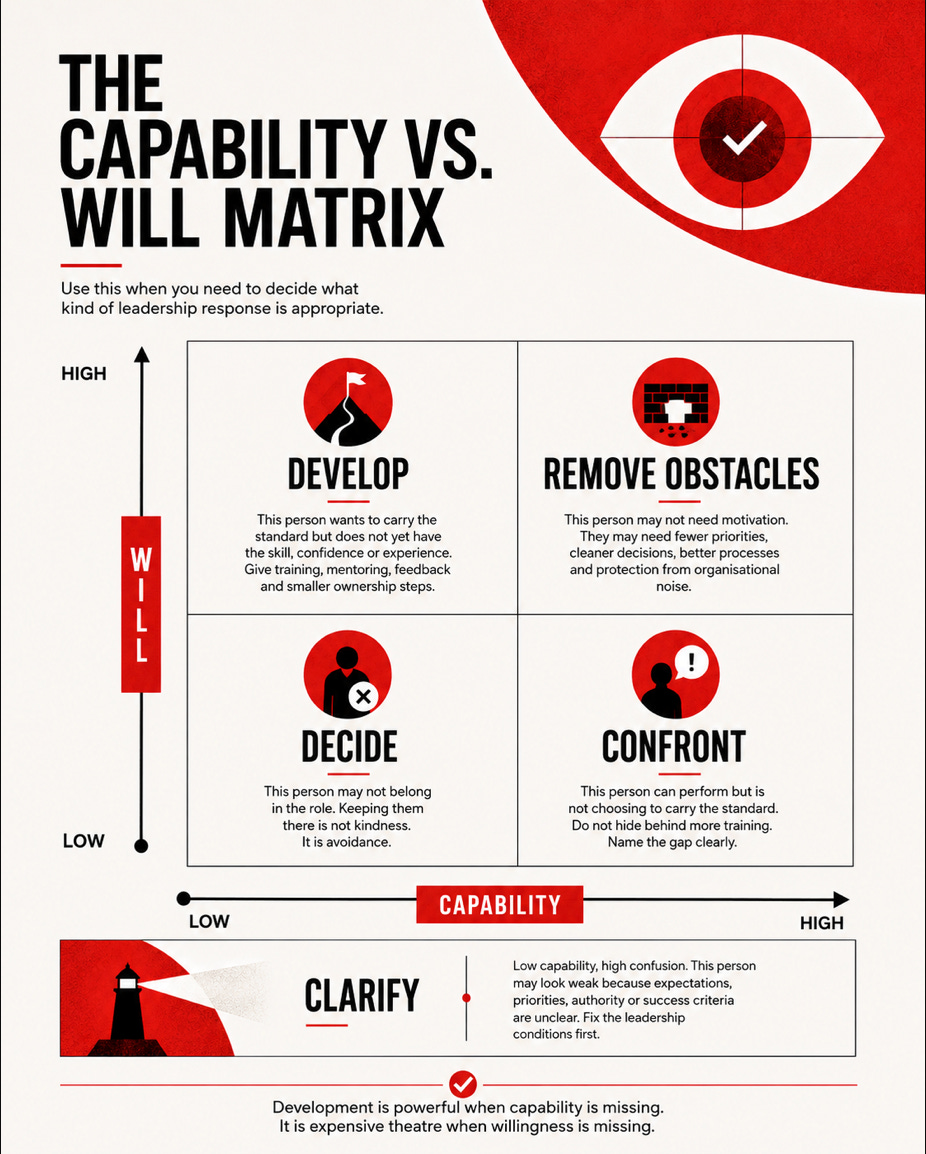
High will, low capability
Develop.
This person wants to carry the standard but does not yet have the skill, confidence or experience. Give training, mentoring, feedback and smaller ownership steps.
High capability, low will
Confront.
This person can perform but is not choosing to carry the standard. Do not hide behind more training. Name the gap clearly.
Low capability, high confusion
Clarify.
This person may look weak because expectations, priorities, authority or success criteria are unclear. Fix the leadership conditions first.
High capability, high distraction
Remove obstacles.
This person may not need motivation. They may need fewer priorities, cleaner decisions, better processes and protection from organisational noise.
Low will, low values fit
Decide.
This person may not belong in the role. Keeping them there is not kindness. It is avoidance.
Memorable line:
Development is powerful when capability is missing. It is expensive theatre when willingness is missing.
5. THE DISTRACTION REMOVAL MAP
Use this when someone seems unfocused, slow or inconsistent.
Ask where the distraction really comes from.
Is it personal?
Poor routines, low self-management, weak discipline, phone addiction, lack of planning.
Is it managerial?
Unclear priorities, changing instructions, too many urgent requests, constant interruptions from the boss.
Is it organisational?
Too many meetings, slow approvals, poor processes, conflicting goals, internal politics, unclear ownership.
Is it emotional?
Conflict, fear, low trust, resentment, anxiety, frustration or learned helplessness.
Then remove what should not be there.
Do not coach focus into a system that keeps destroying it.
Memorable line:
Before you blame the person for losing focus, check who keeps stealing it.
6. THE DISCIPLINE SYSTEM BUILDER
Use this when the person has motivation but behaviour is inconsistent.
Build a system with four elements.
Standard
What must happen?
Rhythm
When does it happen?
Trigger
What starts the behaviour?
Review
How do we learn from the result?
Example:
Every Friday before 12:00, the project owner sends a one-page progress update with three points: what moved, what is blocked and what decision is needed.
That is discipline.
Not drama.
Not pressure.
Not heroic willpower.
A system.
Memorable line:
Discipline is not being stronger than your distractions. Discipline is designing a system where distractions have less power.
7. THE 30-DAY MOTIVATION RESET PLAN
Use this when you do not yet know whether a person should be developed, challenged, moved or exited.
Week 1: Diagnose
Use the Lazy Label Scorecard. Identify whether the issue is value, capability, clarity, distraction or will.
Week 2: Clarify
Define the expected result, standard, ownership and timeline. Remove ambiguity.
Week 3: Support
Provide the specific support required: training, mentoring, resources, authority, fewer priorities or obstacle removal.
Week 4: Decide
Review behaviour after clarity and support have been provided.
If performance improves, continue development.
If performance does not improve because capability is still missing, adjust the development plan.
If performance does not improve because willingness is missing, stop pretending this is a motivation issue.
Make the decision.
Memorable line:
Do not make permanent people decisions before you diagnose. But do not postpone permanent people decisions after the diagnosis is clear.
LEADERS ARE READERS
Drive by Daniel H. Pink
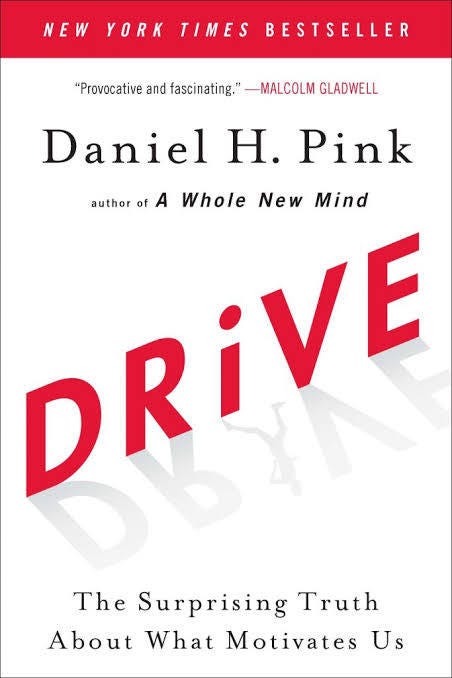
This book matters because it challenges the simplistic idea that people are mainly moved by rewards and punishments. Pink argues that deeper motivation is connected to autonomy, mastery and purpose.
Key shifts:
People need autonomy, not constant control.
Mastery grows through challenge, progress and feedback.
Purpose connects effort to meaning.
External rewards can help, but they do not replace inner motivation.
Leaders do not install motivation by force. They create conditions where motivation can grow.
Connection to this article:
Before you call someone lazy, ask whether the role gives them enough autonomy, mastery and purpose to bring real energy to the work.
FINAL WORDS
Do not use the word lazy too quickly.
It may make you feel clear.
But it can make you wrong.
Some people need clarity. Some need capability. Some need a quieter system. Some need a stronger connection to the goal. Some need discipline. Some need courage. Some need consequences.
And some need to leave the role because they are not willing to carry what the role requires.
Leadership is not pretending everyone can be saved.
Leadership is seeing clearly enough to know what each person actually needs.
Sometimes the most brutal leadership move is not to push harder.
It is to diagnose better.
You got this!

Gregor Kosi
The CEO Coach