

“The moment a result belongs to everyone, it usually belongs to no one.”
Gregor Kosi

PART 1 — THE MOST DANGEROUS WORD IN WEAK TEAMS: “WE”
Let’s start with an illusion
“We all own this.”
No, you don’t.
And that one sentence explains why so many organizations look collaborative on the surface while quietly bleeding ownership underneath.
Because what sounds like alignment is often just shared responsibility without a clear owner.
This is one of the most expensive illusions in modern leadership:
the belief that responsibility can be collective.
Direction can be collective.
Energy can be collective.
Commitment can be collective.
But responsibility?
Responsibility becomes real only when it becomes visible.
Why “we” feels right — and fails in reality
This is why so many teams sound aligned in the room and then fall apart in execution.
Because “we” feels good.
It removes tension. It creates belonging. It protects people from exposure.
But the moment you say:
“I own this by Friday,” everything changes.
Now there is pressure. Now there is clarity. Now there is no place to hide.
And most people would rather feel included than exposed.
The experiment that explains more than we admit
More than a century ago, French agricultural engineer Max Ringelmann observed something deceptively simple and deeply unsettling.
He asked people to pull a rope.
First alone. Then in pairs. Then in larger groups.
What he found was not intuitive.
When one person pulled alone, they gave close to their full effort.
In pairs, the average contribution dropped to around 93% per person.
In groups of three, it fell to about 85%.
And by the time eight people were pulling together, each individual was contributing less than half of what they were capable of alone.
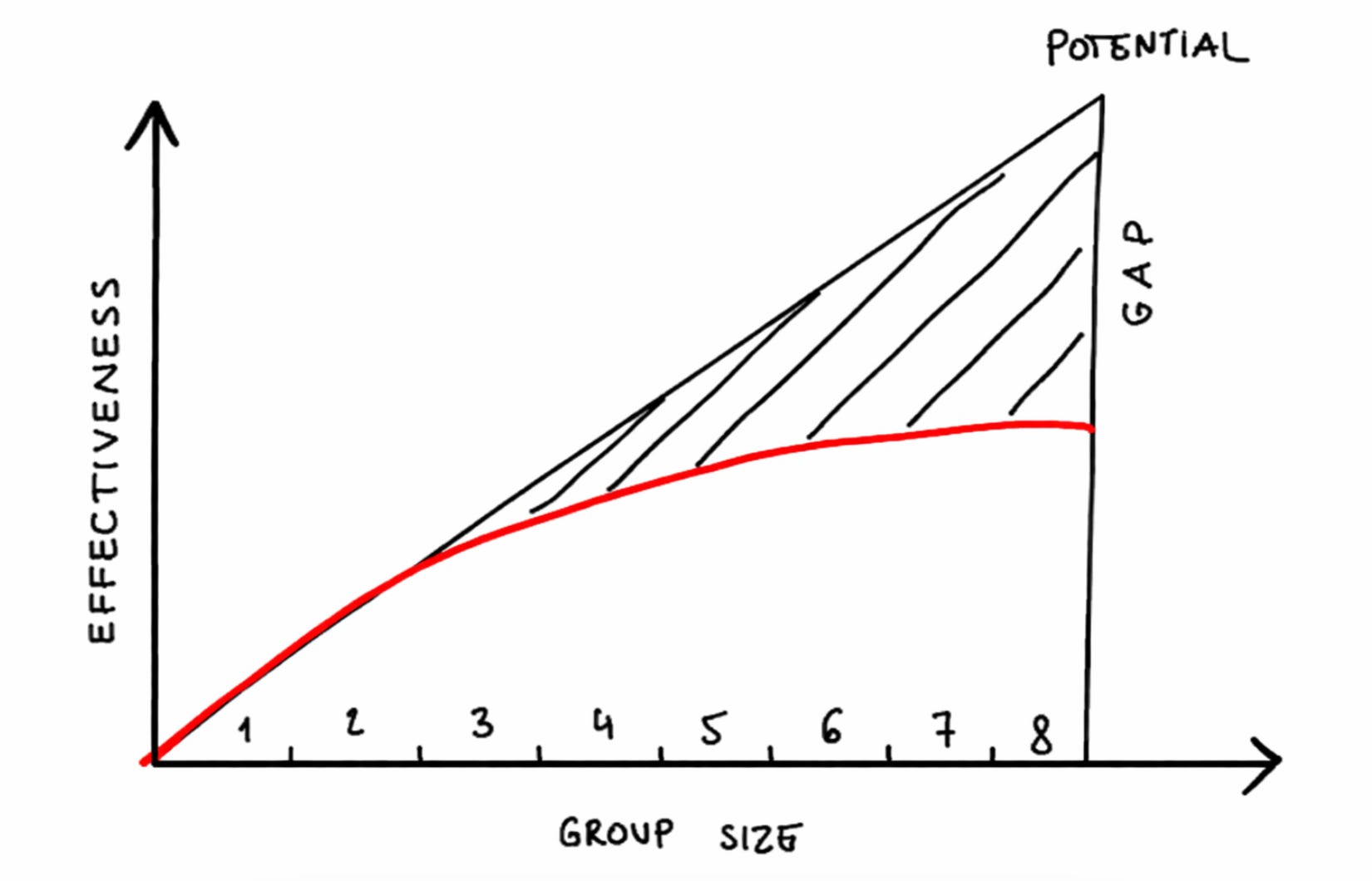
More people. Less effort per person.
Not because people didn’t care. Because something changed.
Their effort became less visible.
The moment effort becomes less visible, people begin — subtly, almost unconsciously — to give less of it.
Later research confirmed what the experiment already suggested: part of the loss comes from coordination, but a significant part comes from motivation — when individual contribution is harder to identify, effort naturally declines.
And that is the part most organizations still fail to understand.
The rope never disappeared
The experiment never ended. It just moved into the office.
Now the rope is a meeting. A target. A project. A brainstorm. A strategy deck.
A cross-functional initiative with eight owners and no adult in the room.
And the same law still applies:
The less visible my contribution feels, the easier it becomes to assume that someone else will carry the weight.
The uncomfortable truth
Collective responsibility works like caring for the planet.
The more we say “we’re all responsible,” the more we quietly expect someone else to do the hard part. And in the end, nobody does.
PART 2 — RESPONSIBILITY COLLAPSES THE MOMENT EXPECTATIONS ARE NOT INDIVIDUAL
Where teams actually fail
The Ringelmann effect is not really about effort.
It is about something I have seen again and again as a CEO:
responsibility begins to collapse the moment it is no longer absolutely clear
what exactly is expected from each individual.
Because the truth is disarmingly simple.
If I cannot clearly see what is mine, it becomes remarkably easy to behave as if it isn’t.
And most teams don’t fail in execution. They fail much earlier.
They fail in definition.
The moment everything starts to drift
I have seen this pattern too many times.
A leadership team defines a strong goal: growth, efficiency, customer experience.
The room is aligned. Everyone agrees.
And then comes one simple question:
“Who owns this?”
The answers are always the same.
“It’s shared.”
“We are all responsible.”
“It’s cross-functional.”
And in that moment, the result is already at risk.
Not because people lack capability.
But because ownership has already started to diffuse.
Why shared KPIs quietly destroy ownership
A shared KPI without individual ownership is not alignment.
It is diffusion. It sounds collaborative. But in practice, it behaves like avoidance.
And this is not just experience. It shows up clearly in data.
Only 47% of people strongly agree they know what is expected of them.
Only 28% feel their opinion actually matters.
And globally, only around 20% of people are engaged at work.
This is not a motivation problem. It is a clarity problem.
Because if I don’t know what is mine, why would I fully commit to it?
What real ownership actually looks like
Every person in the team needs a clear line of sight.
What is expected from me.
What I deliver.
By when.
So clear that no one can instinctively look around the table.
Because the moment people can point at others, responsibility has already disappeared.
A CEO reality check
I have lived this. A clear commercial target. Strong ambition. Full alignment.
Ownership?
“Shared between purchasing and sales operations.”
Purchasing optimized cost. Sales optimized volume.
Both were right. The result was wrong.
Not because people failed. But because ownership never fully landed.
Only when we translated that shared KPI into individual ownership did performance change.
Not because people suddenly cared more.
But because the work finally had a place to land.
The second mistake nobody talks about
And even that is not enough. Because clarity without capability creates pressure, not ownership.
I have seen leaders define expectations perfectly… and still fail.
Because nobody asked the only question that matters:
Can this person actually deliver this? Not in theory.
In reality.
The relay race problem

Think of a relay race. Everyone knows their part.
But one runner cannot properly hold the baton.
The team does not lose at the finish line. It loses in the handover.
That is how organizations fail. Not in effort. But in misalignment between expectation and capability.
The real conclusion
This is why “more accountability” almost never works.
Because accountability is not the starting point. It is the result.
It appears when expectations are clear
and capability is real.
Fix those two. And ownership stops being a discussion. It becomes behavior.
Responsibility does not disappear in failure.
It disappears in definition.
PART 3 — THE RINGELMANN EFFECT IN REAL LIFE
Where responsibility disappears in plain sight
The Ringelmann effect does not live in theory.
It lives in your calendar.
You see it in meetings that feel productive, in discussions that sound intelligent, and in decisions that seem aligned right up until the moment you notice that nothing actually moved.
Because responsibility rarely disappears in dramatic moments.
It disappears in ordinary ones.
And that is precisely what makes it so dangerous.
In meetings — where nothing forces ownership
Most meetings do not fail because people are incapable.
They fail because nothing in the room requires anyone to carry the outcome.
People show up.
They listen carefully.
They contribute selectively.
They stay engaged — just enough to remain part of the conversation.
But never enough to become accountable for it.
Because silence, in most organizations, is free.
There is no cost for not challenging weak thinking.
No cost for not taking ownership of the next step.
No cost for leaving the room without clarity.
And so, without ever saying it aloud, people begin to optimize.
Not for progress.
For safety.
I have sat in leadership meetings where the thinking was strong, the arguments were sharp, and the room was full of highly capable people.
And still, at the end of it, one simple question remained unanswered:
“Who owns the next step?”
The room didn’t resist.
It paused.
Because nobody had been required to answer that question before.
That is how responsibility disappears.
Not in conflict.
In politeness.
A meeting without a clearly defined owner does not create alignment.
It creates the illusion of progress while quietly delaying the outcome.
In brainstorming — where safety replaces thinking
This is where the illusion becomes even more dangerous.
Because brainstorming feels like creativity.
Energy is high.
Ideas are moving.
Participation is visible.
And yet the quality of thinking often declines the moment it becomes public.
Research consistently shows that individuals who think alone first often produce more ideas — and more original ones — than groups that begin with open discussion.
Not because groups lack intelligence.
But because social dynamics quickly begin to shape thought.
People adjust.
They hesitate.
They wait for cues from hierarchy.
They soften what they actually believe.
And slowly, the room begins to converge.
Not around the strongest idea.
But around the least uncomfortable one.
I have seen strategy sessions end with decisions that no one truly believed in — but no one challenged either.
The idea that survived was not the best.
It was the safest.
The loudest voice does not win because it is right.
It wins because it enters the space before others decide whether it is safe to follow.
In missed results — where failure begins early
This is where the illusion finally breaks.
A goal is set.
The ambition is real.
The direction is clear.
The alignment is verbal.
And still, the result is missed.
Then come the explanations.
Dependencies.
Misalignment.
Timing.
Capacity.
All of them valid.
None of them decisive.
Because the real failure does not happen at the end.
It happens at the beginning.
At the moment when work is shared before it is owned.
I have seen this across commercial targets, transformation projects, and cross-functional initiatives.
Everything is defined at the top.
Nothing is translated at the individual level.
So people stay busy.
Meetings continue.
Updates are shared.
Progress appears to exist.
Until one day it becomes obvious that movement was never the same as ownership.
And by then, the result is already gone.
Work does not fail at the deadline.
It fails at the moment when nobody can clearly say: this part is mine.
PART 4 — WHY COLLECTIVE RESPONSIBILITY DOES NOT WORK
The difference between language and execution
Collective responsibility exists as language.
It exists as intention.
As aspiration.
As emotional comfort.
But it does not exist as an execution mechanism.
Results do not move because people agree in principle.
They move because someone knows:
this is mine.
What is expected.
What must be delivered.
By when.
By which standard.
Until responsibility lands in a person, it remains abstract.
And abstract responsibility never delivers concrete results.
That is why so many teams confuse moral agreement with operational ownership.
They believe that because everyone nodded, everyone owns it.
But nodding is not ownership.
Agreement is not ownership.
Ownership begins only when responsibility stops living in the room and starts living in a person.
Collective responsibility sounds noble.
Execution is always personal.
Why people avoid ownership
People do not avoid responsibility because they are lazy.
They avoid it because responsibility creates exposure.
The moment something becomes yours, it reveals more than your output.
It reveals your thinking.
Your consistency.
Your courage.
Your discipline.
Your competence.
And that kind of visibility is uncomfortable.
That is why vague environments feel safer.
They allow people to stay included without being fully seen.
They allow participation without exposure.
They allow people to remain near the result without standing under it.
That is why collective language is so seductive.
It protects the ego.
“We” protects the ego.
Ownership reveals it.
Why leaders keep repeating the lie
This is not only a team problem.
It is also a leadership problem.
Because “we all own this” is not just a sentence teams use to avoid responsibility.
It is also a sentence leaders use when they do not want to define responsibility sharply enough.
Sometimes because they want to sound inclusive.
Sometimes because they want to avoid tension.
Sometimes because they themselves are not ready to decide what must belong to whom.
But leadership is not the art of preserving comfort.
It is the discipline of creating clarity.
And clarity rarely feels soft in the moment.
It feels like pressure.
Exposure.
Consequence.
That is why it works.
I have seen leaders call for more ownership while refusing to define the ownership structure clearly enough for anyone to carry it.
That is not empowerment.
It is abdication disguised as collaboration.
Weak leaders preserve comfort.
Strong leaders create clarity.
PART 5 — WHY 1-ON-1S CHANGE EVERYTHING
Why groups dilute responsibility
This is why 1-on-1 conversations so often achieve what group settings cannot.
Not because teams are bad.
But because groups allow responsibility to diffuse.
The moment more people enter the space, ownership begins to thin out.
Attention spreads.
Risk spreads.
Exposure spreads.
In a group, I can remain near the issue without fully stepping into it.
I can listen, contribute, agree, even sound committed — and still leave without anything truly landing in me.
That is the hidden comfort of the group.
A 1-on-1 changes that immediately.
Because once the room shrinks, so does the distance between the person and the responsibility.
Ambiguity becomes harder to maintain.
Excuses become easier to test.
Gaps in thinking surface faster.
Progress becomes visible.
In a group, responsibility can circulate.
In a 1-on-1, it has to land.
Why leaders see the truth faster in 1-on-1s
A person can sit through a large team meeting, say all the right things, nod at the right moments, and leave with their image intact.
Then you sit with the same person alone for twenty minutes, ask three precise questions, and the real situation becomes obvious.
What exactly did you commit to?
What have you actually delivered?
Where are you blocked?
Now the fog clears.
Because a 1-on-1 does not give the same room for social hiding.
It reveals whether the person understood the expectation, owns the outcome, and has the capability to carry it.
That is why so many leaders underestimate the 1-on-1.
They treat it as softer.
In reality, it is often the most honest format.
The group protects perception.
The 1-on-1 reveals reality.
Responsibility is not pressure. It is response-ability.
Responsibility is not only about being held accountable.
It is about being developed enough to answer reality well.
Responsibility is the ability to respond.
And that ability requires:
clarity.
competence.
learning.
emotional maturity.
Without clarity, people guess.
Without competence, they hesitate.
Without learning, they repeat.
Without maturity, they defend instead of respond.
That is why a strong 1-on-1 is not merely a control mechanism.
It is a developmental space.
Responsibility is not pressure.
It is the capacity to respond without hiding.
Why learning and responsibility cannot be separated
Many cultures fail here without naming the failure.
They ask for ownership.
But they punish mistakes.
They ask for initiative.
But they shame uncertainty.
They ask people to carry more.
But do very little to strengthen their ability to carry it.
And then they are surprised when people retreat into caution.
That reaction is not irrational.
It is adaptive.
If mistakes are punishable, people hide.
If people hide, learning dies.
If learning dies, responsibility becomes blame management.
That is why the strongest 1-on-1s are not the ones with the most pressure.
They are the ones where clarity is high, standards are real, and truth can still be spoken without humiliation.
Where learning is unsafe, responsibility becomes performance.
Where learning is possible, responsibility becomes growth.
PART 6 — THE MEETING SYSTEM THAT MAKES EVERY VOICE COUNT
You do not fix this by asking people to “speak up more”
If you want to beat the Ringelmann effect in real life, do not begin by asking people to contribute more.
That is too superficial.
The problem is rarely willingness.
The problem is that the room has been designed in a way that allows contribution to disappear.
And when a system rewards passivity, you do not solve it by appealing to good intentions.
You solve it by redesigning the conditions.
That is where leadership begins.
You do not fix ownership by asking for more effort.
You fix it by removing the places where effort can hide.
Start with silent thinking
Before discussion begins, give everyone a few minutes to write.
No talking.
No reactions.
No interruptions.
This protects thought before hierarchy enters.
It gives reflective people time to form language before faster minds and stronger personalities take over.
I have seen meetings improve dramatically with this one change.
Because the structure stops rewarding speed over substance.
In weak meetings, the fastest thought wins.
In strong meetings, the clearest thought survives.
Use round-robin before open discussion
If you want every voice to matter, you cannot leave participation to personality.
Ensure every person speaks once before anyone speaks twice.
This slows the fast.
Protects the thoughtful.
Prevents extroversion from impersonating depth.
And it sends a signal that the room belongs to thinking, not just speed or hierarchy.
If the room belongs only to the fastest voices,
it does not belong to the best thinking.
Let the senior person speak last
If the most powerful person in the room speaks first, the room shrinks.
Not visibly.
Psychologically.
People adjust to authority.
They edit themselves.
They measure safety before offering truth.
When the senior voice comes last, the room has space to think before it has to align.
The earlier power speaks, the smaller the room becomes.
No topic ends without an owner
This is where most meetings quietly fail.
A topic is discussed.
The room feels aligned.
Then everyone moves on.
No owner.
No deadline.
No definition of done.
Just the impression that something meaningful happened.
It didn’t.
A topic is complete only when someone knows:
this is mine,
this is due,
this is what done looks like.
A conversation without an owner is not progress.
It is emotional movement without operational effect.
Brainwrite before you brainstorm
If the goal is quality, do not begin with open discussion.
Begin with thought.
Let people generate ideas individually first.
Then in pairs.
Then in the group.
Once the room goes public too early, the dynamics begin to distort the content.
People censor themselves.
They anchor too quickly to dominant ideas.
They lose weaker thoughts that needed time to form.
If you open the room too early,
the room shapes the idea before the idea has had time to form.
End with visible commitments
Do not end meetings with “great alignment.”
End them with names, dates, standards, and next moves.
Because vague endings create expensive Mondays.
A strong meeting does not leave people feeling positive.
It leaves them knowing exactly what belongs to them.
A meeting without named ownership is just organized delay.
PART 7 — THE INNER SHIFT
The real shift is not tactical. It is developmental.
At some point, every serious conversation about responsibility stops being operational and becomes human.
Because even after you clarify the goal, define the owner, and structure the meeting properly, one truth remains:
some people step into responsibility, and some continue to look for places to hide.
That difference is not primarily tactical.
It is developmental.
Weak cultures ask:
“How do we get everyone more engaged?”
Strong cultures ask:
“How do we make contribution visible enough that disengagement becomes difficult to hide?”
The first assumes the problem is energy.
The second understands the deeper problem is ambiguity.
And this is why so many organizations keep confusing motivation with maturity.
Motivation fluctuates.
Maturity carries.
Motivation asks, “How do I feel about this?”
Maturity asks, “What is mine to carry, regardless of how I feel today?”
Weak cultures chase energy.
Strong cultures build structure that reveals reality.
Weak leaders speak collectively. Strong leaders translate reality.
Weak leaders speak in collective language.
“We all own this.”
“We need to improve this.”
“We have to become more proactive.”
It sounds inclusive.
It also sounds safe.
Because collective language often protects the leader as much as the team.
It allows direction without sharpness.
Expectation without consequence.
Pressure without precision.
Strong leaders speak differently.
They translate direction into individual reality.
“This part is yours.”
“This is what I need from you.”
“This is how we will know it is done.”
Because clarity is one of the highest forms of respect.
Vagueness may feel softer in the moment, but it becomes far more brutal later — when people fail inside expectations that were never truly defined.
Weak leaders preserve comfort.
Strong leaders create clarity strong enough to carry consequence.
Mature professionals do not run from ownership
At the highest level, ownership is not a burden.
It is dignity.
To be trusted with something real.
To know where you stand.
To know what matters.
To know your contribution counts.
That is what serious people actually want.
Not less responsibility.
More meaningful responsibility.
Because the opposite of ownership is not freedom.
It is irrelevance.
Immature cultures create the perfect conditions for permanent childhood at work.
Shared language.
Blurred expectations.
Distributed blame.
No clean mirror.
Everyone stays involved.
No one grows up.
Ownership is not a burden placed on strong people.
It is the condition through which people become stronger.
TL;DR
Max Ringelmann discovered a truth most organizations still avoid: the more people share a task, the less effort each individual tends to give.
Not because people are lazy.
Because effort becomes less visible.
And when effort becomes invisible, responsibility starts to disappear with it.
That same law now lives in meetings, shared KPIs, brainstorming sessions, and every conversation where “we” replaces ownership.
A team goal without individual responsibility is not alignment.
It is diffusion.
Responsibility is not pressure.
It is response-ability.
And if everyone owns it, nobody does.
ATTENTION: UNLOCK YOUR PRACTICE
The free section exposed the lie.
The paid section gives you the tools.
Because insight does not fix your next meeting, your next blurred KPI, or your next polite brainstorm.
That is where most leaders stop.
They understand the truth, then return to the same room, with the same habits, and the same leaks through which ownership keeps escaping.
The paid section is where the article becomes a working system.
Inside, you will get the Anti-Ringelmann Toolkit I would actually use with leadership teams:
The Ownership Lock™ to make sure no discussion ends without a real owner
The KPI Translation™ to turn team goals into individual responsibility
The Capability Check™ to test whether the person can truly carry what you assign
The No-Hiding Meeting Design™ to make contribution visible before hierarchy distorts it
The 1-on-1 Responsibility Script™ to expose fog, excuses, and capability gaps fast
The Language Reset™ to replace “we should” with ownership that lands
The Reality Test for Leaders™ to reveal who really carries the result if it fails
The Weekly Ownership Review™ to catch diffusion before it becomes a missed target
You can read the free section and agree with it.
Or you can unlock the paid section and start rebuilding how ownership works in your team on Monday.
PAID SUBSCRIBERS ALSO GET:
Subscriber-only articles — deeper frameworks, sharper tools, and real-life case examples I do not share publicly
Full archive access — every guide, article, and premium tool unlocked
Exclusive printable templates — copy, print, and use in your next meeting or hard conversation
Direct community access — comment, ask questions, and get answers from me personally
SPECIAL OFFER — “LEADERS ARE READERS”
FINAL WORDS
Teams do not fail because nobody cared.
They fail because care was never translated into ownership.
“We” creates warmth.
Ownership creates results.
And the future will belong to the teams where someone can clearly say:
this part is mine.
ENGAGE WITH THIS IDEA
Comment: Where does responsibility break most often in your team? I read every reply.
Share: Send this to one leader who still says “we all own this” when nobody clearly does.
Subscribe: Join leaders who do not just talk about responsibility — but design it into reality.
