

Part 1 – The Illusion of Managing People
Most managers believe their job is to “manage people.”
Assign tasks. Check results. Push harder. Correct mistakes.
But managing people is a complete misunderstanding of human nature.
People are not resources.
They are not lines in a spreadsheet.
They are not Lego bricks you can assemble into predictable outcomes.
Human behavior is complex — and largely driven by the level to which our core needs are met.
That makes behavior unpredictable.
Trying to manage people would therefore mean directing their behavior.
Mission impossible.
“Managing people is nonsense. People are not Lego bricks.”
“Human behavior is unpredictable. Expectations are not.”
What is more predictable is what people care about, what drives them, what fuels their inner fire.
That’s why leadership is not about managing people.
It’s about managing expectations.
And this is where the magic begins.
I learned this the hard way when I tried to convince people that I was right — and that my expectations were obvious.
What followed were silent breakdowns.
Tasks weren’t done because “someone forgot.”
Work was delivered, but not in the way I expected.
From the outside, it looked like sabotage.
It wasn’t sabotage.
It was misalignment.
“When tasks ‘fail,’ it’s rarely sabotage. It’s misunderstood expectations.”
Everything changed only when I stopped pushing my expectations
and started connecting them with theirs.
Part 2 – The Real Cause: The Leadership Triangle
The root problem is misalignment.
Every leader operates within a triangle:
Expectations — goals, ambitions, demands
Abilities — competence, skills, potential
Results — actual outcomes achieved
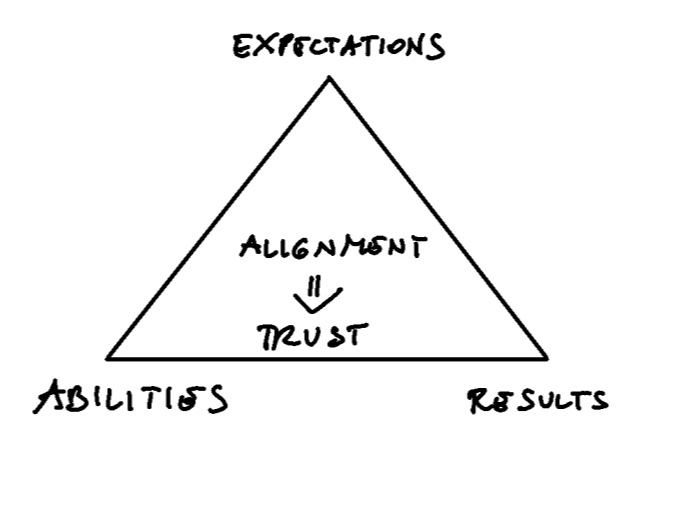
When expectations are clear, abilities are nurtured, and results match, trust is built.
When the triangle falls out of alignment, trust collapses.
“Trust is not given. Trust is engineered through alignment.”
This explains why engagement initiatives so often fail.
Gallup reports that only 23% of employees worldwide are engaged, while 15% are actively disengaged.
The issue is not motivation.
The issue is misaligned expectations living inside misjudged abilities.
Part 3 – The Three Sides of the Triangle
Each side of the triangle reveals a different leadership challenge.
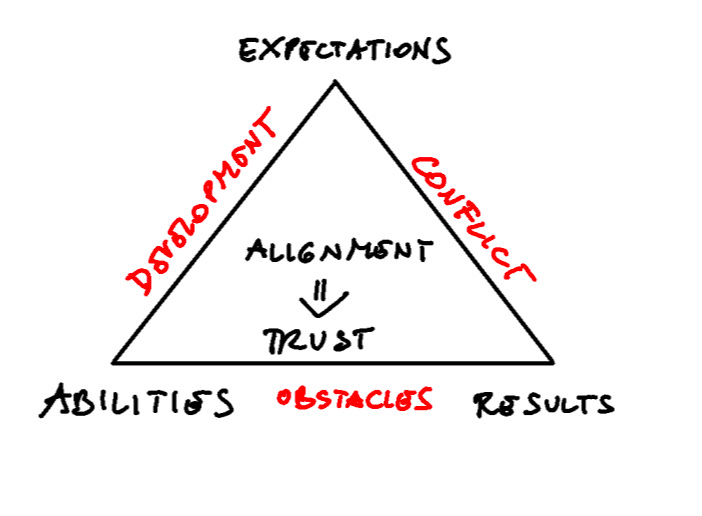
1. Conflict (Expectations ↔ Results)
When results don’t meet expectations, conflict arises.
This is not failure — it’s feedback.
Very often, the real failure sits with the leader:
expectations were demanded without checking capacity.
Conflict is not a signal to push harder.
It’s a signal to recalibrate expectations.
2. Development (Expectations ↔ Abilities)
When abilities fall short of expectations, you have two options:
Lower expectations.
Or raise abilities through coaching, training, mentoring.
This is where true growth happens.
The breakthrough for me was realizing this:
clarity is not what people say they will do —
clarity is how they plan to do it.
“Clarity is not WHAT people do. It’s HOW they plan to do it.”
The moment someone explains the execution path, abilities become visible.
And so do the gaps.
3. Obstacles (Abilities ↔ Results)
Sometimes abilities exist, but results don’t show.
Why?
Because of hidden blockers: culture, beliefs, values, or structure.
In these cases, pushing people harder only deepens frustration.
The leader’s real role is to remove what silently blocks performance.
When all three sides work in harmony, trust becomes not a slogan, but a system.
Part 4 – Why Trust Collapses Under Stress
Our expectations are not just rational.
They are emotional.
They are tied to our deepest human needs:
Safety
Variety
Connection
Significance
When these needs are unmet, leaders project insecurity into the workplace.
A leader lacking safety demands control — even when stability exists.
A leader lacking connection seeks significance — pushing teams beyond reason just to feel worthy.
This projection distorts the triangle.
And under pressure, stress amplifies it.
Imagine walking down a dark path.
You see something on the ground.
A rope — or a snake?
Your interpretation triggers fear before you know the truth.
Leadership works the same way.
Missed targets.
Delayed projects.
Difficult conversations.
Instead of seeing signals, leaders see threats.
The triangle bends.
And trust breaks.
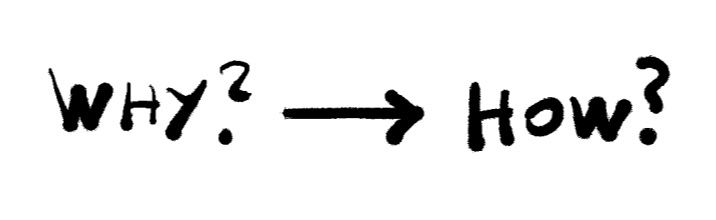
This is also where leaders obsess over WHY and forget the stabilizer.
WHY lights the fuse.
But HOW keeps the fire burning.
“WHY lights the fuse. HOW keeps the fire burning.”
“If someone can’t explain the path, they don’t understand the goal.”
HOW is not motivation.
HOW is ability made visible.
Part 5 – From Managing People to Managing Expectations
The mature leader makes a shift.
People don’t need to be managed.
They need to be trusted.
Trust is not hope.
It’s alignment.
And alignment is not an accident — it’s leadership’s first responsibility.
That means:
Setting expectations that stretch, not suffocate
Developing abilities systematically, not sporadically
Clearing obstacles with courage, not denial
“Leadership is not the art of pushing people.
It’s the science of aligning triangles.”
Alignment doesn’t require control.
And it certainly doesn’t require endless meetings.
What it requires is rhythm.
One simple ritual changed the quality of leadership conversations across my teams:
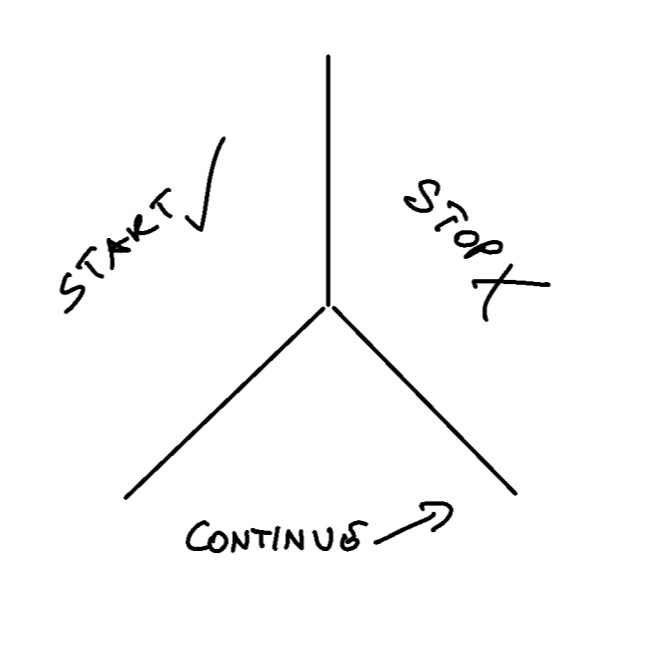
Once a month, three questions:
START — What should we start doing?
STOP — What should we stop or change?
CONTINUE — What works and should stay?
Another hard-earned truth:
Stop asking people what motivates them.
Many won’t know — or they’ll adapt the answer to your expectations.
Ask what demotivates them instead.
“Stop asking what motivates people. Ask what demotivates them — they’ll talk for hours.”
Demotivation reveals friction.
Friction reveals misalignment.
Reflection Tool – The Leadership Triangle Audit
Use this regularly.
Identify a recent conflict or disappointment.
Map the triangle:
What were the expectations?
What abilities were truly in place?
What results actually occurred?
Diagnose the misalignment:
Expectation too high?
Ability not yet developed?
Obstacle ignored?
Adjust deliberately:
Reset expectations.
Invest in development.
Remove blockers.
Over time, trust stops being a wish
and becomes a design choice.
TL;DR
Managing people is an illusion.
Human behavior is unpredictable. Expectations are not.
Trust is built when expectations, abilities, and results align.
Motivation is a weak signal. Demotivation reveals truth.
WHY starts movement. HOW sustains performance.
Alignment doesn’t need control — it needs clarity.
Final Words
People don’t need to be managed.
They need to be understood, aligned, and trusted.
Leadership is not about shaping behavior.
It’s about designing expectations people can actually meet.
“People follow clarity — not control.”
That’s where most leaders fail.
And that’s where real leadership begins.
Engage With This Idea
💬 Where is your leadership triangle most out of balance — expectations, abilities, or results?
🔗 Send this to a leader still trying to “manage people.”
✉️ Join 444+ leaders building trust through alignment.
🔒 ATTENTION: Unlock Your Practice - Join The Community Of Paid Subscribers!
Everything above explains why trust breaks.
This section shows you what to do on Monday.
No theory.
No motivation.
No leadership theatre.
Just simple, repeatable moves that stop misalignment before it turns into conflict, politics, and quiet sabotage.
Inside, you’ll work with:
A 5-minute weekly audit to spot where expectations, abilities, and results drifted this week
A clear script to reset expectations without sounding soft or aggressive
The “HOW test” that reveals in 60 seconds whether someone truly understands the goal
A demotivation checklist that exposes what kills performance faster than lack of skill
A 20-minute monthly START / STOP / CONTINUE ritual that replaces ten useless meetings
This is not extra content.
It’s the operating system for leaders who are tired of repeating themselves…
and still not getting what they asked for.
If you want to understand leadership, the free section is enough.
If you want to run a team that executes without drama, keep reading.
TODAY ONLY — SPECIAL OFFER: “LEADERS ARE READERS”
Get 20% off your first year. Because leaders are readers — and the best leaders invest in their growth.
🔒 Paid Section — The Alignment Operating System (OS)
Everything above explains why leadership breaks.
This section gives you the operating system to prevent it.
Not theory.
Not reflection.
Execution.
1️⃣ The 5-Minute Weekly Alignment Audit
Run this once a week. Alone. No slides. No prep.
Take one situation where something felt “off.”
Then answer three questions:
Expectations:
What exactly did I expect — in observable terms?Abilities:
Did the person/team realistically have the skills, time, and authority to deliver?Results:
What actually happened — not what I hoped would happen?
ATTENTION: Wherever the answers don’t match, trust leaked.
Fix that first.
Not motivation.
Not attitude.
Alignment.
2️⃣ The Expectation Reset Script (Firm, Not Aggressive)
Use this when something isn’t working.
Say it exactly like this:
“Let’s pause.
I think my expectation wasn’t clear enough.
Here’s what I need to see — and by when.”
Then add:
“Tell me how you’d approach this.”
No blame.
No softness.
No pressure.
Clarity without ego is authority.
3️⃣ The HOW Test (60 Seconds)
This is the fastest capability test you’ll ever use.
After setting a goal, ask one question:
“Walk me through how you’d do this.”
Don’t interrupt.
Don’t correct.
If the HOW is vague → ability is missing.
If the HOW is detailed → alignment exists.
If someone can’t explain the path, they don’t understand the goal.
This test saves months of frustration.
4️⃣ The Demotivation Checklist (Use Before Performance Drops)
Stop guessing motivation.
Instead, check these five killers:
Unclear expectations
Conflicting priorities
No decision authority
Repeated rework
Silent criticism
You don’t fix demotivation with speeches.
You remove friction.
5️⃣ The 20-Minute Monthly START / STOP / CONTINUE Ritual
Once a month.
No more.
Ask only this:
START: What should we start doing next month?
STOP: What creates effort without results?
CONTINUE: What works and must stay untouched?
Document decisions.
Close the meeting.
Alignment beats consensus.
This ritual replaces:
Status meetings.
Alignment workshops.
Leadership theatre.
Final Reminder
You don’t need better people.
You need better alignment.
Trust is not built by control.
It’s built by design.
If you apply even one of these practices consistently,
your team will feel it before they understand it.
That’s leadership.