


There is a famous story about a janitor at NASA.
It may be apocryphal.
But that does not make it useless.
Some stories survive not because they are historically perfect, but because they reveal a truth we still refuse to face.
As the story goes, President John F. Kennedy visited NASA during the race to the Moon. He saw a janitor carrying a broom and asked him what he was doing.
The janitor supposedly replied:
“I’m helping put a man on the Moon.”
That sentence is used in thousands of leadership talks.
Purpose.
Mission.
Alignment.
Culture.
And rightly so.
Because in one sentence, the janitor connected the smallest visible task to the largest shared mission.
He was not “just cleaning.”
He was contributing.
He saw meaning.
He saw himself inside the mission.
He understood why his work mattered.
He was engaged.
But here is the uncomfortable part.
Most companies want that kind of answer from their people.
Then they build organizations where the honest answer would be very different:
“I’m just attending another training.”
“I’m just doing what my manager asked.”
“I’m just trying not to make a mistake.”
“I’m just waiting for this transformation to pass.”
“I’m just surviving until Friday.”
That is not a training problem.
That is a readiness problem.
Because people do not grow just because they are given knowledge.
They grow when they still see meaning, safety, energy, and future in the place where that knowledge is supposed to be used.
Training does not develop people. Engagement does.
The NASA janitor story is widely repeated in leadership writing, often connected to Kennedy’s 1962 visit, but it is best used as a leadership parable rather than a verified historical exchange. We do not need mythology to be historically perfect for it to be psychologically true.
And the psychological truth is this:
Every company wants the NASA janitor.
Very few companies build the conditions that create him.
PART 1 — THE GREAT PARADOX
We keep adding knowledge to people who are not ready to receive it.
Most companies still treat development like a mechanical process.
There is a skill gap.
Find a course.
Send the employee.
Expect improvement.
Communication problem?
Communication training.
Leadership problem?
Leadership academy.
Sales problem?
Sales training.
Ownership problem?
Accountability workshop.
It feels logical.
But humans are not machines.
You do not install behavior into a person the way you install software into a computer.
A person must first become available for learning.
Something inside them must say:
This matters.
I am safe enough to try.
I have the energy to engage.
I still see a future here.
Without that, training does not land.
It passes through.
I learned this the expensive way as a CEO.
For years, we invested in development. We sent people to training. We created leadership programs. We believed that if people received the right knowledge, the right tools, and the right frameworks, behavior would eventually follow.
Sometimes it did.
But only sometimes.
Outside of a few bright exceptions, the conversion from theory to practice was painfully low. If I am brutally honest, perhaps 15% of people were able to turn training into real behavioral change.
The rest understood the ideas.
They just did not live them.
That difference matters.
Understanding is intellectual.
Application is emotional.
Change is behavioral.
And behavior does not change because a slide was beautiful.
Behavior changes when a person has enough meaning, safety, energy, and future to engage with the change.
William A. Kahn, one of the foundational thinkers on employee engagement, described engagement as the expression of a person’s full self at work: physically, cognitively, and emotionally. His 1990 work identified three psychological conditions that shape engagement: meaningfulness, safety, and availability.

That is the missing foundation of most development programs.
Companies ask:
“What training do they need?”
The better question is:
“Are they psychologically ready to grow?”
Because if a person does not see meaning, they will comply.
If they do not feel safe, they will pretend.
If they do not have energy, they will survive.
None of these states creates real development.
Training before readiness is like planting seed on concrete.
PART 2 — THE HIDDEN COST
A completed training is not proof of development. It is proof of attendance.
The cost of failed training is not only the invoice.
That is the visible cost.
The real cost is hidden in the organization:
Time spent in programs that do not change behavior.
Managers repeating the same expectations.
HR losing credibility.
Employees becoming cynical about “another initiative.”
Leaders pretending development happened because attendance was high.
Talented people watching mediocrity survive.
Culture becoming allergic to change.
And then the organization wonders why people are not more engaged.
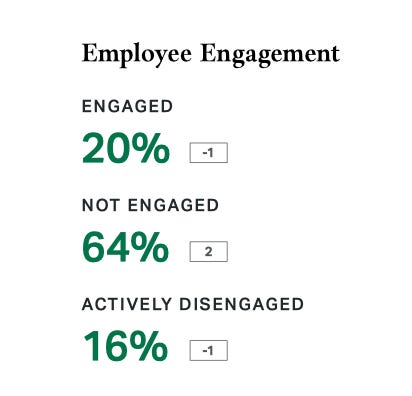
Gallup’s State of the Global Workplace 2026 reports that global employee engagement fell to 20% in 2025, its lowest level since 2020. Gallup estimates that low engagement cost the world economy approximately $10 trillion in lost productivity, about 9% of global GDP.
Now ask the uncomfortable question:
How much of your training budget is being spent on people who are physically present, but psychologically absent?
You cannot train commitment into someone who has already emotionally left.
The issue is not only what people learn.
It is whether the system allows them to use it.
A meta-analysis on training sustainment found that work environment support matters for whether people continue using learned knowledge, skills, and attitudes after training. Peer support, supervisor support, and organizational support all influence whether training actually transfers back into work.
In simple language:
If the system rewards old behavior, old behavior wins.
If the manager never follows up, training fades.
If the team mocks new behavior, the person retreats.
If the organization does not create time, ownership, and psychological safety, learning becomes decoration.
This is why onboarding is so critical.
Research on onboarding shows that when onboarding is done well, it supports job satisfaction, organizational commitment, lower turnover, higher performance, career effectiveness, and lower stress. More recent research also links onboarding to organizational identification, wellbeing, and lower turnover intention.
That means poor onboarding is not an administrative mistake.
It is a leadership failure at the beginning of the relationship.
When you onboard badly, you do not only lose speed.
You lose belief.
And belief is the first fuel of development.
The first weeks do not only teach people how work works.
They teach people whether growth is safe here.
PART 3 — WHERE IT SHOWS UP IN REAL LIFE
1. In onboarding: the new employee is not weak. He is often unsupported.
Many new employees are judged too quickly.
“Not independent enough.”
“Too slow.”
“Does not understand our way.”
“Maybe we hired the wrong person.”
Sometimes that is true.
But often the company hired potential and then abandoned it.
A new employee usually has engagement but lacks competence.
That is normal.
The problem begins when the organization treats low competence as low value.
I have seen people who looked weak at the beginning become extremely strong when the right leader personally invested in them.
And I believe every leader should experience the role of mentor.
Not as a side activity.
As leadership.
Because mentoring forces you to slow down enough to see whether the person lacks ability, clarity, confidence, or belonging.
Those are different problems.
And they require different leadership.
A new employee does not only need information.
He needs interpretation.
This is where companies need two roles.
Mentor
The mentor develops competence.
The mentor explains:
How the work should be done.
What good looks like.
Which standards matter.
Where mistakes usually happen.
How to improve fast.
Buddy
The buddy integrates culture.
The buddy explains:
How people communicate here.
What is really valued.
Which unwritten rules exist.
How decisions are made.
How conflict is handled.
How to belong without pretending.
A mentor teaches the work.
A buddy teaches the reality of the organization.
Every company has a culture.
The question is whether new people learn it from the right people.
Or from the loudest cynics.
2. In training programs: people sit in the room, but they are not really there.
One of the biggest mistakes I made as a CEO was asking people:
“What motivates you?”
Most people could not answer.
The question was too abstract.
Too polished.
Too far from their real experience.
But when I asked:
“What demotivates you?”
They could fill several pages.
That taught me something important.
People are often much more aware of what is draining them than what is driving them.
And if you do not remove the demotivators, you should not be surprised when motivators do not work.
This is where many training programs fail.
They try to add skills on top of frustration.
They try to install knowledge into people who are already emotionally blocked.
They try to build capability without first restoring readiness.
The issue is not only the content.
The issue is the state of the person receiving the content.
You cannot inspire people over a system that keeps draining them.
3. In transformation: your best experts can become your strongest resistance.
This is the painful archetype.
The experienced employee.
The one with knowledge.
History.
Context.
Memory.
Technical depth.
Organizational scars.
From the outside, this person looks like an asset.
But inside, they may have stopped believing.
They have seen too many transformations fail.
Too many promises disappear.
Too many strategies renamed.
Too many leaders change direction.
Too many “new beginnings” become the same old ending.
So they protect themselves.
They become distant.
Sharp.
Quiet.
Cynical.
Hard to impress.
Not because they lack competence.
Because they lack hope.
I understand this personally.
After 17 years of leading a country organization and a team of more than 2,000 people, I experienced what it means to become an outsider myself.
Not because I had no competence.
But because I had leaders above me who operated as micromanagers.
After years of responsibility, ownership, and leadership, I suddenly felt like I was only reporting again.
That changes something in a person.
Not immediately.
But slowly.
You do not lose competence.
You lose fire.
Micromanagement does not only control people.
It slowly removes their authorship.
And when authorship disappears, engagement follows.
PART 4 — THE DEEPER MECHANISM
People do not resist development. They resist meaningless development.
Most companies try to develop people by asking the wrong question:
“What skill is missing?”
But the deeper question is:
“What human condition is missing?”
Kahn’s model is useful because it separates how engagement shows up from what makes engagement possible.
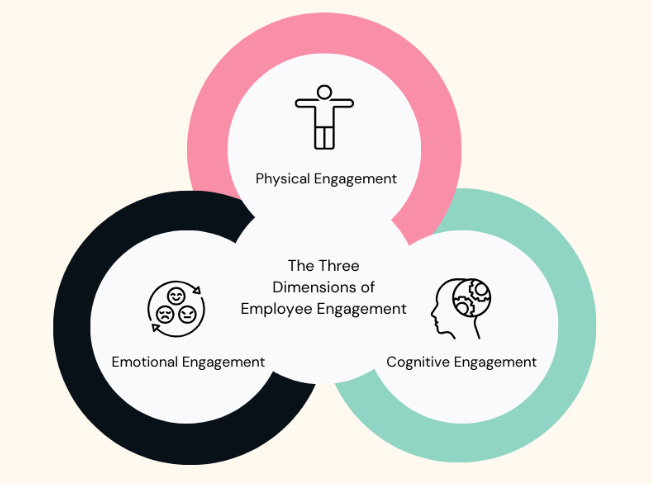
People express engagement in three ways:
Physically — they invest effort.
Cognitively — they invest attention.
Emotionally — they invest care.
But they only bring that full self when three psychological conditions are present:
Meaningfulness — this is worth my energy.
Safety — I can show up honestly here.
Availability — I have enough capacity to give myself to this.
In simple language:
Engagement is the full investment of energy, attention, and care — made possible by meaning, safety, and availability.
1. Meaningfulness
Does this person believe the development matters?
Not to HR.
Not to the company.
Not to the PowerPoint strategy.
To them.
Without meaning, training becomes compliance.
They attend.
They nod.
They may even enjoy the trainer.
But nothing changes.
Because the development is not connected to their identity, aspiration, or future.
People do not commit deeply to correction.
They commit deeply to a future they still want.
That was one of the biggest mistakes I saw in people development:
forcing people into training before understanding their expectations.
Not only their performance gap.
Their expectation.
Ask:
What do they want from this?
Where do they see themselves?
Do they still see a future in this company?
Do they believe growth is possible here?
Do they believe the company will use their growth well?
If training is only connected to today’s problem, it feels corrective.
If training is connected to tomorrow’s aspiration, it feels developmental.
That difference changes everything.
2. Safety
Can this person admit they do not know?
Learning requires exposure.
To learn, you must reveal a gap.
You must say:
“I do not know.”
“I need help.”
“I am not yet good at this.”
“I made a mistake.”
“I need feedback.”
In a low-safety culture, people do not learn.
They perform competence.
They hide confusion.
They defend mistakes.
They avoid questions.
They pretend to understand.
They protect status.
Then leaders say:
“They are not learning fast enough.”
No.
They are not safe enough to learn honestly.
Without safety, cognitive engagement collapses.
People may be present in the room, but their mind is busy protecting their image.
A person cannot learn deeply while defending themselves constantly.
3. Availability
Does this person have the energy to grow?
This is the condition leaders underestimate most.
A person may care.
A person may feel safe.
A person may even want to learn.
But if they are overloaded, emotionally drained, politically exhausted, or trapped in constant urgency, they will not have the capacity to develop.
They will survive.
And survival is not the same as growth.
Without availability, physical engagement becomes minimum effort.
Cognitive engagement becomes scattered attention.
Emotional engagement becomes withdrawal.
You cannot develop a person who has nothing left to give.
So before you send someone to training, ask:
Do they have meaning?
Do they have safety?
Do they have availability?
Because without meaning, people comply.
Without safety, people pretend.
Without availability, people survive.
And none of the three will truly develop.
PART 5 — THE MODEL
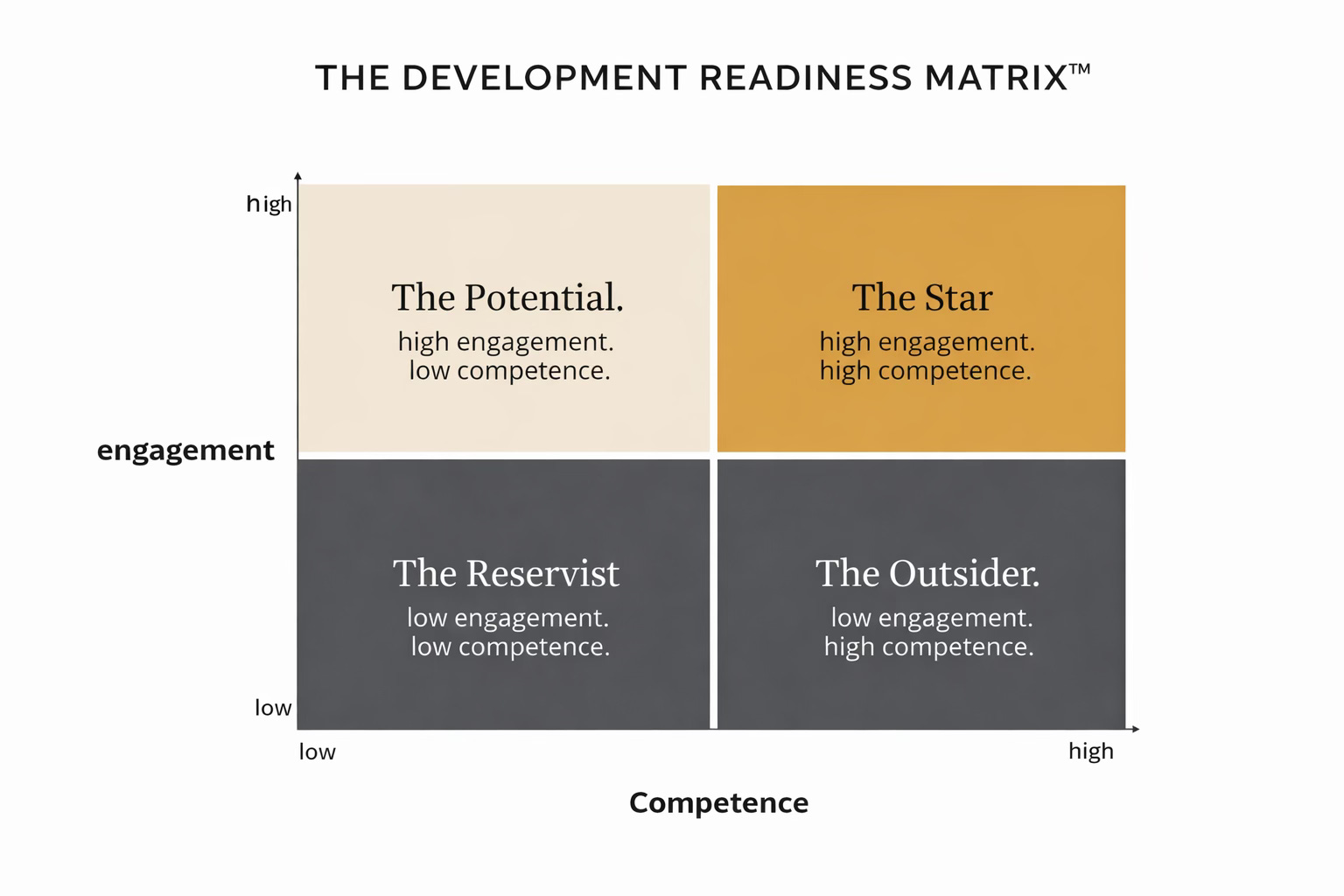
The Development Readiness Matrix™
Most companies divide people into “good” and “bad.”
That is too primitive.
A better way is to look at two dimensions:
Engagement
Competence
This creates four archetypes.
1. The Potential
High engagement. Low competence.
This is often the new employee.
They want to contribute.
They care.
They ask questions.
They make mistakes.
They need structure.
Do not confuse low competence with low potential.
The Potential needs:
Mentor support.
Buddy support.
Clear standards.
Fast feedback.
Psychological safety.
Small early wins.
Leadership mistake:
Expecting independence too early.
Leadership shift:
Build competence without killing engagement.
Potential is fragile before it becomes performance.
2. The Reservist
Low engagement. Low competence.
This is the person nobody wants to deal with.
They sit on the bench.
Not fully in.
Not fully out.
Not growing.
Not contributing.
Not trusted.
Sometimes this is a new employee who never received proper onboarding.
Sometimes it is a poor hire.
Sometimes it is someone the organization allowed to drift for too long.
The Reservist needs:
Honest diagnosis.
Clear expectations.
Short activation cycle.
Support.
Decision.
Leadership mistake:
Avoiding the conversation.
Leadership shift:
Do not let people disappear inside the system.
The bench is not a development strategy.
3. The Outsider
Low engagement. High competence.
This is the dangerous one.
Because the organization often still depends on them.
They know a lot.
They contribute when necessary.
They understand the system.
They may even outperform others.
But emotionally, they are gone.
The Outsider needs:
Reconnection to meaning.
Respect for experience.
Removal of unnecessary control.
Renewed ownership.
Honest conversation.
Future-based challenge.
Leadership mistake:
Taking them for granted.
Leadership shift:
Do not confuse competence with commitment.
The most dangerous disengaged employee is not the weak one.
It is the competent one who stopped believing.
4. The Star
High engagement. High competence.
This is the person every company loves.
And often slowly destroys.
Because stars get more work.
More pressure.
More urgent projects.
More invisible expectations.
More emotional responsibility.
Until one day the Star becomes an Outsider.
Not because they stopped caring.
Because the company kept withdrawing energy without reinvesting meaning.
The Star needs:
Autonomy.
Challenge.
Recognition.
Strategic influence.
Protection from overload.
A visible future path.
Leadership mistake:
Treating excellence as endlessly renewable.
Leadership shift:
Keep feeding the fire you benefit from.
If you take your stars for granted, do not be surprised when they stop shining for you.
FREE TOOL: THE 3Q DEVELOPMENT READINESS CHECK™
Before you send anyone to training, ask these three questions.
1. Does this person still see a future here?
If not, training becomes extraction.
You are developing someone for somewhere else.
Or worse, asking someone to learn for a future they no longer want.
2. Does this development connect to their aspiration?
If not, training becomes correction.
They may attend.
They may even enjoy it.
But they will not own it.
3. Does this person have support to use the learning after the training?
If not, training becomes frustration.
They return with new language into the same old system.
And the system wins.
Use this before every development investment.
If one answer is no, do not cancel development.
Prepare readiness first.
If you cannot create readiness, do not pretend you created development.
PART 6 — THE REAL-LIFE CASES
1. The CEO and the leadership academy
Situation:
A company invests in a leadership academy.
The content is strong.
The trainer is credible.
The participants enjoy the sessions.
Mistake:
The CEO expects the academy to fix leadership behavior, but does not change the system around it.
No new meeting rhythm.
No visible application.
No follow-up from managers.
No consequence for old behavior.
No link to real decisions.
Consequence:
Leaders return inspired.
Then the old system absorbs them.
Within weeks, the new language disappears.
Shift:
The CEO connects development to operating rhythm.
Every training module creates:
One leadership behavior to practice.
One meeting habit to change.
One peer commitment to track.
One visible result to review.
If the system stays the same, training becomes a motivational interruption.
2. The leadership team that learned tools but avoided truth
Situation:
A leadership team attends a communication workshop.
The tools are useful.
Feedback models.
Conflict language.
Meeting rules.
Decision frameworks.
Mistake:
They try to use communication tools without addressing low trust.
Consequence:
They speak better, but not truer.
They use new language to avoid old tension.
They become more polished, not more honest.
Shift:
The team stops asking, “How should we communicate?” and starts asking:
“What are we not saying because the room is not safe enough?”
Only then do the tools begin to work.
A team does not need more communication tools before it can tell the truth.
3. The new employee who looked weak
Situation:
A new employee underperforms early.
They ask too many questions.
They move slowly.
They miss unwritten expectations.
They do not yet understand “how we do things here.”
Mistake:
The organization judges too quickly.
“He is not independent enough.”
“She is not strong enough.”
“Maybe we hired the wrong person.”
Consequence:
The new employee loses confidence.
They ask fewer questions.
They hide mistakes.
They become smaller.
Shift:
A leader personally mentors the employee.
The employee receives:
Clear standards.
Practical feedback.
A cultural buddy.
Safe space for mistakes.
A 30-day activation plan.
Result:
The person grows.
Not because pressure increased.
Because support became specific.
Some people do not need lower standards.
They need a better bridge to reach them.
PART 7 — THE INNER SHIFT
The mature leader does not start with training. The mature leader starts with truth.
The immature leader asks:
“What course do they need?”
The mature leader asks:
“What condition is preventing growth?”
That distinction matters.
A skill gap is not always a training issue.
Sometimes it is a meaning issue.
Sometimes it is a safety issue.
Sometimes it is an energy issue.
Sometimes it is a decision issue.
Engagement beats initial incompetence.
But it does not beat permanent misfit.
A Potential needs support.
A Reservist needs a decision.
An Outsider needs reconnection.
A Star needs stewardship.
Different people.
Different conditions.
Different leadership.
“More training” often sounds generous.
But sometimes it is avoidance.
Because the real question is harder:
Do they still want to grow here?
That is where development begins.
Strong leadership is not giving everyone the same chance.
It is giving each person the right truth.
TL;DR
You do not have a training problem. You have a readiness problem.
Training does not develop people. Engagement does.
Engagement beats initial incompetence. It does not beat permanent misfit.
A mentor teaches the work. A buddy teaches the reality of the organization.
The bench is not a development strategy.
The most dangerous disengaged employee is the competent one who stopped believing.
Training before readiness is like planting seed on concrete.
Insight shows you the problem.
Practice changes it.
In the paid section, you get The Development Readiness Field Manual™ — a practical system to diagnose and lead all four archetypes:
Potential — needs structure.
Reservist — needs a decision.
Outsider — needs reconnection.
Star — needs protection.
Inside, you’ll get the matrix, readiness audit, activation plan, mentor/buddy canvas, outsider script, reservist decision tree, star protection protocol, and training ROI check.
PAID SUBSCRIBERS ALSO GET:
Subscriber-only articles — deeper frameworks, sharper tools, and real-life case examples I do not share publicly
Full archive access — every guide, article, and premium tool unlocked
Exclusive printable templates — copy, print, and use in your next meeting or hard conversation
Direct community access — comment, ask questions, and get answers from me personally
SPECIAL OFFER — “LEADERS ARE READERS”
FINAL WORDS
The future of leadership development will not belong to companies with the biggest training budgets.
It will belong to companies that understand readiness.
Because people do not grow simply because we schedule them into programs.
They grow when they still believe there is something worth growing for.
They grow when the system gives them meaning.
Safety.
Energy.
Support.
Standards.
Future.
So before you buy another course, launch another academy, or send another group into another workshop, ask the harder question:
Are we developing people?
Or are we trying to train life back into a system that already drained it out of them?
Leadership is not the art of sending people to training.
It is the responsibility of creating the conditions in which people can become more than they are today.
Training is not the beginning of development.
Readiness is.
ENGAGE WITH THIS IDEA
Mirror question:
Where in your company are you still trying to solve disengagement with training?
Comment:
Which archetype do you see most often: Potential, Reservist, Outsider, or Star?
Share:
Send this to one leader who still believes training alone changes behavior.
Subscribe:
Join The Modern Leader if you want practical leadership systems for building people, not just managing performance.