

“The most expensive meeting in your company is not the one that lasts too long. It is the one that makes everyone feel aligned while nobody leaves responsible.”
— Gregor Kosi
PART 1 — THE GREAT PARADOX
We live in the most connected age in history.
Calendars are full.
Dashboards are live.
Documents are shared.
AI can summarize the meeting before the last person leaves the room.
And still, organizations are drowning in unclear next steps.
Microsoft’s Work Trend Index found that inefficient meetings are the number one productivity disruptor, while 55% of people say next steps are unclear after meetings.
That is not a meeting problem.
That is a leadership problem.
Because if people leave the room and still do not know what happens next, the meeting did not create movement.
It created noise.
The lie is this:
If we talk about it together, we are moving it together.
No.
Talking is not moving.
Agreement is not action.
Presence is not responsibility.
Discussion is not decision.
Most meetings are not where work happens.
Most meetings are where work is postponed in socially acceptable language.
A meeting without ownership is delayed failure.
PART 2 — THE HIDDEN COST
A bad meeting does not end when people leave the room.
It continues in private interpretations.
“I thought you would handle it.”
“I thought finance needed to confirm.”
“I thought we were waiting for data.”
“I thought this belonged to the project team.”
This is how time disappears.
Not in one dramatic failure.
In thousands of small, polite delays.
Harvard Business Review reported that about 70% of meetings keep employees from working and completing their tasks. Microsoft also reported that people are in 3x more Teams meetings and calls per week than in February 2020.
But the deeper cost is not time.
The deeper cost is trust.
People hear the same promises.
They see the same problems.
They attend the same updates.
They watch the same owners disappear behind the word “we.”
Slowly, the culture learns:
Nothing really changes after meetings.
So people adapt.
They attend.
They nod.
They protect themselves.
They wait for stronger signals.
This is how cynicism is born.
Not from one bad speech.
From repeated meetings where the organization says something matters and then fails to attach responsibility to it.
When words do not produce visible action, trust starts looking for the exit.
PART 3 — WHERE IT SHOWS UP IN REAL LIFE
1. In leadership meetings
The leadership team reviews performance.
Sales is behind.
Costs are rising.
A project is delayed.
Everyone comments.
The CEO asks for more ownership.
Everyone nods.
Then nothing changes.
Why?
Because “more ownership” is not ownership.
Ownership needs a name.
2. In project meetings
The team discusses a critical project.
Everyone agrees it matters.
Everyone agrees it is urgent.
Everyone agrees the deadline is risky.
Then the project still slips.
Because urgency without one owner only creates pressure.
Not execution.
3. In one-on-ones
A manager meets a direct report.
The conversation is friendly.
The tone is positive.
The employee feels heard.
But nothing becomes sharper.
No behavior is named.
No standard is clarified.
No next commitment is visible.
That is not coaching.
That is emotional maintenance.
If the meeting does not change responsibility, it only changed the mood.
PART 4 — THE DEEPER MECHANISM
The most dangerous word in weak execution is often we.
“We should improve this.”
“We need to follow up.”
“We must communicate better.”
“We will take care of it.”
It sounds mature.
It feels collaborative.
It keeps the room comfortable.
But in execution, “we” often becomes a hiding place for nobody.
This is where Max Ringelmann matters.
Ringelmann’s classic rope-pulling research showed that as group size increases, individual effort tends to decrease. Later research reexamined the effect and found that this was not only about poor coordination, but also motivational loss: when individual contribution becomes less visible, people often reduce effort.
Read the brutal deeper dive here:
IF EVERYONE OWNS IT, NOBODY DOES

“The moment a result belongs to everyone, it usually belongs to no one.”
This is exactly what happens in meetings.
The more people “own” a topic, the less any single person feels personally responsible for the next move.
The task becomes shared.
The effort becomes invisible.
The responsibility becomes diluted.
The next move disappears.
I wrote more about this in my previous article:
If Everyone Owns It, Nobody Does.
That sentence is not a slogan.
It is an operating law.
Responsibility does not disappear when people fail. It disappears when nobody defines it.
PART 5 — THE MODEL
THE KPO WARRANTY MEETING™
Most meetings should be killed.
Some should be shortened.
A few should be protected.
But there is one meeting every serious company needs:
KPO.
KPIs. Projects. Open Topics.
It is not a meeting for talking.
It is a meeting for steering.
1. KPIs — Show Reality
KPIs are Key Performance Indicators.
They show whether the business is moving in the direction you agreed.
Revenue.
Margin.
Cash flow.
Customer satisfaction.
Employee turnover.
Delivery reliability.
Quality.
Conversion.
Cost.
A KPI answers one brutal question:
Are we on track or are we lying to ourselves?
If the KPI is green, learn what works.
If the KPI is red, face reality.
No drama.
No blame.
No theatre.
Just truth.
2. Projects — Move Reality
Projects are how strategy becomes work.
This is where OKRs help.
Objective defines what you want to achieve.
Key Results define how you will know you achieved it.
Every project needs:
One owner
Clear milestones
Visible risks
A next checkpoint
A definition of done
Without this, projects become beautiful intentions with deadlines.
3. Open Topics — Protect Reality
Open Topics are small issues that keep the system healthy.
A recurring customer complaint.
A broken handover.
A missing template.
A blocked decision.
A communication gap.
A small people issue.
They are not always urgent.
But if ignored long enough, they become expensive.
Open Topics should be captured, assigned, solved, parked, or killed.
KPIs show reality. Projects move reality. Open Topics protect reality.
FREE TOOL — THE 5-MINUTE MEETING WARRANTY CHECK™
Use this at the end of every important meeting.
Before anyone leaves, answer:
What exactly did we decide?
Who owns the next move?
What is the deadline?
What is the first checkpoint?
What does done look like?
What is the main risk?
Who needs to know?
If you cannot answer these seven questions, the meeting is not finished.
It only stopped.
PART 6 — THE REAL-LIFE CASES
CEO case
A CEO reviews monthly performance.
Everyone explains.
Nobody owns recovery.
Next month, the same red KPI returns.
Shift:
Every red KPI gets one owner, one recovery action, one deadline, one checkpoint.
Mature CEOs do not ask, “Did we discuss it?” They ask, “Who owns reality now?”
Leadership team case
A team complains about poor collaboration.
Sales blames operations.
Operations blames finance.
Finance blames unclear inputs.
Everyone is partly right.
And nobody is responsible.
Shift:
No topic leaves the meeting without owner, deadline, checkpoint.
Trust improves because reality becomes visible.
One-on-one case
A manager meets a capable but inconsistent employee.
The conversation is friendly.
But nothing changes.
Shift:
Use Continue — Stop — Start.
What should you continue because it creates value?
What should you stop because it creates friction?
What should you start to increase ownership?
Team meetings create alignment. One-on-ones create ownership.
PART 7 — THE INNER SHIFT
The immature leader fills the calendar. → The mature leader protects attention.
The immature leader wants people informed. → The mature leader wants people responsible.
The immature leader asks: “Did we have the meeting?” → The mature leader asks:“Did the meeting change reality?”
That is the shift.
Meetings are not communication events.
They are responsibility events.
Every meeting either strengthens ownership or weakens it.
There is no neutral meeting.
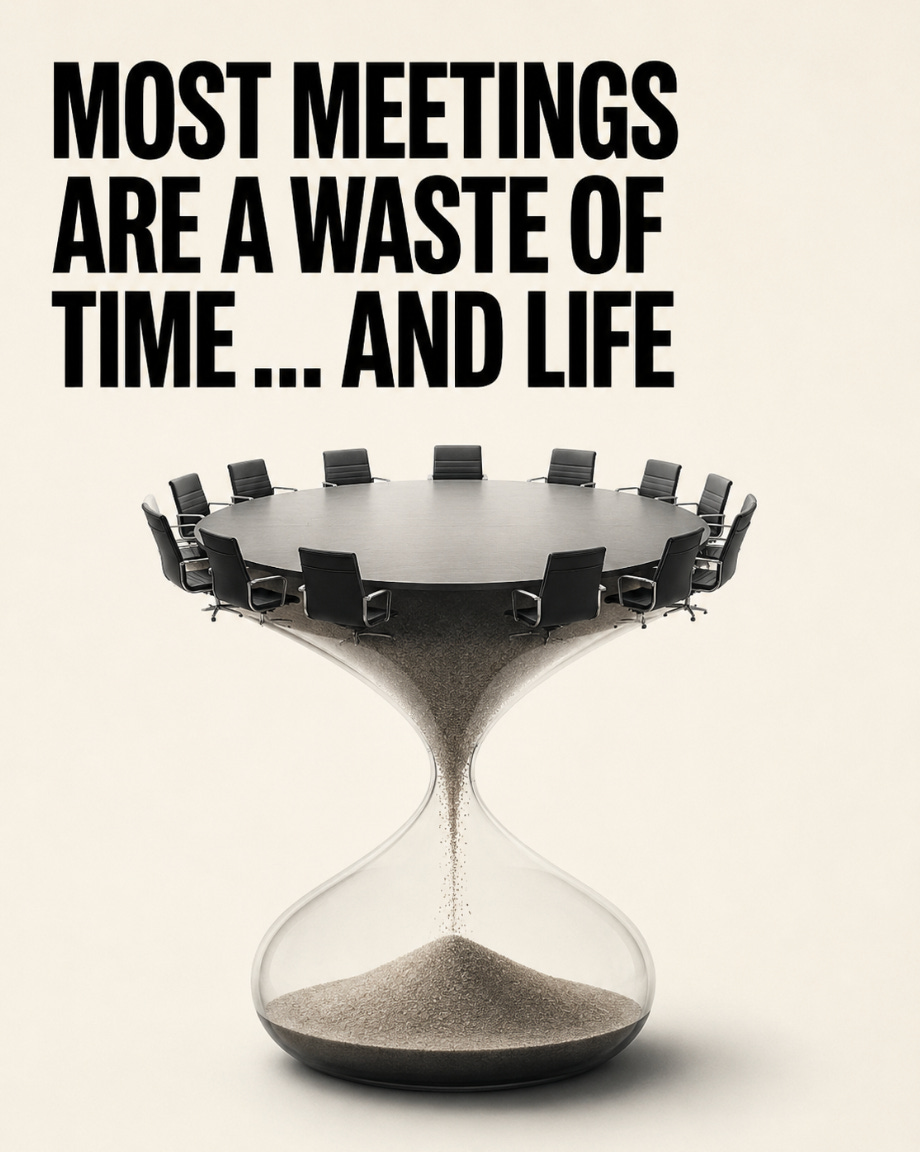
Most meetings are a waste of life.
They steal time.
They blur responsibility.
They protect hesitation.
They make people feel busy while the future waits.
But the right meeting is different.
The right meeting shows reality.
Moves projects.
Protects the system.
Names ownership.
Shortens the distance between promise and proof.
That meeting is not a waste of time.
It is the warranty for your successful future. Because success is not created by annual plans. Success is created by the rhythm between what you promised and what you are brave enough to check.
TL;DR
Most meetings waste time because they create talk without ownership.
A meeting without ownership is delayed failure.
Collective responsibility often destroys personal accountability.
Ringelmann showed that effort drops when individual contribution becomes invisible.
KPO is the meeting worth protecting: KPIs, Projects, Open Topics.
KPIs show reality. Projects move reality. Open Topics protect reality.
One-on-ones make responsibility personal.
🔒 ATTENTION: UNLOCK YOUR PRACTICE
The free section showed you the truth.
The paid section gives you the system.
Because understanding meeting dysfunction will not change your company.
Running better meetings will.
Inside the paid section, I give you The KPO Warranty Meeting Leadership Manual™:
Meeting Kill List™
KPO Agenda Template™
Owner–Deadline–Checkpoint Rule™
KPI Red-Zone Conversation™
Project Reality Snapshot™
Open Topic Triage™
Continue–Stop–Start One-on-One™
Use it on Monday.
Because the most expensive meeting is not the longest one.
It is the one that makes people believe something moved when nothing changed.
Paid subscribers also get:
Subscriber-only articles — deeper frameworks, leadership cases, and tools I do not share publicly.
Full archive access — every past guide, playbook, and operating system unlocked.
Exclusive printable templates — copy, print, and use in your next leadership conversation.
Recommended reading — curated books that deepen the practice.
Direct community access — comment, ask questions, and get answers from me personally.
Upgrade to Paid & Get the Field Manual
It’s your daily companion to move from theory to transformation.
TODAY ONLY!!!!
SPECIAL OFFER: “LEADERS ARE READERS”
Get 20% off your first year.
Because leaders are readers — and the best leaders invest in their growth.
FINAL WORDS
Meetings are a waste of life until they create ownership.
If nobody leaves responsible, nothing really happened.
If one person leaves with clarity, a deadline, and a checkpoint, the future has already started to move.
ENGAGE WITH THIS IDEA
Mirror question:
Which meeting in your organization creates the strongest illusion of progress?
Comment:
Where do you lose the most time — KPIs, projects, open topics, or one-on-ones?
Share:
Send this to one leader who is tired of meetings but has not yet redesigned ownership.
Subscribe:
Join The Modern Leader if you want leadership that turns fog into clarity, talk into ownership, and meetings into execution.
