

For years, the wrong question has echoed through boardrooms, organizations, and private doubts:
Are women less effective leaders?
It was the wrong question then.
It is an insulting question now.
The better question is this:
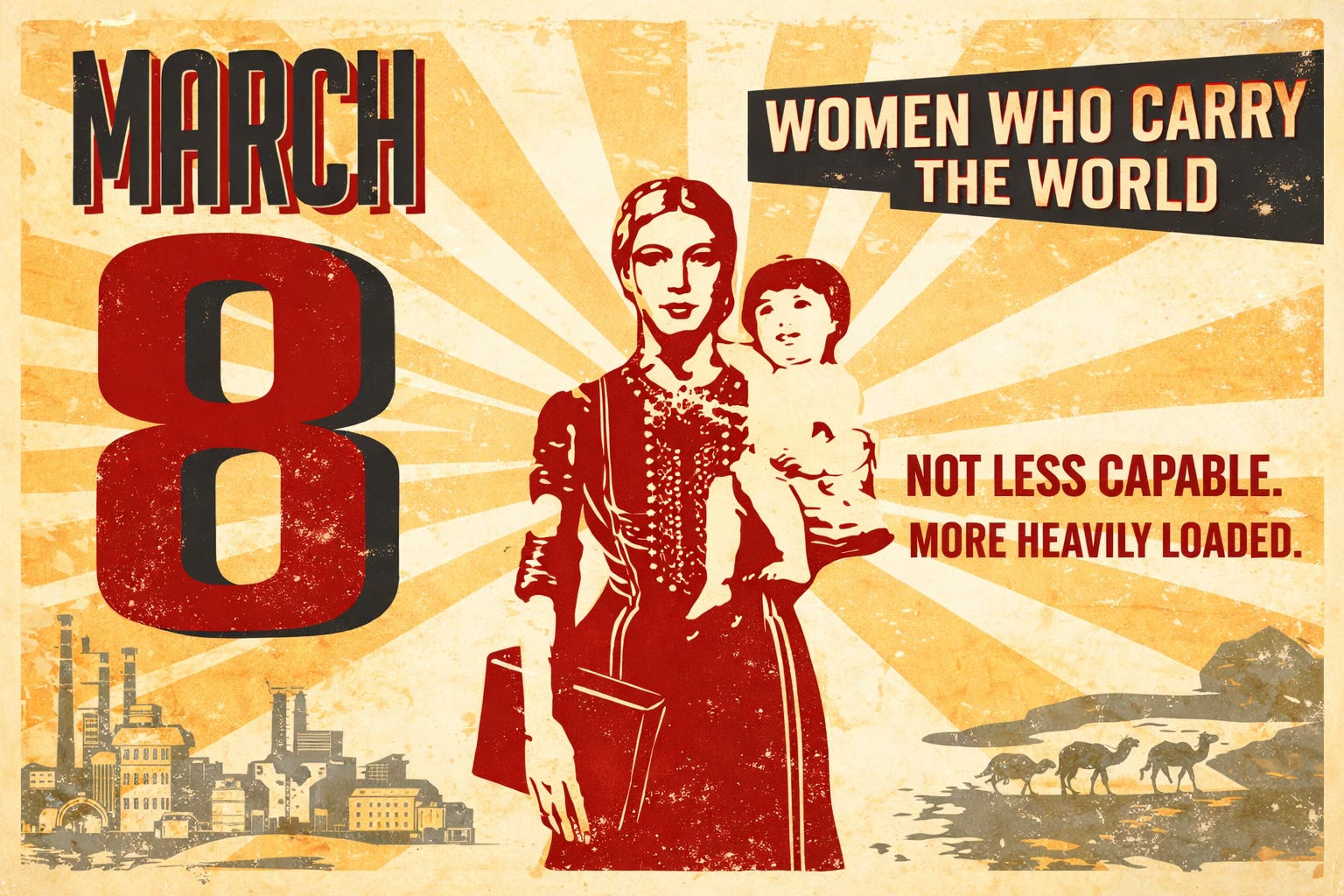
How much leadership potential have organizations been wasting by forcing women to lead under heavier emotional, structural, and invisible burdens than men?
Because the latest data does not suggest that women leaders are weaker.
It suggests they are carrying too much.
Gallup’s State of the Global Workplace 2025 found that manager engagement fell from 30% to 27% in 2024, and among all groups, female managers saw the steepest drop: minus 7 percentage points. Gallup also reminds us that 70% of team engagement is attributable to the manager. In other words: when women leaders are drained, the consequences do not stay personal. They become organizational. (Gallup.com)
That is not a “women’s issue.”
That is a leadership issue.
A business issue.
A human issue.
And today, on International Women’s Day, I want to say this clearly:
Many women are not failing at leadership.
They are succeeding inside systems that make success unnecessarily expensive.
Part 1: The myth was never neutral
I have worked with leaders long enough to know that many organizations still operate with an outdated subconscious model:
Think manager = think male.
Not always consciously.
But culturally.
Operationally.
Historically.
That model rewards control, constant availability, emotional restraint, speed, certainty, and endurance without complaint. It praises output while quietly outsourcing relational labor, emotional stabilization, and team climate management to women.
So women leaders are often asked to do two jobs at once:
Lead the business.
And regulate the human atmosphere around it.
They are expected to deliver results, but also to soften the room.
To be decisive, but never “too much.”
Warm, but not weak.
Strong, but still pleasant.
Visible, but not threatening.
This is not leadership.
This is asymmetry disguised as professionalism.
And asymmetry always has a price.
Part 2: The research is clear — the burden is real
Let’s leave ideology aside and look at the evidence.
Gallup reports that female manager engagement dropped by 7 percentage points, while male manager engagement saw no equivalent decline of that magnitude. Younger managers and female managers were the hardest hit. Gallup also notes that female managers experienced some of the biggest wellbeing decreases in the past year. (Gallup.com)
McKinsey and LeanIn’s Women in the Workplace 2024 shows that women remain underrepresented at every stage of the corporate pipeline. At the manager level, women make up 39% of roles; at the C-suite, 29%. (McKinsey & Company)
Deloitte’s Women @ Work 2025 adds another layer. Women are 50.1% of the global working-age population, yet only 40% of total employment and 35.4% of management positions globally. In the same report, 36% of women say their stress levels are higher than a year ago, 25% say they took time off work in the past year because of mental health challenges, and only around half describe their mental health as good. (Deloitte)
Then comes the second shift.
Deloitte found that in partnered households, women still carry the greatest responsibility for cleaning (57%), childcare (53%), caring for other adults (52%), and shopping for household items (51%). The lack of access to care translates into more than 2 million lost workdays annually across surveyed countries and an estimated US$16.5 billion missed economic opportunity. (Deloitte)
Read that again.
We keep evaluating women leaders as if the race were equal.
It is not.
Some are running the same race with extra weight on their backs, a second shift at home, cultural penalties at work, and the expectation that they remain composed while carrying everybody else’s emotional weather.
So no, the data does not prove women are less effective.
It proves many organizations still do not understand the full cost of what women are being asked to absorb.
Part 3: This is not about weakness. It is about depletion.
The problem is not reduced engagement. The problem is reduced regeneration.
That is a profound distinction.
Because when a woman leader is tired, the lazy observer may say:
“She is losing energy.”
But what is often happening is this:
She is spending energy in too many invisible places.
On anticipatory thinking.
On relational repair.
On emotional diplomacy.
On over-preparation to avoid being questioned.
On saying yes where a man might say no.
On being available beyond role boundaries.
On carrying guilt for ambition and guilt for absence at the same time.
That is not inefficiency.
That is overextension.
And overextension, repeated long enough, becomes disengagement.
Not because the leader stopped caring.
Because the system stopped replenishing.
Burnout is often not a sign that someone cares too little.
It is proof they cared for too long without enough structural support.
Part 4: The future of leadership is not more masculine. It is more human.
This is where many organizations still miss the point.
The answer is not to teach women to become more like the old leadership stereotype.
The answer is to evolve leadership itself.
That matters because the leadership challenges of this decade are not solved by command-and-control reflexes alone.
Hybrid work.
Change fatigue.
Low trust.
Mental overload.
Fragmented attention.
Retention pressure.
Social polarization.
These conditions require relational intelligence, psychological safety, boundary clarity, sense-making, and the ability to create commitment without intimidation.
Catalyst describes the new model of leadership as increasingly centered on resilience, flexibility, emotional intelligence, social influence, and empathy. (Catalyst)
In other words, many of the capacities once dismissed as “soft” are becoming core strategic assets.
And yet here is the paradox:
The very qualities the future of leadership needs most are often the same qualities women have long been expected to provide for free.
That era must end.
Empathy is not free labor.
Emotional regulation is not invisible labor.
Holding teams together is not a personality trait.
It is leadership work.
And leadership work must be recognized, protected, and supported.
Part 5: New visible rules for women leaders — and for the systems around them
On a day like today, praise is not enough.
Flowers are not enough.
Panels are not enough.
Campaigns are not enough.
Women do not need another day of symbolic appreciation followed by 364 days of structural contradiction.
They need new visible rules.
Here are five I would put on the wall of every organization:
1. Stop confusing self-erasure with commitment
A woman does not become a better leader by becoming endlessly available.
2. Boundaries are not aggression
Clear limits are not a rejection of teamwork. They are a condition for sustainable leadership.
3. Relational labor counts
The person who reduces friction, creates trust, and keeps a team emotionally functional is creating business value.
4. Regeneration is a performance strategy
Recovery is not indulgence. It is leadership maintenance.
5. “Good enough” is sometimes healthier than heroic
Perfection is expensive. Presence is more important.
TL;DR
Women are not less effective leaders.
They are too often leading under heavier, less visible burdens.
Gallup shows the sharpest engagement decline among female managers: -7 points.
So this International Women’s Day, the message should not be:
“Women can lead too.”
That is far too small.
The real message is:
Women have been leading for a long time.
The real question is whether our organizations are finally ready to deserve them.
Final words
To every woman doing a great job out there:
The world has often measured your output
without measuring your load.
It has admired your strength
while depending on your silence.
It has benefited from your leadership
without always protecting the leader.
Today, let us say something more honest than “thank you.”
Let us say:
We see the weight.
We see the value.
And the future of leadership will be built not by asking you to carry more,
but by building systems worthy of what you already bring.
Engage With This Idea
Comment: Which invisible rule do women leaders still pay for the most?
Share: With one woman whose leadership has held more together than most people will ever know.
Subscribe: For no-fluff leadership insights that honor both performance and humanity.