

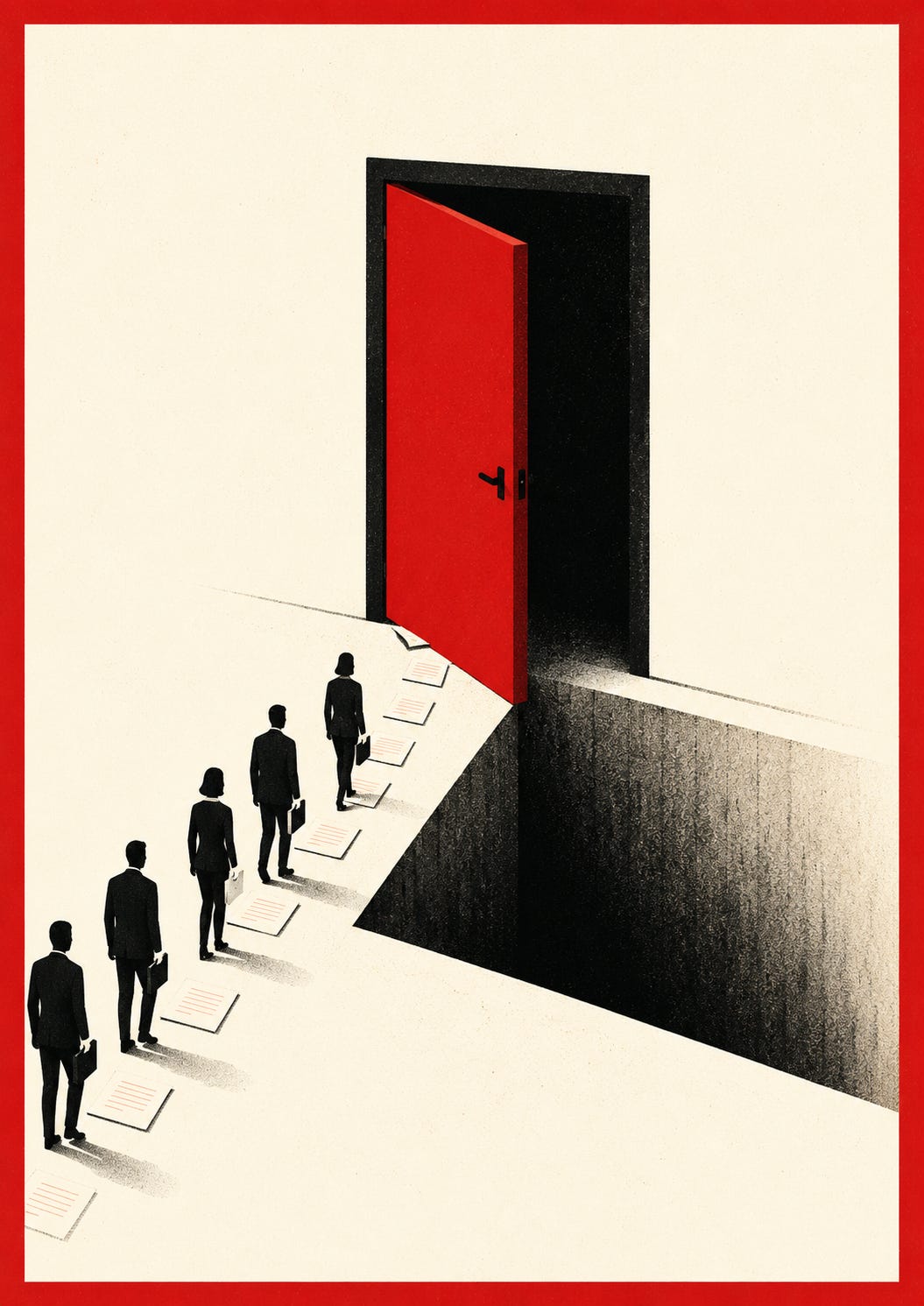
There are three leadership traps where we do not simply fall into a hole.
We dig it ourselves.
And once we are inside, it is very hard to climb out.
When I speak with leaders from different companies, I can often recognize quite quickly which of these three roles they are playing:
The Parent.
The Therapist.
The Caretaker.
And before you think this is written from a place of judgment, let me be very clear.
It is not.
As CEO, especially at the beginning of my leadership career, I found myself in all three roles more than once.
In fact, the deepest leadership hole I ever fell into was the one I dug myself.
You have probably said it too.
The sentence every good leader says at some point.
“My door is always open.”
And you probably meant it.
Not as a corporate phrase.
Not as a motivational poster.
But literally.
My door is open.
You can come to me.
I am here for you.
I want to be available.
I want to be close to the team.
It sounds noble.
It sounds supportive.
It sounds human.
And in many ways, it is.
But what I did not understand at the time was this:
When your team hears that your door is always open, they may not hear support.
They may hear permission to consult you about everything.
At the beginning, this can even feel good.
People come to you.
They ask for your opinion.
They involve you.
They want your decision.
You feel important.
You feel informed.
You feel like you have everything under control.
But slowly, something changes.
The questions become smaller.
The problems become more banal.
The decisions become less strategic.
And suddenly, people are standing in your office with issues they could have solved without you.
Not because they are stupid.
Not because they are lazy.
But because you trained the system to bring everything back to you.
And then one day, something in you snaps.
You lose it.
The caring Parent suddenly becomes much less caring.
And this is where the first trap begins.
1. THE PARENT LEADER
The Parent Leader is the leader who slowly becomes the source of all answers.
At first, this role feels responsible.
People come to you because they trust you.
You answer because you want to help.
You decide because it is faster.
You solve because you can.
But every time you answer too quickly, you may be taking away one thinking repetition from your team.
And people do not become capable because you think for them.
They become capable because they learn to think, decide, carry risk, and learn from the result.
The Parent Leader creates what I call a competence illusion.
You start believing you know everything.
Your team starts believing you know everything.
And once everyone believes that the leader knows everything, the team naturally becomes more passive.
They wait.
They check.
They ask.
They hide.
They protect themselves.
They bring problems instead of recommendations.
You may think you are building trust.
But you may actually be building dependency.
And once dependency grows, something ugly happens.
Your people start hiding information from you, because they do not want to disappoint you. They start blaming each other, because nobody wants to carry the full responsibility. Conflicts increase, ownership decreases, and you begin to feel surrounded by a team that is not capable enough.
At that moment, many leaders ask the wrong question:
“Why is my team so weak?”
The better question is:
“Is the team really the problem, or did my leadership style help create this behavior?”
That question hurts.
But it also frees you.
Because the way out is not to close the door.
The way out is to change what people must bring through the door.
Not:
“What should I do?”
But:
“What do you recommend?”
Not:
“Can you solve this for me?”
But:
“What are your options, what is your preferred solution, and what risk do you see?”
Not:
“Please decide for me.”
But:
“This is within your responsibility. Decide, inform me, and learn from the outcome.”
The goal of leadership is not to become the smartest person in every room.
The goal is to make the room smarter when you are not in it.
2. THE THERAPIST LEADER
The second leadership trap is the role of the Therapist.
This is the leader who becomes the judge, mediator, psychologist, emotional container, and conflict-resolution department of the company.
Someone is upset with someone.
They come to you.
Then the other person comes to you.
You listen.
You try to be fair.
You want to understand both sides.
You want to calm things down.
You want to solve it like a mature adult.
So you step in.
You explain one person to the other.
You translate emotions.
You organize a meeting.
You search for balance.
And sometimes, it works.
For a while.
Until the next conflict appears.
Then another one.
And then another one.
Before you know it, you are no longer leading a team.
You are running a kindergarten for adults with job titles.
That may sound harsh.
But if your employees remind you of children, I do not blame you.
This role fits perfectly into a kindergarten.
The problem is that your employees are not children.
And you are not their teacher.
Peter Drucker once pointed to a brutal leadership truth: if a manager spends too much time solving people problems, then either there are too many people, or the people are not effective enough.
Whether we like that sentence or not, the point is clear.
If you spend too much of your leadership energy solving conflicts between adults, you do not only have a people problem.
You have a maturity problem.
And sometimes, you are part of it.
Because every conflict you solve instead of them is a conflict they did not learn how to solve themselves.
The Therapist Leader asks:
“What happened?”
The Supporter Leader asks:
“What conversation have you already had with them directly?”
The Therapist Leader says:
“I will talk to them.”
The Supporter Leader says:
“What do you need in order to talk to them yourself?”
The Therapist Leader wants peace.
The Supporter Leader wants maturity.
That is a very different standard.
If you want responsibility in your team, you must take responsibility as a leader too.
And that means refusing to become the emotional shortcut for every uncomfortable conversation.
Your job is not to remove every conflict.
Your job is to raise the level at which conflict is handled.
3. THE CARETAKER LEADER
The third trap often begins with one painful question:
“Why does this always happen to me?”
If you have ever asked yourself that, you may have found yourself in the role of the Caretaker.
The Caretaker Leader is usually someone who was first very good at their professional job.
They were competent.
Reliable.
Trusted.
Respected by colleagues.
Then, almost overnight, they become the leader of the very people they used to sit with, joke with, complain with, and maybe even gossip with.
Yesterday, you were part of the team.
Today, you are responsible for the team.
Yesterday, you were one of them.
Today, you are the boss.
And this transition is not only professional.
It is emotional.
You do not want your team to think that the new role went to your head. You do not want them to think you changed. You do not want to lose the relationship, the closeness, the informal trust you had before.
So you try to sit on two chairs.
You want to represent the interests of the company.
But you also want to protect the relationship with the team.
You want to support leadership decisions.
But you also want your people to feel that you are still on their side.
You become the first among equals.
You try to take care of everyone.
You soften messages.
You absorb pressure.
You explain away poor performance.
You protect the team from uncomfortable truths.
You return from meetings with management with promises, explanations, and half-messages.
But sooner or later, reality catches up.
Your boss expects you to defend the company’s interest.
Your team expects you to defend theirs.
And when you come back empty-handed, the team starts losing respect.
They accuse you of selling your soul.
Management starts doubting your clarity.
And you start wondering why on earth you ever accepted the leadership role in the first place.
That is the Caretaker trap.
You try to take care of everyone.
And in the end, nobody fully trusts you.
The Caretaker Leader takes care of everything until nobody owns anything.
This is also why I do not believe in servant leadership.
I believe in supporter leadership.
A leader is not here to serve every discomfort of the team.
A leader is here to support people with clarity, standards, responsibility, and the conditions for ownership.
Support is not rescue.
Support is not softness.
Support is not taking the weight from people.
Support is helping people build the strength to carry the right weight.
The Caretaker Leader says:
“I will protect you from pressure.”
The Supporter Leader says:
“I will help you understand the pressure and carry your part of it.”
That is the difference.
And it changes everything.
THE REAL PROBLEM WAS NEVER ONLY THE TEAM
The most important lesson in all three traps is this:
The problem was never only the employees.
Yes, people can be passive.
Yes, people can avoid responsibility.
Yes, people can behave immaturely.
Yes, people can bring problems instead of solutions.
But leadership always has to ask the deeper question:
“What part of this behavior is being rewarded by the system I created?”
Because the more you control, solve, protect, and feel helpless, the less responsible, reliable, and independent your team becomes.
The Parent creates dependency by giving too many answers.
The Therapist creates dependency by solving too many conflicts.
The Caretaker creates dependency by taking care of too much.
Different roles.
Same result.
The leader carries too much.
The team carries too little.
And the more the leader carries, the more the team learns not to carry.
This is the leadership loop that breaks many good leaders.
You open the door.
People come in.
You solve.
They return.
You get frustrated.
You control more.
They think less.
You carry more.
They own less.
And one day, you want to lock the door of the office you proudly opened.
THE OWNERSHIP RETURN AUDIT
Before you ask why your team does not take more ownership, ask where you may have taken ownership away.
Take 15 minutes.
Answer these four questions honestly.
1. Where am I giving answers too quickly?
Which decisions should people start bringing with a recommendation instead of a question?
New leadership question:
“What are your options, what do you recommend, and what risk do you see?”
2. Where am I solving conflicts people should solve directly?
Which tension keeps coming to me because people avoid speaking to each other?
New leadership question:
“What conversation have you already had with them directly?”
3. Where am I protecting people from pressure?
What truth am I softening because I do not want to create discomfort?
New leadership question:
“What does the team need to understand in order to grow?”
4. Where have I confused care with ownership?
Complete this sentence:
“I may be taking too much care of…”
Then complete:
“The responsibility I need to return is…”
This is not about becoming cold.
It is about becoming clear.
TL;DR
“My door is always open” sounds supportive, but it can create dependency.
The Parent Leader gives too many answers and creates passivity.
The Therapist Leader solves conflicts adults should learn to solve directly.
The Caretaker Leader takes care of everything until nobody owns anything.
The problem is rarely only the team.
The more you control, solve, and protect, the less ownership you create.
Real support is not rescue.
Real support is clarity, standards, responsibility, and the conditions for ownership.
ATTENTION: UNLOCK YOUR PRACTICE
Reading this may help you recognize the trap.
But recognition alone will not change your leadership.
Because on Monday, the same things will happen again.
Someone will come to you without a recommendation.
Someone will avoid a difficult conversation.
Someone will ask you to decide something that belongs to them.
Someone will expect you to protect them from pressure.
And if you do not have a new operating system, the old role will return.
The Parent will answer.
The Therapist will mediate.
The Caretaker will protect.
Not because you are weak.
Because you have no new script yet.
That is what the paid section gives you.
Not more theory.
A practical reset.
In the paid section, you will get:
The 3 Leadership Traps Self-Diagnostic
The Ownership Return Script Pack
The Supporter Leadership Reset
The 7-Day Leadership Dependency Detox
Weekly Book Recommendation
The free section showed you the trap.
The paid section helps you get out of it.
Upgrade.
Use the tools.
Return ownership.
FINAL WORDS
The hardest part of leadership is not learning how to help people.
Most good leaders already want to help.
The hardest part is learning when your help is no longer helping.
When it replaces thinking.
When it absorbs responsibility.
When it delays maturity.
When it protects people from the pressure that would make them stronger.
Your team does not need you to be the Parent.
They need you to build judgment.
Your team does not need you to be the Therapist.
They need you to raise the standard of direct communication.
Your team does not need you to be the Caretaker.
They need you to support them with clarity, courage, standards, and trust.
Because the goal is not to be needed forever.
The goal is to build people who can carry more truth, more pressure, and more ownership than they could before they met you.
That is leadership.
Not serving weakness.
Supporting strength.
ENGAGE WITH THIS IDEA
Leadership Mirror Question:
Where are you creating dependency with good intentions?
Comment
Which trap do you recognize most in yourself: Parent, Therapist, or Caretaker?
Share
Share this with one leader who is carrying too much and wondering why the team carries too little.
Subscribe
Join 500+ modern leaders learning how to lead with clarity, responsibility, and human strength.