

I used to get a lump in my throat before annual development reviews.
Not because I feared people.
Because I feared the truth.
Early in my career, I often didn’t give feedback during the year. Sometimes I genuinely had no time. Sometimes I avoided it. And when review season came, I circled the real point like a cat around hot soup—anything but directness.
Then I’d sit in a room with someone’s entire year in my hands… and try to repair it in one hour.
That’s not leadership.
That’s a ritual to ease the leader’s conscience.
Most leaders don’t fear reviews.
They fear the truth they delayed.
And if you’ve ever felt that same lump in your throat, you already know why:
An annual review is rarely a performance tool.
It’s a relationship debt collection meeting.
The tragedy isn’t that reviews exist.
The tragedy is what they replace:
real-time calibration
timely feedback
shared ownership of results
a development rhythm that strengthens people month by month
Your annual review is not the problem.
Your year is the problem.
PART 1 — MY CEO CONFESSION: THE REVIEW WAS MY ALIBI
For years I thought the annual review was “the important moment.”
Now I see it differently.
It was my alibi.
It let me postpone hard conversations. Postpone clarity. Postpone leadership.
And postponing leadership always produces the same damage:
People get surprised.
Top performers get punished (because they carry what others avoid).
Here’s the part leaders don’t want to admit:
I didn’t avoid feedback because I lacked technique.
I avoided feedback because I feared my own image collapsing.
If I’m direct, they might not like me.
If I’m direct, they might push back.
If I’m direct, I might become “the bad guy.”
So I chose kindness.
But it wasn’t kindness.
It was fear wearing perfume.
Kindness without clarity is just avoidance.
When you don’t calibrate continuously, the review becomes an emotional dump.
You talk about too much.
You remember only the last few months.
You mix facts with frustration.
You mix development with compensation.
You mix performance with personality.
Then you wonder why people leave after review season.
Annual reviews don’t build performance.
They build politics.
Politics is what grows when truth is delayed.
And here’s the real cost.
Withholding feedback is not neutral.
It steals time.
And time is the only resource your employees can’t get back.
PART 2 — THE RITUAL FAILS. THE RHYTHM WORKS.
Most organizations run annual reviews like a legal process.
Collect evidence. Assign ratings. Defend positions. Close the file.
But humans don’t grow inside a courtroom.
Humans grow inside a loop.
A learning loop looks like this:
Align goals (results, projects, development)
Provide resources (training, mentoring, coaching)
Monitor through regular two-way check-ins
Adjust quickly
Repeat
Annual reviews fail when they try to compress that loop into one meeting.
That’s why the best performance management isn’t “better wording.”
It’s a better year.
The ritual fails.
The rhythm works.
A performance system without rhythm isn’t a system.
It’s theatre.
And theatre collapses under pressure.
PART 3 — WHY REVIEWS FAIL: DELAYED FEEDBACK BECOMES JUDGMENT
When feedback is delayed, it stops being information.
It becomes a verdict.
And verdicts trigger survival:
defensiveness
perception management
“evidence collecting”
identity (“I am bad”) instead of behavior (“I did X”)
This is why numeric ratings often feel like school grades.
Even when “fair,” they distort calibration.
Measurement isn’t bad.
Bad measurement creates bad behavior.
So I lead with a behavioral standard:
typical behaviours
patterns, not incidents
impact, not opinions
corrections, not labels
follow-up, not closure
Here’s the line I want you to steal:
If your annual review contains “new information,” your leadership is late.
Incidents are weather.
Patterns are climate.
You don’t coach weather.
You coach climate.
Don’t manage moods.
Manage patterns.
PART 4 — THE CEO PLAYBOOK: A REVIEW THAT BUILDS PERFORMANCE (NOT FEAR)
You want the annual meeting to stay? Fine.
But kill the annual surprise.
This is the operating system.
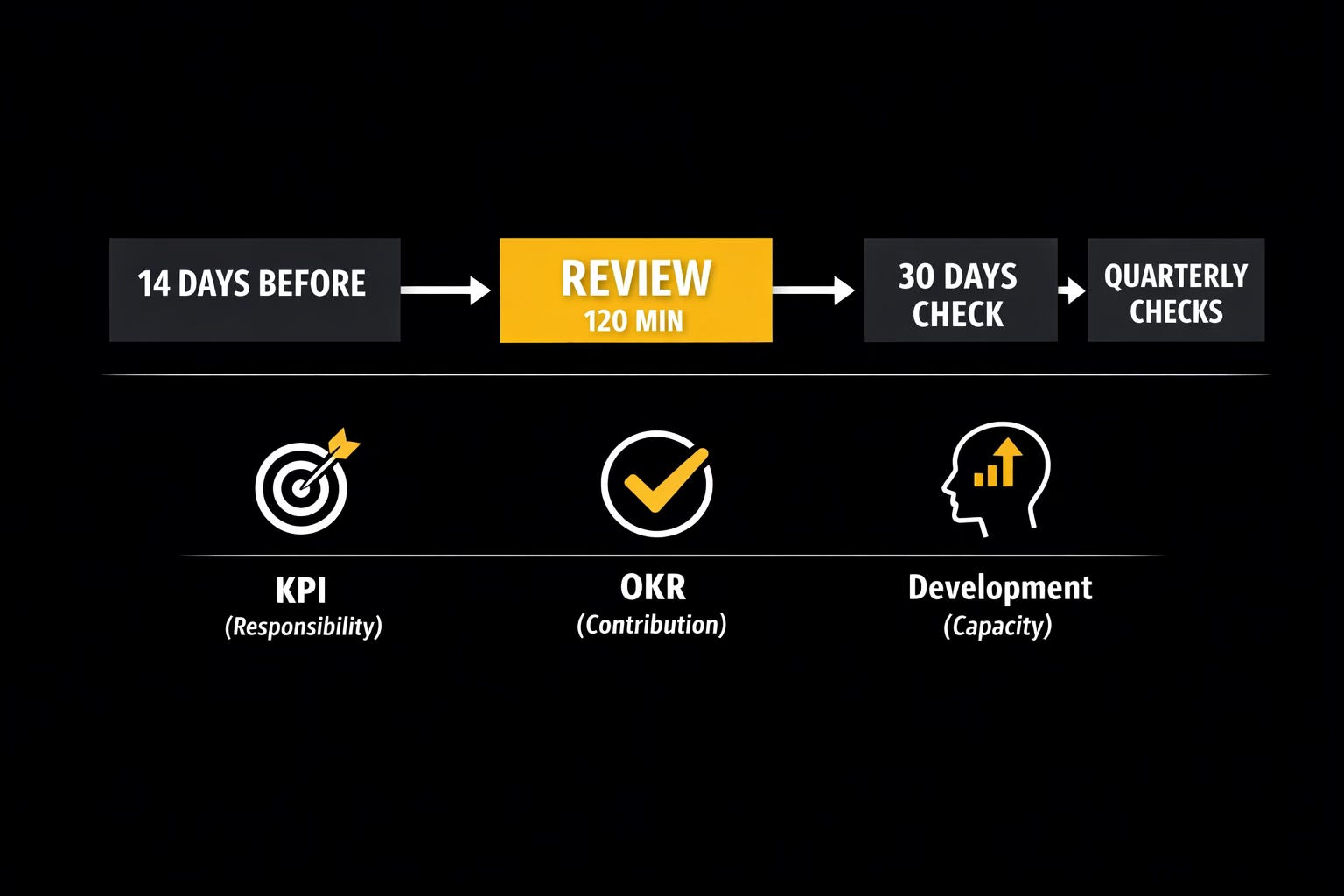
1) The 14-day calibration protocol
Two weeks before the meeting:
the employee fills the form first
the manager fills theirs separately
only then do you meet to compare reality
From “defend yourself” → to “align the truth.”
2) The 1-minute evidence ledger (weekly)
Once a week, one minute per person:
Win (what worked)
Friction (what repeated)
Next (what I’ll address)
No novel.
Just truth.
A leader without notes becomes a leader with bias.
3) Pattern over incident
Ask:
What repeats?
In which situations?
What’s the impact on results / team / clients?
What will we do differently next month?
Now you’re not reviewing the past.
You’re designing the future.
4) Performance + potential
Assess both:
performance (results achieved)
potential (capacity for higher expectations)
Then choose the adult move:
adjust expectations, or
increase capability with support
Wishing isn’t leadership.
Design is.
5) Two-way review (the leader gets reviewed too)
Ask the employee to evaluate your support:
clarity of priorities
availability
feedback quality
obstacle removal
development support
If they can’t review you, you can’t lead them.
6) End with 3 outcomes: KPI + OKR + development
KPI = your responsibility
OKR = your contribution
Development = your capacity
And yes: two hours per employee.
That’s not expensive.
That’s respect.
PART 5 — THE POTENTIALS CONFERENCE (THE ANTI-BIAS MOVE)
Most leaders think reviews are unfair because “people feel them unfair.”
No.
They’re unfair because they’re often based on one manager’s view.
Fix it with one move:
THE POTENTIALS CONFERENCE
90 minutes. Same-level leaders. Evidence only. No salary talk.
Per employee:
Where are they strongest under pressure?
What pattern holds them back (one sentence)?
Integrator or silo-builder — what’s the evidence?
One development priority (book/training/coach)
One 60-day observable metric
This one meeting makes reviews:
fairer
cleaner
less emotional
more strategic
Bias shrinks when truth has multiple witnesses.
PART 6 — LEADERS ARE READERS (AND LEADERS ARE NOT ALWAYS COACHES)
In my later CEO years I lived one principle harder than ever:
LEADERS ARE READERS.
If I saw a competence gap, I didn’t just rate it.
I gave direction:
a book tied to the gap
a targeted training
and when needed: a coach or mentor
Because here’s the truth:
You can’t always be the boss and the coach.
Trying to be both often poisons the relationship.
A coach supports the employee.
And supports the leader—by removing poison from the power dynamic.
Coaching isn’t a luxury.
It’s relationship protection.
THE 10 + 1 PRINCIPLES (YOUR STANDARD)
If you want one clean policy, use this:
No surprises: critical feedback happens close to the moment.
14-day preparation: employee first, manager second.
No school grades: if ratings exist, they must have behavioral anchors.
Explain through behavior + impact: no labels, no guessing.
Pattern over incident: manage repetition, not moods.
Results tied to plan: what was agreed, what was delivered, what changed.
Performance + potential: raise expectations only if capacity supports it.
Two-way review: employee evaluates leader support.
Cross-functional check: silo-builder or integrator—evidence required.
Close with 3 goals: KPI + OKR + development + follow-up rhythm.
+1) Leaders are Readers: every gap has a development track (book/training/coach).
SCREENSHOT BOX: 3 LINES TO START THE REVIEW RIGHT
Use this word-for-word:
“You go first. Tell me your year.”
“We’ll talk patterns, not incidents.”
“Then we agree on 3 things: KPI, OKR, and one development focus.”
THE ONE EXERCISE — THE NO-SURPRISES AUDIT (10 MIN)
Write two lists:
A) What I already said to their face this year
B) What I’m planning to say in the annual review
If B contains new items…
You don’t have a review problem.
You have a courage-and-rhythm problem.
Fix the year.
And the review becomes light.
TL;DR
Annual reviews fail when they try to fix a year of silence.
Keep the annual meeting if you want—but kill the annual surprise.
Build the system: preparation, weekly truth, patterns, performance+potential, two-way feedback, Potentials Conference, KPI/OKR/development, and real coaching support.
ATTENTION: IF YOU WANT THE WHOLE SYSTEM, NOT JUST THE IDEA
This free section gives you the philosophy and the framework.
But leaders don’t fail because they lack philosophy.
They fail because Monday comes… and they don’t know what to say, what to send, or what to do first.
So I built THE PAID SECTION below.
Not as “more content.”
As a complete operating system you can run immediately.
If you’re tired of review-season theatre, the paid section gives you a clean, printable rhythm:
what to do 4 weeks before
what to send 14 days before
how to run the 120 minutes
how to calibrate fairness with the Potentials Conference
how to lock in development with books, training, and coaching
The free section changes your mind.
The paid section changes your calendar.
FINAL WORDS
Every year, leaders sit across from people and try to measure a life.
Not the whole life, of course.
Just the part that fits into KPIs, projects, and calendars.
But humans are not spreadsheets.
Humans are stories.
And stories don’t change from one annual verdict.
They change from one honest moment… repeated often enough to become a new identity.
The annual review can stay.
But let it be what it was always meant to be:
Not a confession of what you avoided.
Not a courtroom.
Not a ritual of guilt.
A mirror.
A reset.
A shared vow to build a stronger year—together.
Because the best performance management system is not a form.
It’s a relationship with rhythm.
Truth on time is love.
Truth too late is a bill.
Engage
Comment: What’s the hardest part for you—directness, consistency, or calibration?
Share: Send this to one leader who still thinks reviews are the “main feedback moment.”
Subscribe: If you want leadership practices you can apply on Monday, join The Modern Leader.
PAID SECTION — THE 7-PAGE PERFORMANCE REVIEW OPERATING SYSTEM
You don’t need more theory. You need a system your leaders can run without talent, drama, or improvisation.
Below is the full playbook—everything is inside this paid section. No downloads. No extra documents.
Page 1 — The Timeline (the year that makes the review easy)
Week -4 (10 min): Manager scans the year (Evidence Ledger highlights).
Week -2 (Send + explain): Employee form goes out. Employee fills first.
Week -1 (5 min): Manager form + 3-stakeholder micro-check.
Review day (120 min): Run the agenda (below).
Week +4 (30 min): 30-day checkpoint.
Quarterly (20 min): 60/90 follow-ups.
If you skip the follow-up, you didn’t do a review.
You did a conversation.
Page 2 — The “14-Day Email” leaders can copy/paste
Subject: Annual Development Review — Preparation + How We’ll Run It
Hi [Name],
Our annual development review is on [Date/Time].
To make it useful (and fair), I’m asking you to fill out the self-review first and send it back by [Date].
A few rules so this stays constructive:
We’ll focus on patterns, not one-off incidents.
We’ll use behavior + impact, not labels.
There should be no surprises—anything sensitive should be addressed before or immediately after it happens.
We will end with 3 agreements: KPI (results), OKR (projects), and one development focus.
Please be direct. This is for your growth, not paperwork.
Thanks,
[Leader]
Page 3 — Employee Self-Review (1 page)
1) Your year in 5 lines:
Biggest win:
Biggest lesson:
Biggest frustration:
One thing you’re proud of:
One thing you regret:
2) Results (KPI):
KPI you owned:
What moved? What didn’t? Why?
3) Projects (OKR):
Biggest contribution:
What blocked you?
4) Your patterns (be honest):
Pattern that helps me:
Pattern that hurts me:
Situations that trigger my worst version:
5) Support from me (your leader):
What helped?
What was missing?
What should I do differently next quarter?
6) Next year proposals:
KPI focus (1–2):
OKR focus (1):
Development focus (1 competency):
Page 4 — Manager Review Prep (1 page)
A) Evidence Ledger summary:
Wins (3 bullets):
Frictions (3 bullets):
Pattern to strengthen (1):
Pattern to correct (1):
B) Behavior → Impact → Replacement:
Typical behavior I see:
Impact on results/team/clients:
Replacement behavior:
60-day observable metric:
C) Performance + Potential snapshot:
Performance: High / Medium / Low (why)
Potential: High / Medium / Low (why)
Best next move: adjust expectations OR increase capability
D) Three commitments:
KPI:
OKR:
Development:
Page 5 — The 120-Minute Agenda + Scripts
0–10: Employee summary (you listen + ask)
10–25: Strengths + wins
25–55: Patterns (helping/hurting) — behavior + impact
55–75: Results reality (KPI + OKR)
75–95: Potential + constraints (capacity, role fit, systems, support)
95–110: Next period agreements (KPI/OKR/Development)
110–120: Employee reviews leader + schedule 30-day checkpoint
Hard-moment scripts:
“I’m going to be direct because I respect you.”
“This is a pattern, not an incident—do you see it too?”
“Here’s the impact I’m observing. What impact do you think it has?”
“What would ‘better’ look like next month in observable behavior?”
“What support do you need from me to deliver?”
“Where have I been unclear?”
“Where did you feel unsupported by me?”
Page 6 — Potentials Conference Kit (90 minutes, anti-bias)
Purpose: calibrate performance + potential + collaboration, reduce bias.
Rules: no salary. no gossip. evidence only.
Format: 6 minutes per employee.
Per employee (6 minutes):
Pressure strength (1 sentence)
Limiting pattern (1 sentence)
Integrator vs silo-builder (evidence)
Support track (choose ONE): book / training / coach
60-day metric (observable)
Outputs (1 page per employee):
Development priority:
Risk to watch:
Support track:
60-day metric:
Page 7 — Development Engine (Leaders are Readers + Coach/Mentor)
A) The Development Track Menu (choose one as priority)
Book (fast self-upgrade)
Training (skill injection)
Coach/Mentor (behavior change + accountability)
B) The 3C Coach/Mentor Filter
Competence with scars
Chemistry
Code
C) 3 Coach Interview Questions
“Which behavior do you change first—and why?”
“How do you measure progress in 60 days?”
“What’s your protocol when the client resists?”
D) The 60-Day Success Metric
Pick ONE observable shift:
fewer escalations
faster decision cycles
better stakeholder feedback
consistent delivery rhythm
improved 1:1 quality
measurable KPI movement
If it can’t be measured, it’s not development.
It’s conversation.