


The dumbest sentence I’ve ever said as a CEO:
“Everything is a priority.”
It sounds like ambition.
It’s not.
It’s a confession: I had no clear vision.
And when a leader has no vision, the organization doesn’t get direction—
it gets routine crises.
“Everything is urgent” becomes the culture.
One idea hunts the next.
People stop thinking long-term and start surviving short-term.
And here’s the brutal part:
If life is about being present here and now, a team can’t afford that luxury.
A team must live in the future.
Because the future is not coming politely.
By 2030, job disruption is projected to hit 22% of today’s roles, with 170 million jobs created and 92 million displaced.
And at Davos in January 2026, the head of the IMF warned that AI will affect around 60% of jobs in advanced economies (and 40% globally)—with young workers likely suffering most as entry-level roles vanish.
So no—this isn’t a tech moment.
This is a trust moment.
When the future becomes uncertain, trust becomes the currency.
And most leaders are spending it like it’s infinite.
Part 1 — The decade of chasing
For my first decade in leadership, my operating system looked like this:
Watch the competition.
React faster.
Add more initiatives.
“Try everything.”
Retail is built on this reflex. And it’s not the only industry.
The hidden cost is predictable:
pressure becomes normal
overtime becomes identity
weekends become “commitment”
leadership becomes 24/7 warfare
If you try to catch two rabbits at the same time—you end up with none.
Yet many companies do the organizational version of it daily: 100 priorities, all important.
That’s not strategy. That’s panic with a calendar.
And here’s the leadership consequence:
You don’t train people to lead.
You train them to comply.
A visionless company doesn’t build leaders.
It builds firefighters.
And then wonders why nobody invents the future.
Part 2 — The first sign trust dropped (it wasn’t conflict)
The first sign trust dropped wasn’t an argument.
It was silence.
I asked the team: “What do you think?”
And instead of ideas, I got the floor.
Not metaphorically.
They looked down—like students in a classroom ruled by a dominant teacher, praying not to be chosen.
I’ve seen that dynamic before: a teacher who constantly performs superiority doesn’t create strong students. He creates silence.
And the “superiority” always gets exposed later—when the students don’t grow.
Organizations work the same way.
If people don’t speak, it’s not because they don’t know the answer.
It’s because they’re unsafe.
And then I said the sentence that burned through my own ego:
“I’m scared. I don’t have the answer.”
Then I asked:
“Do you see yourself in this company long-term?”
Silence again.
That’s when I knew: I had failed as a leader. Not tactically. Systemically.
Silence isn’t neutral.
Silence is a verdict.
Part 3 — The world context: we’re entering an insularity era

This isn’t happening in a vacuum.
Read the article: AI Won’t Take Your Job. But Ignoring It Will.
Edelman’s 2026 Trust Barometer found 7 in 10 people are unwilling or hesitant to trust someone with different values, backgrounds, or information sources.
And the World Economic Forum’s Global Risks Report 2026 ranks misinformation and disinformation as the #2 short-term global risk.
Translation:
We’re not just living through change.
We’re living through collapsing shared reality.
So when AI enters your company, your people don’t ask:
“How does this tool work?”
They ask:
“What does this mean about me?”
That question is identity.
And identity is always emotional.
AI doesn’t replace humans first.
It replaces certainty.
And once certainty is gone, people don’t become more creative.
They become more careful.
Part 4 — Leadership theory: routine crises create follower factories
Here’s the deep mechanism.
1) When everything is urgent, nothing is meaningful
Urgency steals the brain’s bandwidth.
People stop creating. They start reacting.
You don’t get innovation.
You get performance theater.
You can’t build the future with a nervous system stuck in survival.
2) When vision disappears, fear becomes the strategy
Your people will follow ideas—even bad ones—if the cost of questioning is social death.
That’s how you build an army of blind followers.
Not creators.
Followers protect leaders from discomfort.
Creators protect companies from collapse.
3) When presence dies, surveillance becomes the substitute
Here’s a modern leadership curse: many leaders quietly shifted from leading to monitoring—emails, CC chains, dashboards.
That doesn’t build trust.
It builds a Big Brother culture.
And Big Brother cultures don’t create brave people.
They create quiet people.
Daily examples you’ll recognize:
“For visibility” CC (translation: I don’t trust you)
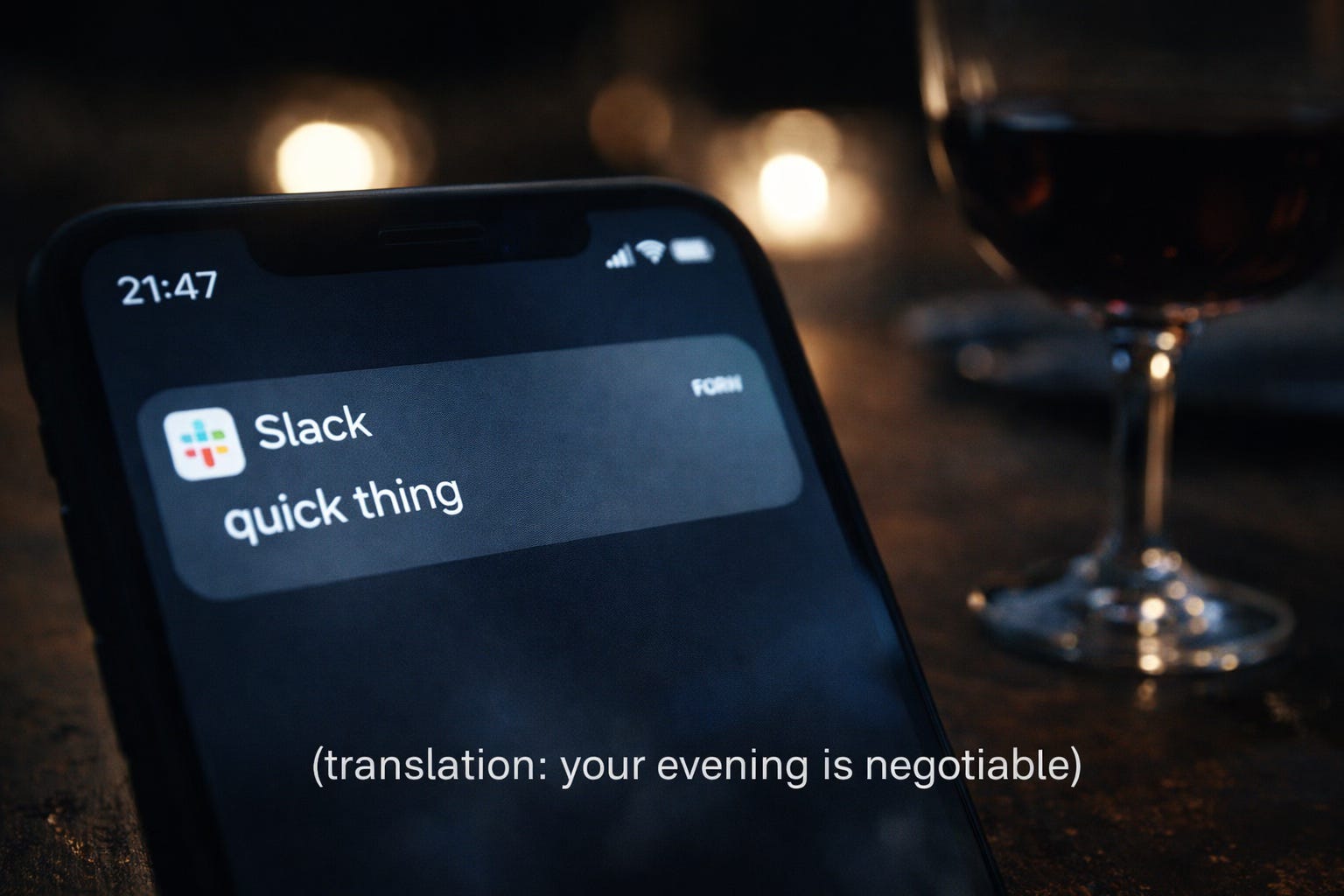
Slack at 21:47 “quick thing” (translation: your evening is negotiable)
A new initiative without killing an old one (translation: we’re stacking anxiety)
Meetings without decisions (translation: we’re avoiding responsibility)
If you want a provocative truth with a bit of humor:
If everything is a priority, congratulations—
you’ve built a company-wide panic subscription.
And the global numbers aren’t flattering.
In 2024, global employee engagement fell to 21%.
And 41% of employees report experiencing “a lot of stress.”
That’s not an HR crisis.
That’s a leadership mirror.
Part 5 — The turning point: we locked the door
Here’s what I did next:
We shut ourselves in a room.
And I asked them not to leave until we said everything.
No presentation.
No “alignment workshop.”
Just truth.
That moment matters because it flips the power dynamic:
from leader-as-answer
to leader-as-container
That’s what real leadership is: you don’t manufacture certainty.
You build a place where the truth can survive.
Trust isn’t built by what you say.
Trust is built by what becomes speakable.
And once truth becomes speakable, ownership returns.
Part 6 — The Trust Migration Loop (run this weekly)
Use this when AI, restructuring, cost pressure, or uncertainty hits.
Step 1: Name reality (no PR language)
Say three things every week:
what changed
what didn’t
what we still don’t know
If you don’t name reality, your organization will—through gossip.
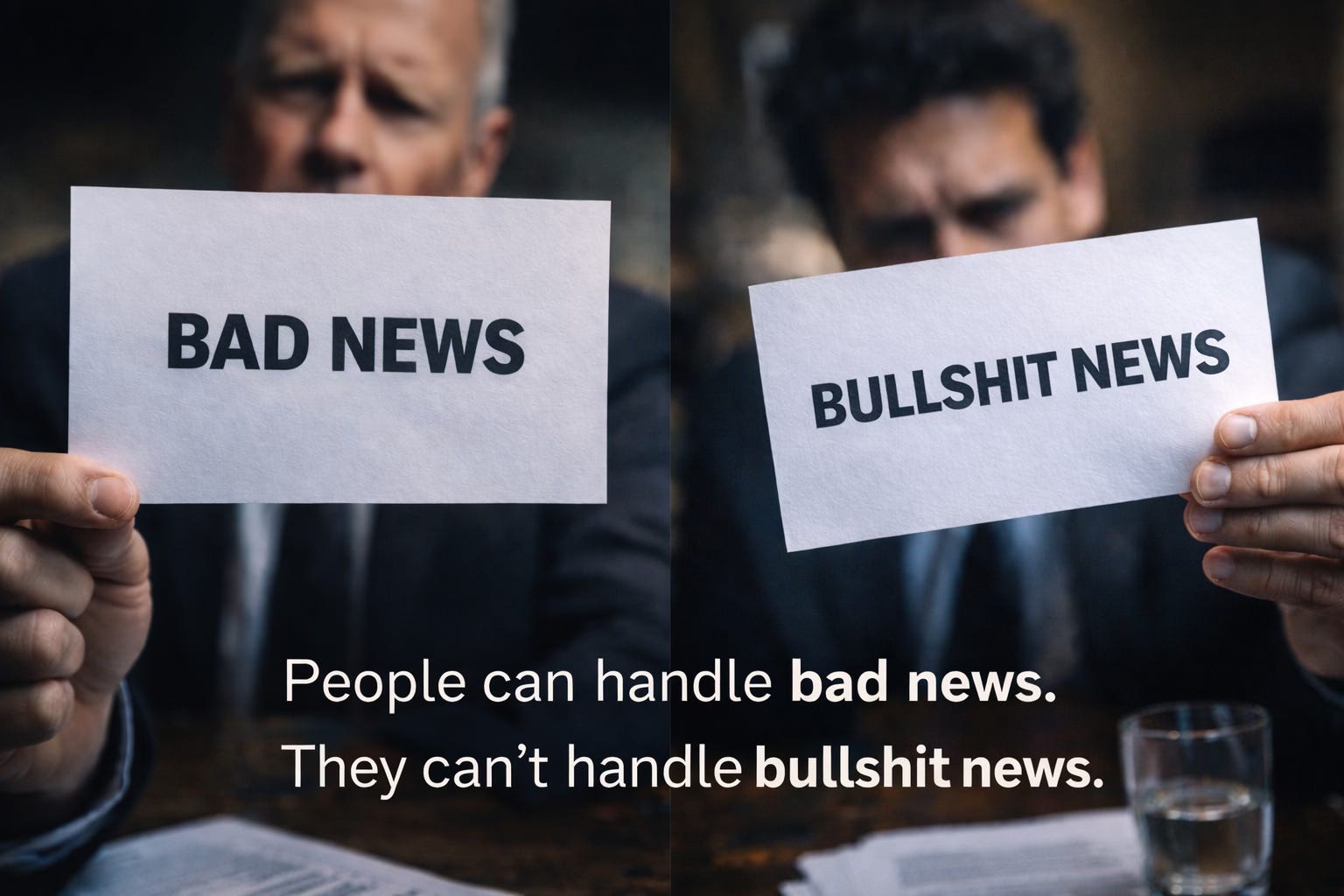
People can handle bad news.
They can’t handle vague news.
Step 2: Replace surveillance with presence
Real communication is an exchange between two conscious, present people.
Presence produces truth.
Surveillance produces compliance.
Presence is the first currency of trust.
Step 3: Convert “priority inflation” into a filter
Ask one question before every initiative:
“Does this move us toward our future, or away from it?”
If you can’t answer that, it’s not a priority.
It’s anxiety with branding.
Step 4: Make trust measurable
Track weekly trust signals:
Do people challenge you?
Do they bring bad news early?
Do they ask hard questions?
Do meetings produce decisions—or silence?
Silence is data.
If you’re not measuring trust, you’re managing illusions.
Part 7 — The signals your people are already watching
Even if you don’t talk about AI, your people see the headlines.
Klarna reported its AI assistant handled two-thirds of customer service chats and did work equivalent to 700 full-time agents.
Shopify’s CEO told teams they must show why AI can’t do the work before asking for more headcount.
Your people don’t interpret these as “innovation stories.”
They interpret them as: “Prove you deserve a seat.”
So when a leader says “AI will help,” many employees hear:
“AI will judge.”
That’s why this is a trust moment.
TL;DR
“Everything is a priority” is a confession of visionlessness.
Silence is the earliest sign of fear.
AI is not the main disruption—uncertainty is.
Routine crises create follower factories.
The leader’s job is to make truth safe and the future clear.
Engage With This Idea
Comment: Where do you see “routine crises” replacing real priorities?
Share: Send this to a leader who thinks silence means alignment.
Subscribe: If you want leadership that survives the next decade—stay close.
Final Words: Two Directions
A. The “popular” direction
Most leaders will treat this like a tech rollout.
More tools.
More dashboards.
More monitoring.
More “efficiency.”
They’ll keep stacking initiatives and call it agility.
They’ll cut fast without redesigning roles.
They’ll mistake silence for alignment.
And then they’ll say the line every weak leader says:
“People don’t want to work anymore.”
No.
People don’t want to be used anymore.
They won’t lose to AI.
They’ll lose to the culture they created: fear, silence, and routine crises.
B. The “unpopular” direction
Real leaders will treat this like a trust rebuild.
They’ll cut priorities brutally.
Name reality weekly.
Replace surveillance with presence.
Redesign roles before deleting people.
Measure silence like a fire alarm—not a sign of “respect.”
Because the companies that win won’t have the best AI.
They’ll have the most courageous conversations.
The future test isn’t your AI strategy.
It’s whether your people can tell you the truth.
🔒ATTENTION: Unlock Your Practice
Free content gives you insight.
Paid gives you implementation:
printable tools
scripts for hard moments
a weekly operating system that makes silence visible—and solvable
If this article described your culture too accurately, don’t just nod.
Upgrade.
Use the tools.
And rebuild trust before the future forces it.
Inside the Playbook (printable 8 pages):
The Priority Guillotine — cut “everything is urgent” into 3 real priorities (and 3 STOP decisions).
The Silence Diagnostic — decode silence in real time (punishment / humiliation / irrelevance / conflict).
The Trust Migration Loop — a weekly operating system to rebuild truth, dignity, and ownership.
The Leader-as-Container Scripts — exact phrases for the hardest moments: “Am I safe?”, “This is stupid.”, “We need layoffs fast.”, “I don’t know.”
The Reality Ritual Template — what changed / what didn’t / what we still don’t know (so gossip dies).
The Courageous Meeting Agenda — decisions, not “alignment.”
The Role Redesign Map — redesign work before you delete people.
The Trust Scoreboard — track whether truth is returning (or disappearing).
Paid subscribers also get:
Subscriber-only articles — deeper insights, frameworks, and case examples I don’t share publicly.
Full archive access — every past guide and tool unlocked.
Exclusive printable templates — copy, print, run in your next leadership meeting.
Direct community access — comment, ask questions, and get answers from me personally.
TODAY ONLY: SPECIAL OFFER — “LEADERS ARE READERS” (Get 20% off your first year)!
Because leaders are readers — and the best leaders invest in their growth.
🔒PAID SECTION - “THE FUTURE TEST”
Inside the Playbook (Print this section)
1) THE PRIORITY GUILLOTINE™
Purpose: End routine crises in one meeting.
Rule: Every new priority must pay with a STOP.
PRINT + FILL
A) Our Future (1 sentence):
B) The ONLY 3 priorities for the next 90 days:
C) What we will STOP (so the 3 can win):
D) The decision we’ve been avoiding (because it disappoints someone):
E) Owner + deadline + success metric (for each priority):
Priority 1 — Owner: __________ Deadline: __________ Metric: __________
Priority 2 — Owner: __________ Deadline: __________ Metric: __________
Priority 3 — Owner: __________ Deadline: __________ Metric: __________
If nothing stops, nothing is a priority. It’s just anxiety with branding.
2) THE SILENCE DIAGNOSTIC™
Purpose: Decode silence in real time — without guessing.
When the room goes quiet, silence is usually one (or two) fears.
CIRCLE ONE (OR TWO)
□ Fear of punishment
□ Fear of humiliation
□ Fear of irrelevance
□ Fear of conflict
THE 60-SECOND RESET (PRINT THIS)
“What are we not saying because it feels unsafe?”
“What would be the cost of speaking honestly here?”
“What do you need from leadership so truth becomes possible?”
YOUR MEETING SCRIPT (WRITE YOUR EXACT LINE)
“When you’re silent, I assume one of two things: you’re afraid, or you’ve checked out.
I don’t want either. So tell me the truth: what’s the fear?”
(Adapt in your words):
Silence isn’t alignment. Silence is fear — or resignation.
3) THE TRUST MIGRATION MAP™ (4 WEEKS)
Purpose: Rebuild truth + ownership under uncertainty.
WEEK 1 — REALITY RITUAL (10 minutes weekly)
What changed: ________________________________________________
What didn’t: _________________________________________________
What we don’t know yet: _______________________________________
WEEK 2 — DIGNITY CONTRACT
“What does safety mean here?” _________________________________
“What does performance mean here?” ____________________________
“What will we never do to each other?” _________________________
WEEK 3 — ROLE REDESIGN (before layoffs, before panic)
Tasks becoming routine: ________________________________________
Strengths we must redeploy: ____________________________________
New value we must create: ______________________________________
WEEK 4 — CONSISTENCY SCOREBOARD (trust signals)
People challenge me: □ yes □ no
Bad news comes early: □ yes □ no
Decisions happen fast: □ yes □ no
Silence is decreasing: □ yes □ no
Trust doesn’t rebuild through inspiration. It rebuilds through repetition.
4) THE LEADER-AS-CONTAINER SCRIPTS™
Purpose: Give you exact phrases for the hardest moments — so trust doesn’t collapse in one sentence.
“AM I SAFE?”
“I can’t promise comfort. I can promise dignity, truth, and a fair process.
Your safety here comes from clarity, contribution, and growth — not silence.
If you’re willing to learn and tell the truth, you belong.”
“THIS IS STUPID.”
“Good. Let’s work with that.
What exactly feels stupid — the goal, the timing, the method, or the owner?
Now tell me: what would make it less stupid in one concrete change?”
“WE NEED LAYOFFS FAST.”
“Fast is easy. Responsible is hard.
Before we delete people, we redesign work.
Show me what’s disappearing, what must grow, and where strengths can be redeployed.
If we cut without a future plan, we’re not leading — we’re panicking.”
“I DON’T KNOW.”
“I don’t know yet — and I won’t lie to you.
Here’s what I know. Here’s what I don’t.
Here’s what we will decide by (date).
And here’s how we’ll decide — with facts, dignity, and clear ownership.”
(Your shorter version / your voice):
A leader is not an answer machine. A leader is a container for truth.
5) THE REALITY RITUAL TEMPLATE™
Purpose: Kill gossip by naming reality — weekly, clearly, consistently.
RUN THIS EVERY WEEK (10 MINUTES)
1) What changed (facts only):
2) What didn’t change (stability):
3) What we still don’t know (uncertainty named):
THE ANTI-GOSSIP LINE (READ THIS)
“If we don’t name reality, the organization will — through gossip.
So we name it here, clearly, every week.”
THE ONE QUESTION THAT SAVES CULTURE
“What are people assuming right now — and what’s the truth?”
CLOSE (ONE SENTENCE)
“Here’s what we will do next, and by when.”
Vague leadership creates loud gossip. Clear leadership creates quiet focus.
6) THE COURAGEOUS MEETING AGENDA™
Purpose: Decisions, not “alignment.”
Rule: If the meeting ends without decisions, it was entertainment.
MEETING INTENT (WRITE IT)
Today we will decide:
1) REALITY (3 minutes)
What is true right now (no storytelling):
2) OPTIONS (5 minutes)
Option A: ____________________ Upside: ________ Risk: ________
Option B: ____________________ Upside: ________ Risk: ________
Option C: ____________________ Upside: ________ Risk: ________
3) DECISION (5 minutes)
Decision: ____________________________________________________
Owner: __________ Deadline: __________ Metric: __________
4) STOP LIST (2 minutes)
To make this real, we STOP:
5) TRUTH CHECK (2 minutes)
“What are we not saying that could break this decision later?”
If we can’t decide, we’re not aligned — we’re afraid.
7) THE ROLE REDESIGN MAP™
Purpose: Redesign work before you delete people.
STEP 1 — MAP THE WORK (NOT THE PEOPLE)
Routine work that is shrinking:
Human work that must deepen:
New value we must create:
STEP 2 — MAP STRENGTHS (NOT TITLES)
Top strengths we must redeploy:
1)____________________ 2) ____________________ 3) ____________________
STEP 3 — THE REDEPLOYMENT PLAN
Who moves where, doing what, by when:
STEP 4 — THE BRUTAL QUESTION
Which strengths are we about to fire… and rehire as consultants next year?
Cutting without redesign is not strategy. It’s panic.
8) THE TRUST SCOREBOARD™
Purpose: Track whether truth is returning — or disappearing.
SCORE EACH 1–5 (1 = NO / 5 = YES)
People challenge me openly: 1 2 3 4 5
Bad news arrives early: 1 2 3 4 5
Meetings end with decisions: 1 2 3 4 5
We stop things (not only start): 1 2 3 4 5
Ownership happens without permission: 1 2 3 4 5
Silence is decreasing: 1 2 3 4 5
Gossip is decreasing: 1 2 3 4 5
Clarity about the future is increasing: 1 2 3 4 5
THE ONE INSIGHT
This week, trust moved because:
THE ONE ACTION (7 DAYS)
One action we take in the next 7 days:
Owner: __________ Deadline: __________ Metric: __________
If you’re not measuring trust, you’re managing illusions.