


PART 1 — MY CEO REALIZATION
I noticed it first where the salaries were lowest.
Retail.
Warehouses.
Logistics.
Routine jobs. Repetitive tasks. Minimal room to think.
That’s where the pressure on pay was always the highest.
Every discussion sounded familiar:
“They’re underpaid.”
“We need to compensate them more.”
“Otherwise motivation will drop.”
At first, it looked like a classic compensation problem.
Later, I realized it was something far more fundamental.
The shift happened when we changed one thing —
not salaries,
but autonomy.
We started involving people in projects.
In improvements.
In decisions that shaped their daily work.
And something unexpected happened.
Salary pressure dropped.
Not because people suddenly became altruistic —
but because something more powerful than money returned:
ownership.
That’s when it became brutally clear to me:
The more autonomy you take away from people,
the more expensive they become.
When autonomy goes down, responsibility disappears.
When responsibility disappears, creativity dies.
And when creativity dies, salary stops being motivation.
It becomes compensation.
Not compensation for effort —
but compensation for lost agency.
For suppressed judgment.
For being reduced to “just follow the instructions.”
Pay is not just money.
Pay is recognition of human value inside an organization.
And the moment you design work in a way that strips people of thinking, deciding, and creating,
you no longer motivate them with salary.
You reimburse them.
This pattern is most visible in routine, non-creative roles:
retail assistants, warehouse workers, logistics operators.
Coincidentally, these are:
the lowest-paid jobs, and
the jobs most likely to be automated.
According to McKinsey, up to 30% of current work activities could be automated by 2030, with routine roles at highest risk.
Gallup adds another layer: only 23% of employees globally are engaged at work — engagement is lowest where autonomy is lowest.
This is not primarily a pay problem.
It’s a design problem.
PART 2 — THE SCIENCE BEHIND THE CANDLE
What I observed as a CEO isn’t anecdotal.
It’s one of the most replicated findings in behavioral science.
It starts with a simple experiment.
In the 1940s, psychologist Karl Duncker introduced what later became known as The Candle Problem.
Participants received:
a candle,
a box of matches,
a box of tacks.
The task: attach the candle to a wall so wax wouldn’t drip onto the table.
Most people failed.
They tried melting the candle to the wall.
They tried pinning it directly.
They tried forcing solutions harder.
The breakthrough came only when someone overcame functional fixedness —
the cognitive bias that makes us see objects only for their obvious function.
The solution wasn’t more effort.
It was reframing:
use the box as a platform, pin it to the wall, place the candle on top.
Then came the critical insight.
In 1962, psychologist Sam Glucksberg repeated the experiment — with a twist.
One group was told:
“This is a problem-solving task.”
The other group was told:
“If you’re among the fastest, you’ll receive a financial reward.”
The result surprised economists and managers alike.
The financially incentivized group took 3–4 minutes longer on average.
The reward didn’t improve performance.
It reduced it.
Why?
Because financial incentives narrow cognitive focus.
Extrinsic rewards activate the limbic system — the brain’s reward-and-threat circuitry.
Creative problem-solving depends on the prefrontal cortex — perspective, integration, judgment.
In short:
Money increases effort.
It does not increase insight.
This explains why incentives work for routine tasks —
and fail for complex, creative, human work.
PART 3 — WHAT HAPPENS TO HUMAN POTENTIAL
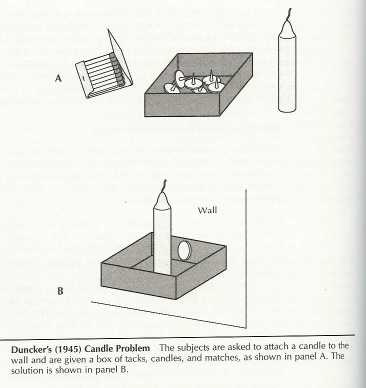
The Candle Problem isn’t about a candle.
It’s about what happens to the human mind when it’s placed inside a narrow frame.
Functional fixedness doesn’t live in objects.
It lives in people.
And organizations are exceptionally good at creating it.
When work is designed around instructions instead of judgment,
when success is measured by compliance instead of contribution,
when thinking is removed “for efficiency,”
human potential contracts.
Quietly.
People stop asking questions.
They stop seeing alternatives.
They stop offering ideas that weren’t requested.
Not because they don’t have them —
but because the system trained them that thinking is unnecessary.
Here’s the unspoken exchange many organizations make:
“Give us your obedience —
and we’ll compensate you financially for the thinking you no longer need to do.”
That’s the moment salary becomes compensation.
Not compensation for work —
but compensation for suppressed potential.
People don’t burn out because they work too much.
They burn out because they are not allowed to matter.
Automation isn’t the enemy here.
If a job requires no thinking, it shouldn’t be done by a human.
Not because humans are inefficient —
but because they are wasted there.
When salary becomes compensation,
leadership has already failed the human system.
PART 4 — THE ARI REDESIGN™ FRAMEWORK
Before you raise pay, redesign the work.
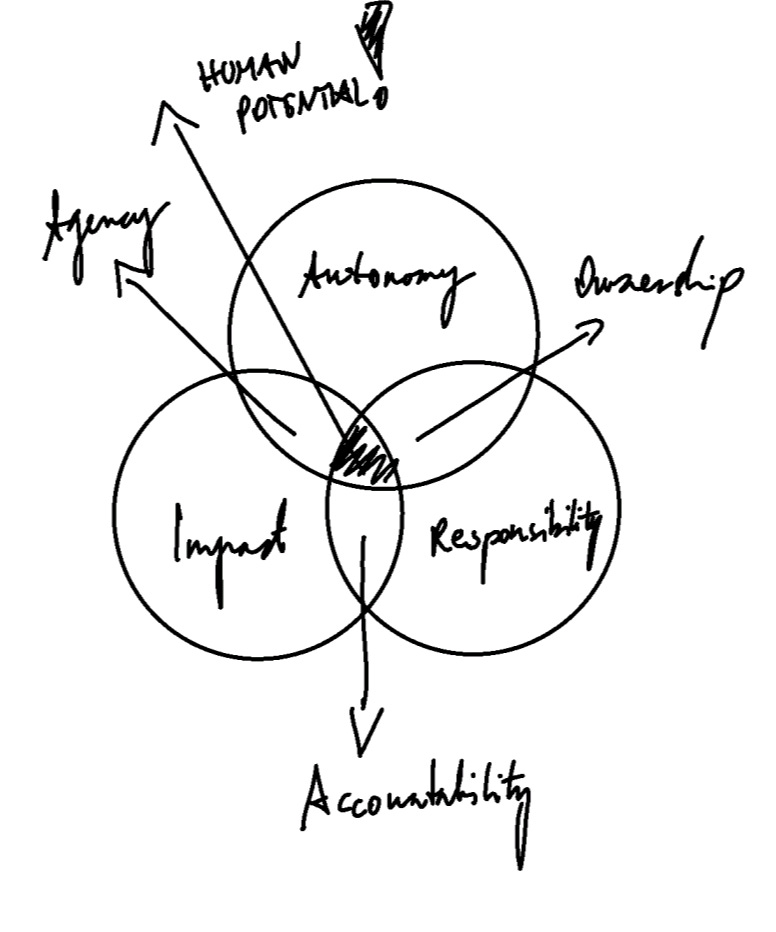
ARI stands for:
Autonomy
Responsibility
Impact
Whenever salary starts behaving like compensation, one of these has collapsed.
A — AUTONOMY
Where is thinking allowed — and where is it forbidden?
Replace instructions with decision space.
Define clear boundaries, then grant freedom inside them.
Autonomy without responsibility creates freedom without ownership.
Autonomy without impact creates choice without meaning.
R — RESPONSIBILITY
Who truly owns the outcome?
Shift from task ownership to judgment ownership.
Stop asking “Did you follow the process?”
Start asking “What did you decide — and why?”
Responsibility without autonomy becomes pressure.
Responsibility without impact becomes symbolic.
I — IMPACT
Can people see that their thinking changes something?
Close the loop.
Every idea deserves closure — used or explained.
Impact without responsibility becomes noise.
Impact without autonomy creates visibility without agency.
THE INTEGRATION RULE
Autonomy + Responsibility create Ownership.
Responsibility + Impact create Accountability.
Autonomy + Impact create Agency.
When all three are present, human potential is no longer suppressed or compensated —
it is activated.
Pay should reward contribution.
Not compensate for its absence.
PART 5 — APPLYING ARI (THE LEADERSHIP CHECK)
Now apply the ARI REDESIGN™ Framework to your own organization.
Not theoretically.
Practically.
Autonomy
Where have we removed thinking “for efficiency” —
and replaced judgment with instructions?
Which roles have clear tasks,
but no real decision space?
Responsibility
Where do we demand accountability
without granting authority?
Which roles carry responsibility in words,
but not in ownership of outcomes?
Impact
Where does effort disappear without closure?
Which people cannot see how their thinking changes anything —
and are therefore left with salary as the only signal of value?
Now connect the dots.
Where autonomy is lowest and impact is weakest,
salary pressure is almost always the highest.
That is not a coincidence.
That is compensation at work.
If you redesigned just one role using ARI:
which decision would you return?
which responsibility would you make explicit?
which impact would you finally make visible?
You don’t need a bigger budget to answer these questions.
One honest application of ARI
is worth more than a budget increase.
In the paid section, you’ll find a structured way to run this check across roles and teams — without guesswork or defensiveness.
TL;DR
Salary becomes compensation when autonomy disappears.
Money increases effort, not insight.
Incentives narrow thinking in complex work.
Human potential collapses when judgment is removed.
Before raising pay, redesign Autonomy, Responsibility, and Impact.
This is a leadership design problem — not a motivation problem.
Engage With This Idea
Comment
Where in your organization has salary quietly become compensation for lost autonomy, responsibility, or impact?
Leave a comment.
Share
Send this to one leader who still believes motivation can be fixed with money.
Subscribe
Join 400+ leaders redesigning work for human potential — not compliance.
🔒 PAID SECTION — UNLOCK THE ARI PRACTICE
Most leaders already understand that motivation is broken.
Very few redesign work deeply enough to fix it.
If salary pressure is rising, engagement is falling, or responsibility feels thin,
the issue is not motivation.
It’s design.
Upgrade to paid if you want to move from talking about motivation
to designing conditions where motivation no longer needs to be pushed.
This paid section turns the Candle Problem into a leadership operating practice.
Inside the ARI REDESIGN™ Practice
The Salary Reality Check
A diagnostic to see where pay still motivates — and where it has already become compensation for lost autonomy, responsibility, or impact.
The Autonomy Redesign Map
Identify which decisions were removed “for efficiency” and which must be returned to restore thinking without losing control.
The Responsibility Reset
Shift roles from task execution to outcome ownership — without pressure, micromanagement, or chaos.
The Impact Loop
A simple practice to make contribution visible again, so money stops being the only signal of value.
The “Before You Raise Pay” Leader Checklist
The questions every leader should answer honestly before approving the next salary increase.
Paid Subscribers Also Get
Subscriber-only articles
Deeper frameworks, sharper leadership cases, and practical insights I don’t publish publicly.Full archive access
Every past article and leadership practice unlocked.Direct access through comments
Ask questions, challenge ideas, and get answers from me personally.
If you want motivation without manipulation,
engagement without incentives,
and responsibility without pressure —
ARI is where leadership design begins.
Upgrade to paid and turn insight into practice.
SPECIAL OFFER — LEADERS ARE READERS
For a limited time:
Get 20% off your first year.
Because leaders don’t outsource their thinking.
They invest in it.
Unlock the paid section to turn insight into leadership practice.