

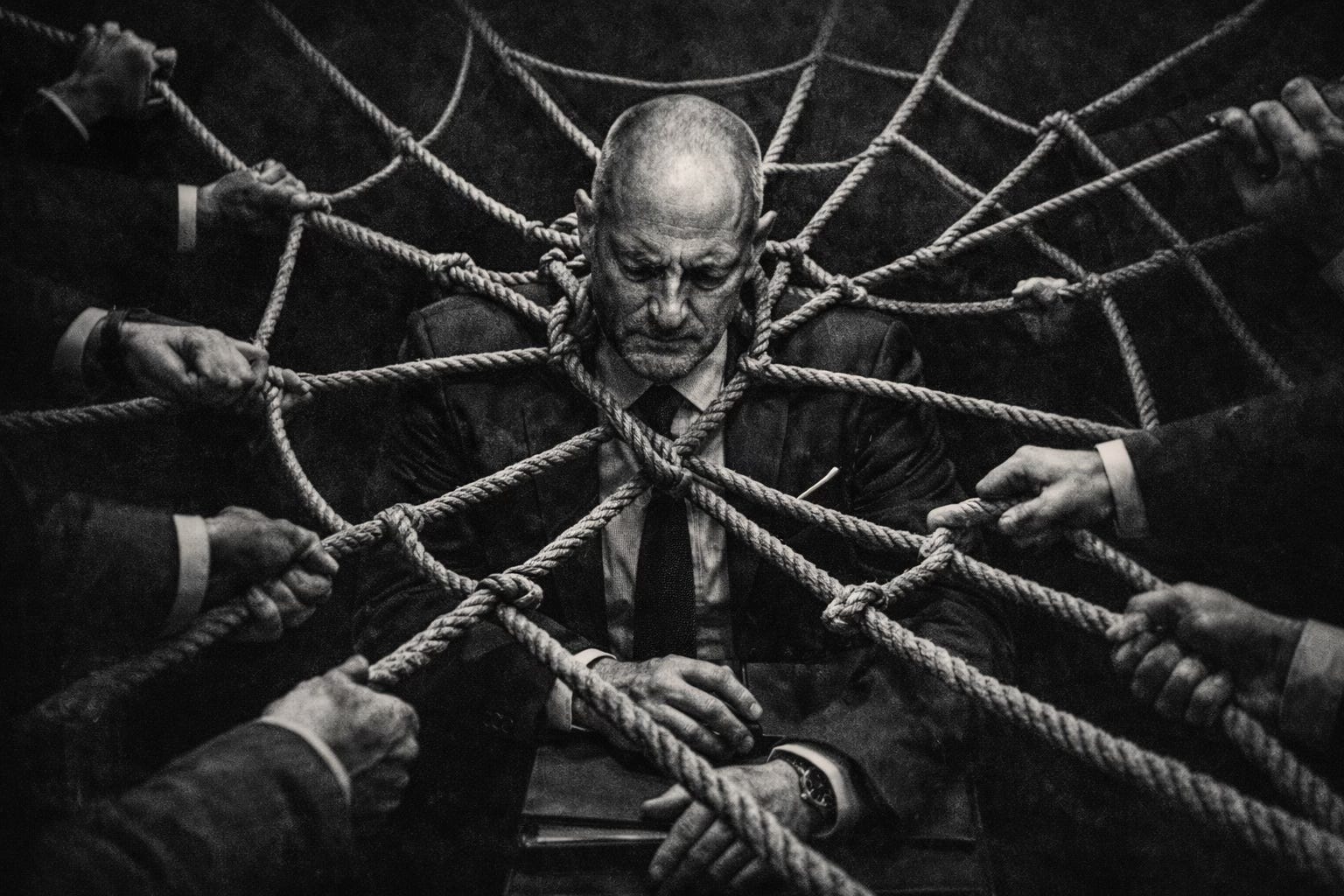
Part 1: The Night I Realized I Was the Problem
21:47.
A late email.
“Gregor, sorry for disturbing you, but we need your decision.”
That sentence used to feel like power.
If everything escalated to me,
it meant I was needed.
Important.
Reliable.
Indispensable.
I thought that was leadership.
I was wrong.
There was a pattern.
The more I solved, the less they thought.
The more I stepped in, the faster they stepped back.
And then I said the sentence every exhausted leader eventually says:
“Why can’t they just take ownership?”
Because I had trained them not to.
Part 2: Why 2026 Makes This Dangerous
Uncertainty activates over-functioning.
In volatile environments, leaders default to speed.
And speed rewards the fixer.
But research shows something uncomfortable:
According to Gallup (2023), only 23% of employees worldwide are engaged at work.
The primary driver of engagement?
The manager.A Harvard Business Review analysis of 7,000+ leaders found that micromanagement and over-control directly correlate with lower initiative and innovation behaviors.
Studies on self-determination theory (Deci & Ryan) show autonomy is one of the three core psychological needs required for intrinsic motivation.
When you rescue, you reduce autonomy.
When you reduce autonomy, you reduce intrinsic motivation.
When you reduce intrinsic motivation, you create compliance — not ownership.
AI will replace compliance.
It will not replace accountability.
Part 3: The Pattern You Already Know
I won’t re-explain the full Drama Triangle here — I’ve written about it in detail before.
You can read the full breakdown here:
Why You Keep Playing Victim, Villain, or Hero — And How to Stop

“If you spend more than 10% of your time solving conflicts, you either have too many employees or the wrong ones.” Peter F. Drucker
What matters for this article is simple:
When leaders over-function, teams under-function.
The “hero” role feels noble.
But systems adapt to it.
And here’s what systems do:
If someone always rescues, others delay decisions.
If someone always fixes, others escalate faster.
If someone absorbs consequences, others avoid responsibility.
Research in organizational psychology calls this learned helplessness transfer — when repeated external rescue reduces internal problem-solving behavior.
It’s not laziness.
It’s conditioning.
Part 4: The Hidden Cost of the Rescuer CEO
Let’s make this personal.
Where did you rescue so often that the team stopped thinking?
What did it cost you?
Energy?
Family presence?
Health?
A study published in the Journal of Applied Psychology shows that leaders who report high levels of role overload and constant intervention have significantly higher burnout rates and lower long-term team performance.
Burned-out leaders create anxious teams.
Anxious teams escalate more.
Escalation feeds the rescuer.
It becomes a closed loop.
Part 5: Ownership Transfer Framework
This is the system I now use with executive teams.
STEP 1: Stop Solving
If the problem won’t destroy the company — pause.
Silence is developmental space.
STEP 2: Ask Ownership Questions
What’s your recommendation?
What options did you consider?
What decision are you proposing?
If I weren’t available, what would you do?
Research shows that leaders who use coaching-style questions instead of directive answers increase problem-solving capacity in teams by up to 30% over six months (HBR coaching effectiveness studies).
Questions build muscles.
Answers build dependency.
STEP 3: Set Consequences + Support
Accountability without support = fear.
Support without accountability = weakness.
Both are required for adult systems.
STEP 4: Reward Adult Behavior
Publicly reinforce initiative.
Not obedience.
Recognition rewires culture.
Part 6: 10 Rescuer Behaviors to Watch
Answering immediately
Rewriting people’s work
Joining every important meeting
Taking over difficult client calls
Shielding from consequences
Saying “It’s faster if I do it”
Solving emotional discomfort
Making decisions others can make
Allowing unclear ownership
Being the bottleneck and calling it leadership
If you do more than three of these weekly,
you are training dependency.
Part 7: Script That Changed My Leadership
The sentence that helped me exit the triangle was this:
“I won’t take your responsibility from you. I will help you carry it.”
It communicates three things:
I trust you.
I expect ownership.
I will support you.
That sentence alone shifted my culture more than any workshop.
Part 8: The 7-Day Experiment
For seven days:
Replace one rescue with one ownership question.
Just one.
Notice:
The silence.
The discomfort.
The thinking.
The growth.
Ownership feels slow at first.
But so does strength training.
TL;DR
Uncertainty triggers rescuing.
Rescuing reduces autonomy.
Reduced autonomy kills intrinsic motivation.
Dead motivation creates dependency.
Dependency destroys accountability.
The future belongs to leaders who design ownership — not heroes who absorb chaos.
⚠️ ATTENTION: INSIGHT DOESN’T CHANGE CULTURE. LANGUAGE DOES.
You now understand the pattern.
But insight won’t save you at 21:47
when someone escalates instead of deciding.
That moment requires skill.
That’s why I built the:
TRIANGLE INTERRUPT SCRIPT™
This is the execution layer.
Inside (paid only):
• The exact interrupt phrases I use in executive rooms
• Escalation scripts for chronic dependency
• The Ownership Ladder diagnostic
• Live role-play drills for leadership teams
• Debrief prompts that expose hidden victim dynamics
• Advanced: identifying covert rescuers in senior leadership
This is not motivational content.
It’s operational leadership.
If you’re building an adult organization,
you need adult language.
Paid subscribers also get:
• Full archive access
• Exclusive playbooks & frameworks
• Advanced diagnostics I use with CEOs
• Community access with serious leaders
This newsletter is not for spectators.
It’s for leaders designing accountable systems.
If you’re ready to stop carrying everyone —
and start building adults —
Join us inside.
TODAY ONLY: SPECIAL OFFER — “LEADERS ARE READERS”
Get 20% off your first year.
Because leaders are readers — and the best leaders invest in their growth.
Lessons Learned
Saving people weakens them.
Empowering people creates discomfort —
and strength.
The most dangerous CEO in 2026
won’t be authoritarian.
It will be the over-helpful one.
Engage With This Idea
Comment: Where are you over-rescuing right now?
Share: Send this to one leader who is exhausted from carrying everyone.
Subscribe: Join The Modern Leader for one signal-packed leadership insights every week — built from proof of life, research, and real executive rooms.