


A job interview is no different than a first date.
If you think you’re a match, you’re essentially agreeing to stick together for a while.
And if you’re wrong, the separation can be costly for both of you.
Costly in money.
Costly in energy.
Costly in trust.
And sometimes… costly in a person’s life.
Because candidates don’t walk into interviews as spreadsheets.
They walk in with optimism. With belief. With a decision already forming inside them.
Some of them will resign from a stable job because they trust your story.
If you hire them on fog, then exit them on frustration, you didn’t just end a contract.
You may have broken someone’s momentum for years.
That’s why I’m blunt about this:
The worse you are at hiring, the better you’ll need to be at developing.
And in the real world, most leaders don’t have the time or the skill to develop their way out of a bad hire.
So they separate.
And then they call it “normal turnover.”
No.
For me it’s a clear sign of incompetent leadership.
Part 1 — Story: what I learned as a CEO
When you run a large organization, hiring mistakes don’t stay small.
They spread.
One wrong hire doesn’t just underperform.
It changes the emotional climate of the whole team:
high performers slow down to compensate,
managers start micromanaging,
trust drops,
politics rises,
standards become negotiable.
Over time, the leader becomes a firefighter.
And the leader starts believing the lie:
“I need better development programs.”
Sometimes you do.
But often the real fix is much more uncomfortable:
You need better interviews.
Because most “development problems” are actually expectation problems that started in the first conversation.
That’s why I always came back to one internal question:
Does this person burden me or supports me?
Not as judgment.
As strategy.
And then the adult follow-up:
What capabilities must they develop?
Who will develop them?
How much will it cost?
How long will it take?
If you can’t answer those questions early, you’re not hiring.
You’re gambling.
Part 2 — Research: why bad interviews are so expensive
Turnover is not just annoying. It’s financially brutal.
The Work Institute 2024 Retention Report estimates turnover costs for employers are approaching nearly a trillion dollars.
And here’s the part most leaders miss:
A big portion of avoidable exits are not “culture” problems in the abstract.
They’re clarity problems.
Role ambiguity has been repeatedly linked to worse outcomes like lower satisfaction and performance.
When expectations are fuzzy, you create a predictable loop:
confusion
rework
conflict
disengagement
exit
Now the uncomfortable hiring truth:
Unstructured interviews feel “human,” but they’re often just theatre.
And theatre is expensive.
Research syntheses show structured interviews predict job performance better than unstructured ones.
And a large meta-analysis shows interview validity depends heavily on content and structure.
So when leaders say, “I trust my gut,” what they often mean is:
“I don’t have a system.”
One more angle you’ll recognize:
Even “feedback” isn’t the cure people think it is.
A major meta-analysis found that in over one third of cases, feedback interventions reduced performance.
Why? Because feedback often triggers ego-defense.
And ego-defense kills learning.
The better solution is simple:
Alignment is prevention. Feedback is damage control.
Choose prevention.
Part 3 — The deeper point: hiring is a leadership decision, not an HR task
Most leaders treat interviews as a filtering event:
“Are you good enough?”
That’s the wrong frame.
A high-integrity interview is an alignment event:
“Is this true for both of us?”
Because if the match is wrong, you will pay twice:
You pay for the wrong hire.
You pay again for the exit.
And the candidate pays too:
confidence
stability
reputation
sometimes a whole life plan
That’s why this sentence matters:
The interview is where you either create clarity of expectations — or create a future conflict.
And clarity is the foundation of psychological safety: a team’s belief that it’s safe to speak up, be honest, and learn.
No safety = no truth.
No truth = no improvement.
No improvement = separation.
Part 4 — Practical system: the MATCH interview
Your interview should do one thing:
Verify a MATCH.
Not exchange opinions.
Not trade charisma.
Not perform.
The 4-layer MATCH model (it applies to dating, too)
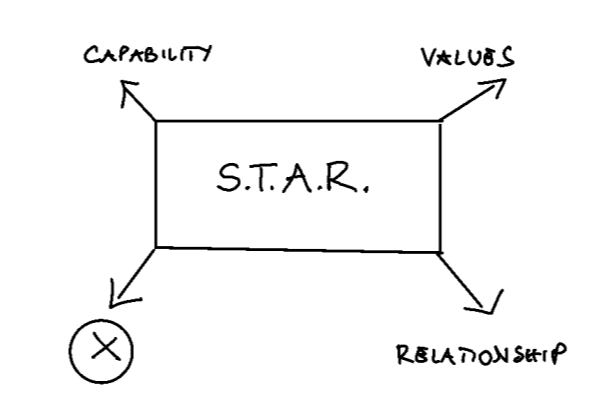
Capability (skills, experience, evidence)
Values + motivators (why they work vs what the job truly is)
Relationship (how they think, listen, respond under pressure)
X-factor (intuition as a signal, then validated with proof)
Here’s the structure I recommend (60 minutes):
0) Frame (2 min)
“Today isn’t about selling. It’s about verifying a match. If it’s a yes, it’s a strong yes. If it’s a no, it’s a clean no.”
1) Capability (20 min)
Two deep dives using STAR (see below).
2) Values + motivators (15 min)
Calibrate what drives them against the real environment.
3) Relationship (10 min)
Challenge + clarity + listening. Watch behavior, not confidence.
4) X-factor (5 min)
One unscripted question. Validate the gut.
5) Expectation alignment (8 min)
Mini-contract: success, standards, boundaries, ownership.
The tool inside capability: STAR (Situation - Task - Action - Result)
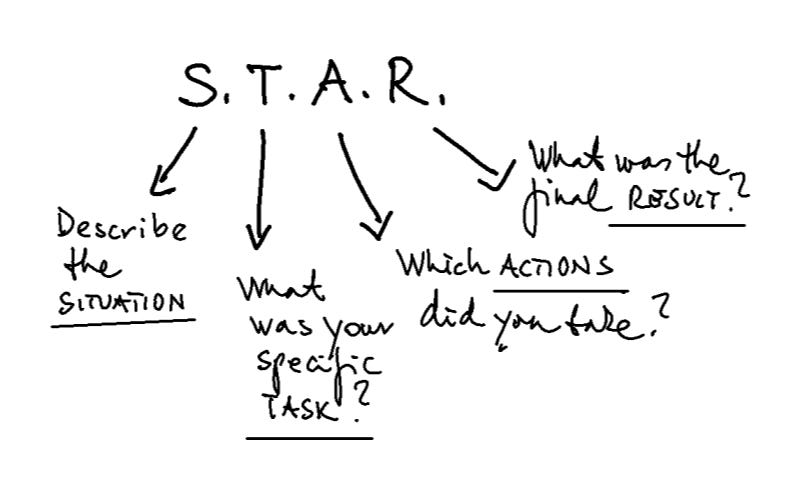
Your non-negotiable follow-ups:
“What was your specific responsibility?”
“What did you do first, second, third?”
“What did you measure?”
“What was the outcome?”
If you don’t get actions and results, you don’t have evidence.
You have storytelling.
Stop asking dumb questions
If you don’t know who you need, you ask questions that don’t measure anything:
“Where do you see yourself in 5 years?”
“What are your weaknesses?”
“Why should we hire you?”
“Are you a team player?”
These questions don’t reveal fit.
They reward performance.
Replace them with situational proof:
“Tell me about a time you had too many priorities. What did you STOP?”
“Tell me about a conflict you improved. What did you DO that changed it?”
“Tell me about a mistake that cost something. What changed after?”
Part 5 — The reflection tool: The Expectation Alignment Canvas
This is the part that prevents costly separations.
Run this in the interview. Write it down.
Success in 90 days is: ______
Success is measured by: ______
Quality standard means: ______
Speed standard means: ______
When priorities clash, we STOP: ______
This role does NOT include: ______
You own: ______
I own (leader/company): ______
Support that exists: ______
Support that does not exist: ______
We re-check alignment on: ______
If you skip this, you will “solve” the same confusion later with feedback.
And feedback is a weaker tool than alignment.
🔒ATTENTION: Unlock Your Practice
NAIL EVERY JOB INTERVIEW - The Employment Master Handbook That Could Save You Thousands Per Candidate
Free content gives you insight.
Paid gives you implementation.
Printable tools.
Scripts for hard moments.
A weekly operating system that makes silence visible — and solvable.
You can start on Monday. Not next quarter. Not “when things calm down.”
If this article described your culture too accurately, don’t just nod.
Upgrade.
Use the tools.
And rebuild trust before the future forces it.
What you get inside the handbook (printable 9 pages)
Hiring Clarity Card (1 page): define “who we need” before you meet anyone
60-minute MATCH Interview Script: minute-by-minute flow (no improvisation)
STAR Drill-Down Guide: follow-ups that force proof (actions + measurable results)
Motivation Calibration Sheet: values & drivers matched against the real job
Expectation Alignment Canvas: the mini-contract that prevents future conflict
Interview Scorecard (1–5): decision rules so “gut feeling” becomes disciplined
Dumb Question → Smart Replacement List: instant upgrades for weak interview culture
Red-Flag Checklist: when to stop the process (before the team pays)
Clean Rejection Script: protect the human, protect your brand
This is the system I wish every leader used before they started talking about “development.”
Paid subscribers also get:
Subscriber-only articles — deeper insights, frameworks, and case examples I don’t share publicly.
Full archive access — every past guide and tool unlocked.
Exclusive printable templates — copy, print, run in your next leadership meeting.
Direct community access — comment, ask questions, and get answers from me personally.
TODAY ONLY: SPECIAL OFFER — “LEADERS ARE READERS” (Get 20% off your first year)!
Because leaders are readers — and the best leaders invest in their growth.
TL;DR
The most expensive meeting in your company is one job interview done badly.
Turnover costs can approach nearly a trillion dollars for employers.
Role ambiguity is linked to worse outcomes.
Structured interviews predict performance better than unstructured ones.
Feedback can backfire; alignment prevents the need for “feedback firefighting.”
Use the MATCH model + STAR + Expectation Alignment Canvas.
Engage With This Idea
Comment: What’s your biggest hiring pain right now?
Wrong attitude?
Weak execution?
Culture mismatch?
People leaving too soon?
Comment one word. I’ll tell you which part of MATCH you’re skipping.
Share: Send this to a leader who still hires on “vibes” and exits on frustration.
Subscribe: If you want leadership that saves money and protects humans—stay close.
Final words
If you want to save time developing people, start nailing your job interviews.
Because hiring is not HR.
Hiring is leadership.
And leadership is responsibility for outcomes — and for humans.
So stop interviewing.
Start matching.
🔒PAID SECTION - NAIL EVERY JOB INTERVIEW — PRINTABLE HANDBOOK
What you get inside the handbook
1) HIRING CLARITY CARD (1 page)
Purpose: Define “who we need” before you meet anyone.
If you can’t fill this in, you’re not ready to interview.
ROLE TITLE: ___________________________
DATE: ____________ HIRING MANAGER: ___________________
A) Why this role exists (one sentence)
This role exists to:
B) The 90-day win (3 measurable outcomes)
C) Non-negotiables (behavior + values)
We will NOT compromise on:
D) Acceptable learning curve (what we can coach)
We CAN develop / teach:
E) Constraints (truth, not marketing)
Time / budget / tools / approvals / dependencies:
F) Ownership & boundaries
This role OWNS: ________________________________________________
This role DOES NOT own: _________________________________________
Gray zones (where people fail): ___________________________________
G) “Burden or support?” (CEO test)
In 6 months, this person should relieve us by:
If we can’t describe that, stop.
2) 60-MINUTE MATCH INTERVIEW SCRIPT (minute-by-minute)
Purpose: No improvisation. No theatre. Just evidence + alignment.
0–2 min — Frame
Say this:
“This isn’t about selling. It’s about verifying a match.
If it’s a yes, it’s a strong yes. If it’s a no, it’s a clean no.”
2–7 min — Candidate context (short)
“What’s the real reason for your change?”
“What would have to be true for you to stay long-term?”
7–27 min — MATCH #1: Capability (STAR deep dive #1)
Pick one critical job situation. Run STAR. Drill down until proof appears.
27–37 min — MATCH #1: Capability (STAR deep dive #2)
Second situation. Same drill-down. No repeating stories.
37–47 min — MATCH #2: Motivation & values fit
“What gives you energy even when it’s hard?”
“What kills your motivation?”
“What’s non-negotiable for you?”
Then you speak:
“Here’s the real environment. Here’s what this role is. Here’s what it is not.”
47–55 min — MATCH #3: Relationship under pressure
Choose one:
“Tell me about a conflict you improved. What did you do?”
“What’s a belief you changed your mind about in the last two years?”
Observe: clarity, listening, ownership, emotional control.
55–58 min — MATCH #4: X-factor (intuition → validate)
Unscripted:
“If after 30 days you realize the role isn’t what you expected, what do you do?”
58–60 min — Close + next steps
“Anything you expected to be asked but wasn’t?”
“Next step is X by (date).”
3) STAR DRILL-DOWN GUIDE (proof, not performance)
Purpose: Force evidence. Stop storytelling.
STAR structure
S — Situation: What was happening? What were the constraints?
T — Task: What was your responsibility?
A — Action: What did you do first/second/third?
R — Result: What changed? How was it measured?
Non-negotiable follow-ups (use until you get specifics)
“What was YOUR part vs the team’s part?”
“What did you do in the first 24 hours?”
“What did you decide to STOP doing?”
“What trade-off did you make?”
“What did you measure weekly?”
“What did you learn and change after?”
Red flag sentence
If you hear too much “we” and too little “I,” say:
“Pause. I need your specific actions, not the team story.”
4) MOTIVATION CALIBRATION SHEET (values & drivers vs the real job)
Purpose: Avoid culture mismatch and “motivation disappointment.”
Candidate name: ______________________ Role: ______________________
A) What drives you (rank top 3)
☐ autonomy ☐ mastery ☐ purpose ☐ recognition ☐ stability
☐ growth ☐ impact ☐ teamwork ☐ challenge ☐ creativity
Other: ______________________
Top 3:
____________________ 2) ____________________ 3) ____________________
B) What kills your motivation (top 3)
____________________ 2) ____________________ 3) ____________________
C) Non-negotiables (truth)
“I will not compromise on…”
____________________ 2) ____________________ 3) ____________________
D) Reality check (you answer honestly)
This role is: _________________________________________________
This role is NOT: _____________________________________________
This environment will frustrate you if: ___________________________
E) Fit decision
☐ Strong fit ☐ Risk (needs alignment) ☐ Misfit
Risk notes: _______________________________________________________
5) EXPECTATION ALIGNMENT CANVAS (mini-contract)
Purpose: Prevent future conflict by aligning before day one.
Role: ____________________ Candidate: ____________________
Date: ____________
Success in 90 days looks like:
Top 3 outcomes:
Quality standard means: ____________________________________
Speed standard means: _____________________________________
When priorities clash, we STOP: ______________________________
This role does NOT include: _________________________________
You own: _________________________________________________
Leader/company owns: ______________________________________
Support that exists: ________________________________________
Support that does not exist: ________________________________
We re-check alignment on (date/cadence): _____________________
Signature (mental): “We agree this is the game we’re playing.”
6) INTERVIEW SCORECARD (1–5)
Purpose: Turn “gut feeling” into disciplined decision-making.
Candidate: ____________________ Role: ____________________
A) Capability (Evidence) — 1–5
Clear actions (not stories) ___
Measurable results ___
Handles trade-offs / priorities ___
Average: ___
B) Motivation & values fit — 1–5
Drivers match reality ___
Non-negotiables compatible ___
Honest about constraints ___
Average: ___
C) Relationship under pressure — 1–5
Listens & clarifies ___
Owns mistakes ___
Calm, direct communication ___
Average: ___
D) X-factor (signal + validation) — 1–5
Authenticity ___
No hidden “performance mask” ___
Intuition aligns with evidence ___
Average: ___
Decision rule
Strong Yes: no category below 4
Yes with conditions: one category at 3 (write conditions)
No: any category ≤2 or multiple 3s
Decision: ☐ Strong Yes ☐ Yes with conditions ☐ No
Conditions (if any): _____________________________________________
7) DUMB QUESTION → SMART REPLACEMENT LIST
Purpose: Upgrade interview culture instantly.
“Where do you see yourself in 5 years?”
→ “What kind of work would make you proud after 12 months—and why?”“What are your weaknesses?”
→ “What feedback do you hear repeatedly—and what did you change?”“Why should we hire you?”
→ “What outcomes can you reliably deliver in the first 90 days?”“Are you a team player?”
→ “Tell me about a time you chose the team over your ego.”“How do you handle stress?”
→ “Describe your worst week. What did you do daily to stay effective?”“What motivates you?”
→ “What conditions make you do your best work—and what conditions kill it?”“Tell me about yourself.”
→ “Give me the 3 experiences that shaped how you work—then we’ll test them with STAR.”
8) RED-FLAG CHECKLIST (stop before the team pays)
Purpose: Exit early when evidence says “no.”
Stop the process if you see 3 or more:
☐ No concrete actions in STAR (only opinions)
☐ Blames others; avoids ownership
☐ Can’t quantify outcomes or learning
☐ Rehearsed “perfect answers” with zero specifics
☐ Avoids conflict questions or becomes defensive
☐ Motivators contradict job reality (and they deny it)
☐ No curiosity: asks nothing meaningful
☐ Ethics gaps: “whatever it takes” energy
☐ Pattern of short tenures with external blame
☐ Disrespectful tone about former colleagues
If you ignore red flags, you’re choosing to pay later.
9) CLEAN REJECTION SCRIPT (protect the human, protect your brand)
Purpose: Reduce damage. Preserve dignity. Keep your reputation clean.
Subject: Update on your application
Hi [Name],
Thank you for the time and trust you invested in our process.
After reviewing the match between the role expectations and your profile, we’ve decided not to proceed.
This decision is about fit — not worth.
If you’d like, I can share one clear reason that may help your next opportunity.
I respect your time and I wish you a strong next step.
Best,
[Name]
Optional one-line feedback (only if asked):
“The biggest gap was ________ relative to what the role requires in the first 90 days.”
REMEMBER: The most expensive word in hiring is “I thought.”
Pozdravljeni,
Lahko prejmem PRINTABLE HANDBOOK v PDF obliki ali Word?
Hvala.
Lp