

Your calendar is not proof of your productivity.
It is proof of your priorities.
Gregor Kosi
It tells the truth.
Not about what you say you value.
But about what you tolerate.
Every meeting you accepted.
Every task you squeezed in.
Every “quick call” you said yes to.
Every urgent request you allowed to become your problem.
Every promise you made because you had energy in the morning and forgot you would still have a body in the evening.
I learned this the hard way as a CEO.
You can be extremely busy and still move nothing important forward.
You can run from meeting to meeting.
Answer every message.
Solve every fire.
Carry every urgent request.
Protect everyone from consequences.
And still end the day with the most dangerous feeling in leadership:
Exhausted, but not effective.
That is the trap.
Most people do not have a productivity problem.
They have a subtraction problem.
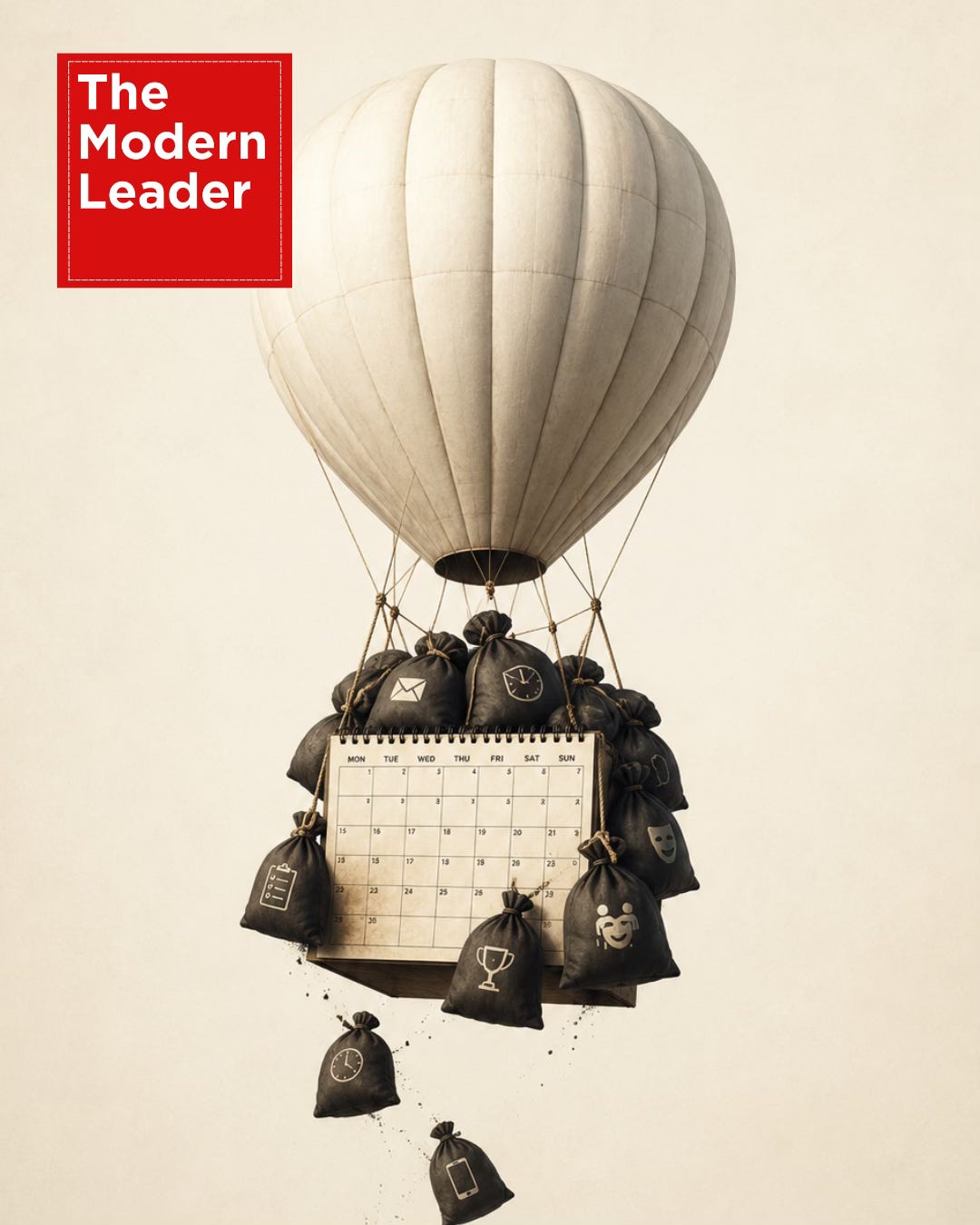
They keep adding gas to the hot-air balloon while the basket is still full of stones.
Another app.
Another system.
Another planner.
Another morning routine.
Another time-blocking technique.
Another promise to “finally get disciplined.”
But the balloon does not rise.
Because the problem was never the gas.
It was the weight.
And this is where most productivity advice fails.
It teaches you how to organize overload.
It rarely teaches you how to remove it.
So you become better at managing the wrong life.
You color-code your exhaustion.
You optimize your stress.
You schedule your own disappearance.
You call it ambition.
But productivity is not about getting more done.
Productivity is about creating a day that does not betray the life you claim to want.
Because one day is not just one day.
One day is a sample of your life.
And if your average day drains you, fragments you, and sends you home empty, then stop calling it “a busy season.”
That is your system.
And systems do not lie.
They produce exactly what they are designed to produce.
PART 1 — THE GREAT PARADOX: YOU ARE NOT TOO BUSY. YOU ARE TOO AVAILABLE.
The modern professional has confused availability with value.
You answer fast.
You attend everything.
You solve problems that are not yours.
You accept work before asking what must disappear.
You fill every gap because empty space makes you feel guilty.
And then you call yourself responsible.
But much of what we call responsibility is often fear wearing a suit.
Fear of disappointing people.
Fear of being seen as difficult.
Fear of not being needed.
Fear of silence.
Fear of your own life when the noise stops.
I have seen this in leaders for years.
The most dangerous leaders are often not lazy.
They are overcommitted.
Overavailable.
Overinvolved.
And secretly proud of it.
They confuse being needed with being effective.
But being needed is not leadership.
Sometimes it is just an addiction to importance.
A full calendar is often fear with better design.
At some point, I stopped asking:
“How much more can I handle?”
I started asking:
“What am I carrying that should never have been mine?”
That question changed everything.
Because the strongest productivity hack is not another to-do list.
It is a not-to-do list.
Before you decide what you will do, decide what you will stop doing.
Before you add goals, remove leaks.
Before you optimize your day, ask which parts of your day should not exist anymore.
A not-to-do list is not laziness.
It is leadership.
It says:
This is mine.
That is not mine.
This deserves energy.
That deserves deletion.
This creates progress.
That only creates movement.
Michael Porter captured the strategic truth perfectly:
The essence of strategy is choosing what not to do.
That sentence belongs in every boardroom.
But it also belongs in your calendar.
Because if you do not choose what not to do, your day will choose for you.
And it will not choose your future.
It will choose the loudest person.
The latest email.
The most nervous manager.
The least mature system.
That is not productivity.
That is surrender.
PART 2 — THE HIDDEN COST: YOUR ENERGY IS NOT INFINITE.
Most people still manage time.
The best leaders manage energy.
Time is the container.
Energy is the content.
You can have three free hours and produce nothing important because your mind is gone, your body is tense, and your nervous system is still sitting in the previous meeting.
You can have a full day and still have no real focus.
You can have a free evening and still be unavailable to your family.
That is why productivity is not only a time-management problem.
It is a maturity problem.
Mature people stop pretending they have infinite capacity.
Imagine you wake up with 100 marbles of energy.
Not time.
Energy.
Focus.
Patience.
Decision quality.
Creativity.
Presence.
Emotional capacity.
Now divide those 100 marbles across 10 priorities.
Ten meetings.
Ten topics.
Ten decisions.
Ten interruptions.
Ten emotional switches.
Ten unfinished loops.
On paper, you had a productive day.
In reality, each priority received 10 marbles.
Ten marbles of focus.
Ten marbles of depth.
Ten marbles of leadership.
That is not productivity.
That is dilution.
Now imagine a different day.
You choose only two major events.
A strategic decision.
A difficult conversation.
A writing block.
A client session.
A leadership meeting that actually matters.
A family evening that deserves your presence.
Now each event receives 50 marbles.
That is not a small difference.
That is a different human being showing up.
The first version of you arrives fragmented.
The second arrives powerful.
Focus is not attention.
Focus is the refusal to divide your life into pieces too small to matter.
I have never seen a strong leader fail because he had too little time.
I have seen many fail because they gave their best energy to the wrong battlefield.
They spent premium energy on low-value noise.
They used their sharpest mind for other people’s poor planning.
They burned their strongest hours in meetings that should never have happened.
They came home exhausted and called it commitment.
But your body knows the truth.
Your body is not your enemy.
It is the first honest member of your leadership team.
And if your body needs to collapse before your calendar changes, that is not ambition.
That is immaturity.
PART 3 — WHERE IT SHOWS UP IN REAL LIFE
You see this everywhere.
The CEO says:
“I just need to push through this quarter.”
But every quarter becomes this quarter.
The manager says:
“I’ll just solve this one more thing for the team.”
But the team never learns ownership because the manager keeps lending them his nervous system.
The entrepreneur says:
“I’ll rest after launch.”
But after launch comes delivery.
After delivery comes sales.
After sales comes hiring.
After hiring come quality problems.
After quality problems comes restructuring.
After restructuring comes the next launch.
Rest becomes a fantasy after the next milestone.
It never comes.
Because the person who cannot protect energy before success will not magically protect it after success.
Success does not cure overfunctioning.
It amplifies it.
This is especially true for high performers with two dangerous inner drivers:
Be perfect.
Work hard.
They do not only work.
They prove.
They prove they are worthy.
They prove they are useful.
They prove they can handle pressure.
They prove they are not weak.
They prove they deserve approval.
Many high performers are not working.
They are negotiating for love with invisible parents.
They learned it early.
Be good.
Be useful.
Be reliable.
Be strong.
Do not complain.
Do not disappoint.
Carry more.
As children, many of us bought affection with performance.
Then later, as adults, we repeat the same pattern.
Only now we call it professionalism.
But the body knows the difference between meaningful effort and emotional self-betrayal.
Your body does not care about your title.
Your body does not care about your KPI dashboard.
Your body does not care that you are important.
Your body does not care that people depend on you.
Your body does not care that you are “just finishing one more thing.”
Your body keeps the score.
And at some point, it stops negotiating.
Fatigue is not always a sign that you did too much.
Sometimes fatigue is a sign that you lack a capability.
And one of the most underestimated capabilities in modern leadership is this:
The ability not to compress too much life into too little time.
That is not weakness.
That is wisdom.
That is not low ambition.
That is high maturity.
PART 4 — THE DRUCKER CUT: STOP BEING EFFICIENT AT THE WRONG THINGS.
Peter Drucker understood something most productivity experts still avoid.
The first duty of a leader is not to become more efficient.
The first duty is to stop doing what should not be done at all.
Efficiency asks:
“How can I do this better?”
Effectiveness asks:
“Should this even be done?”
That distinction can save your calendar.
And your life.
Because nothing is more dangerous than becoming faster at the wrong things.
You can answer emails efficiently.
You can attend useless meetings efficiently.
You can rescue others efficiently.
You can prepare perfect reports nobody needs efficiently.
You can say yes efficiently.
You can burn out efficiently.
This is the tragedy of modern productivity:
Most people are not ineffective because they are lazy.
They are ineffective because they are disciplined in the wrong direction.
They are extremely committed to work that should have been deleted.
Efficiency is doing things right.
Effectiveness is doing the right things.
Maturity is deleting the rest.
This is where productivity must meet strategy.
Not motivation.
Strategy.
A vision tells you where your life is going.
A strategy tells you what you must refuse so the vision has a chance.
Without vision, everything looks equally important.
Without strategy, everything looks like an opportunity.
Without a not-to-do list, your calendar becomes a public park.
Anyone can enter.
That is why the real productivity question is not:
“How do I get more done?”
The real question is:
“What must disappear so my best work can finally breathe?”
Some people do not need another productivity method.
They need deletion.
They need to delete the meeting that produces no decision.
Delete the task that belongs to someone else.
Delete the perfection that adds no value.
Delete the rescue that prevents growth.
Delete the commitment that only exists because they were afraid to disappoint someone.
You do not need another productivity system.
You need the courage to disappoint the wrong people.
That is where freedom begins.
PART 5 — THE MODEL: THE 5 MOST POWERFUL PRODUCTIVITY HACKS
These are not hacks for doing more.
They are hacks for becoming lighter, clearer, and more effective.
They are not time tricks.
They are maturity practices.
1. Build a NOT-TO-DO LIST before your to-do list.
This is the master hack.
Before you ask:
“What do I need to do today?”
Ask:
“What must I stop doing today?”
Write three things:
What will I not give my energy to?
What will I not solve for others?
Which meeting, task, or conversation does not deserve my focus?
A to-do list creates movement.
A not-to-do list creates direction.
And direction beats movement.
Your not-to-do list may include:
meetings without decisions,
tasks that belong to others,
perfectionism beyond usefulness,
repeated emotional rescuing,
urgent but unimportant requests,
starting the day with messages,
saying yes before checking capacity,
fixing what someone else must learn to own.
A not-to-do list is not a list of laziness.
It is a list of leadership boundaries.
It protects the future from the noise of the present.
2. Stop time-blocking everything. Design two real events per day.
Time-blocking can help.
But it can also become a beautiful lie.
You create clean rectangles in your calendar and pretend your body is a machine.
It is not.
You do not live in blocks.
You live in events.
A hard conversation is not a 30-minute block.
It costs energy before.
Focus during.
Recovery after.
A board meeting is not one hour.
A workshop is not half a day.
A strategic decision is not a calendar slot.
It is an event.
So use this rule:
Maximum two real events per day.
Everything else is maintenance.
Emails.
Admin.
Short calls.
Small decisions.
Follow-ups.
Your best energy should go to no more than two real priorities.
Because if everything is important, nothing receives your full self.
And if nothing receives your full self, do not be surprised when nothing meaningful moves.
3. Use the 100-Marble Energy Rule.
Every morning, imagine you have 100 marbles.
Each marble is energy.
Now allocate them before the day steals them.
Ask:
Which two things deserve 50 marbles each?
Which task is stealing marbles without creating value?
Which meeting costs more energy than it returns?
Which commitment looks small but creates emotional residue?
Which “small yes” will become a big no to my body?
This changes the question.
Not:
“How much time do I have?”
But:
“Where will my best energy create the highest return?”
Time is the container.
Energy is the content.
Most people do not waste time first.
They waste energy first.
4. Treat one day as a sample of your whole life.
Look at yesterday.
Not your goals.
Yesterday.
Would you want that day repeated for the next ten years?
If not, stop calling it normal.
Your future is not hidden in your five-year plan.
It is hiding in your average Tuesday.
If yesterday contained no recovery, your life is becoming depletion.
If yesterday contained no deep work, your work is becoming reaction.
If yesterday contained no presence, your relationships are becoming logistics.
If yesterday contained no courage, your identity is becoming compromise.
Do not say:
“Just this week.”
“After this project.”
“When things calm down.”
Things do not calm down by themselves.
They calm down when you stop feeding chaos with your compliance.
If something in your day does not belong in your life, remove it now.
One meeting.
One fake urgency.
One unnecessary perfection.
One rescued responsibility.
One promise made from guilt.
Small removals create big freedom.
5. Master the two types of NO.
There are two kinds of no.
The first is the No of Omission.
This is the invisible no.
Every time you say yes to something, you silently say no to something else.
Yes to another meeting.
No to deep work.
Yes to evening emails.
No to recovery.
Yes to rescuing someone.
No to their responsibility.
Yes to perfectionism.
No to speed.
Yes to overwork.
No to your body.
This is the no most people do not see.
And because they do not see it, they keep sacrificing the most important things without ever making a conscious decision.
The second is the No of Commission.
This is the conscious no.
It asks:
“What must I deliberately refuse so my real goal has a chance?”
This is strategy.
Use this sentence:
“If this becomes a priority, we need to decide what stops.”
That sentence should live in every leadership team.
Because every yes has a cost.
The mature question is not:
“Can I fit this in?”
The mature question is:
“What must disappear if I say yes?”
That is not negativity.
That is strategy.
That is adulthood.
That is leadership.
THE FREE TOOL: THE BALLOON PRODUCTIVITY AUDIT
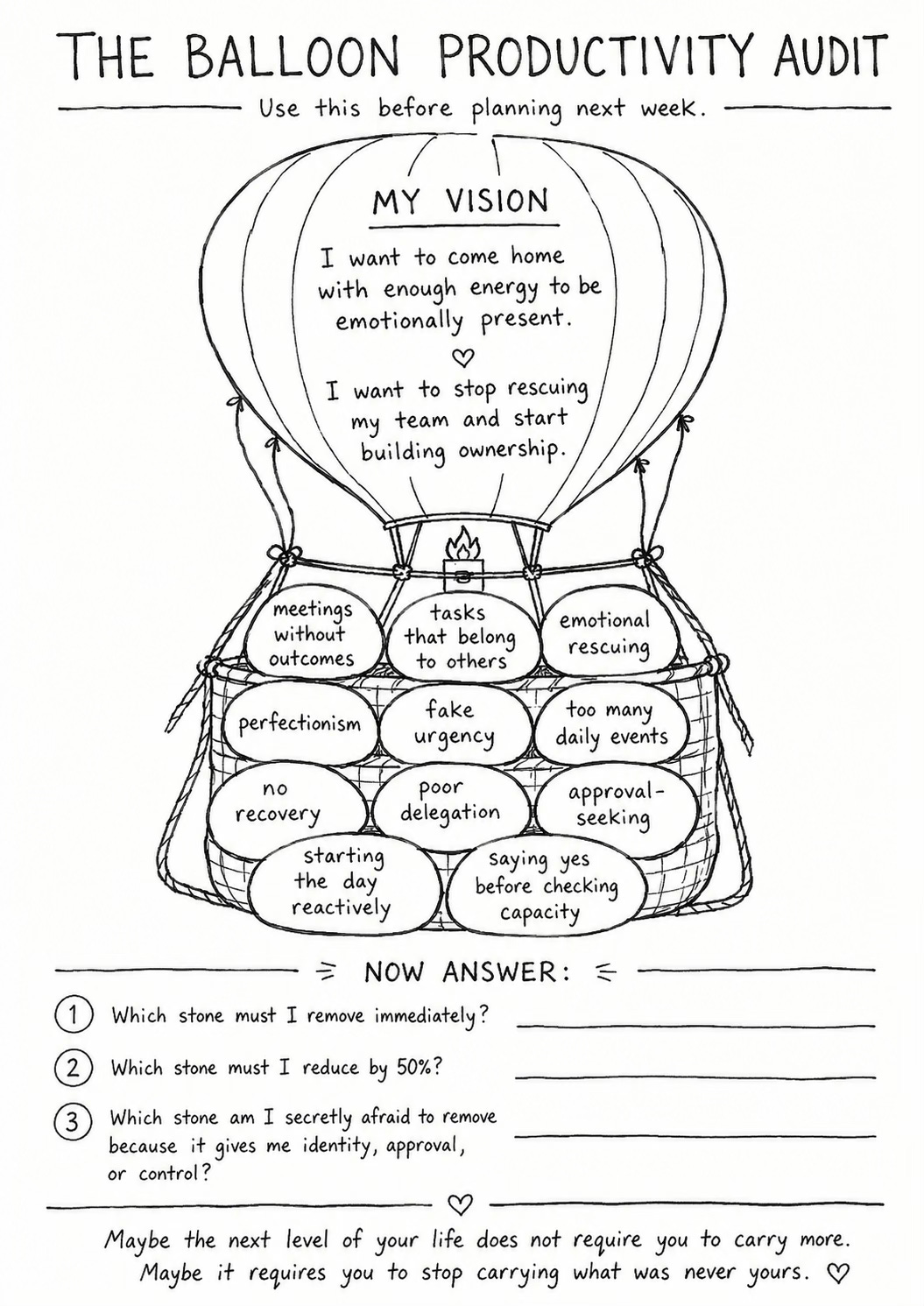
Use this before planning next week.
Draw a hot-air balloon.
At the top, write:
MY VISION
What is the life, leadership, health, relationship, or business direction I claim to want?
Be specific.
Not:
“I want more balance.”
Write:
“I want to come home with enough energy to be emotionally present.”
Not:
“I want better leadership.”
Write:
“I want to stop rescuing my team and start building ownership.”
Now draw the basket.
Inside the basket, write the stones.
These are your energy weights.
Examples:
meetings without outcomes,
tasks that belong to others,
emotional rescuing,
perfectionism,
fake urgency,
too many daily events,
no recovery,
poor delegation,
approval-seeking,
starting the day reactively,
saying yes before checking capacity.
Now answer:
Which stone must I remove immediately?
Which stone must I reduce by 50%?
Which stone am I secretly afraid to remove because it gives me identity, approval, or control?
The third question matters most.
Because many productivity problems are not logistical.
They are emotional.
You do not keep them because they work.
You keep them because they protect an old identity.
The hero.
The perfect one.
The strong one.
The reliable one.
The needed one.
But maybe the next level of your life does not require you to carry more.
Maybe it requires you to stop carrying what was never yours.
TL;DR
Productivity starts with subtraction, not addition.
The strongest productivity hack is the not-to-do list.
A full calendar is often fear with better design.
Stop designing your life around time blocks. Design it around two real events per day.
You do not have unlimited focus. Use the 100-Marble Energy Rule.
One day is a sample of your whole life.
Every yes contains a hidden no.
Strategy means choosing what not to do.
Efficiency is doing things right. Effectiveness is doing the right things. Maturity is deleting the rest.
If you come home empty every day, your calendar is not full. It is stealing your life.
One underestimated capability is the ability not to compress too much life into too little time.
Productivity is not only a time-management problem. It is a maturity problem.
FINAL WORDS
The world will always offer you more.
More tasks.
More meetings.
More opportunities.
More noise.
More urgency.
More chances to prove yourself.
But a meaningful life is not built by accepting more.
It is built by protecting what matters.
The most productive people are not the ones who carry the most stones.
They are the ones who stop calling stones responsibility.
First remove the stones.
Then the balloon rises.
Not because you pushed harder.
Because you finally stopped dragging what was never meant to fly.
ENGAGE WITH THIS IDEA
Leadership Mirror Question:
What is one thing you must stop doing this week if your life is going to become lighter, clearer, and more effective?
Comment
Write one item from your not-to-do list.
Share
Send this to one person who is not lazy — just overloaded with the wrong things.
Subscribe
Join The Modern Leader for practical, no-fluff leadership tools that help you build a life and business that do not depend on your exhaustion.
ATTENTION: UNLOCK YOUR PRACTICE
Insight will not change your calendar.
A system will.
This week, do not try to become more disciplined.
Become more selective.
Because if you do not redesign your day, your old identity will redesign it for you.
The perfectionist will add more.
The rescuer will say yes.
The hard worker will push through.
The approval-seeker will overdeliver.
The strategist will disappear.
And another week will look exactly like the last one.
Only with better excuses.
In the paid section, build your personal Productivity Subtraction System™:
Not-To-Do List Builder
Two-Event Day Planner
100-Marble Energy Sheet
Two Types of No Scripts
Balloon Productivity Audit
Weekly Calendar Reset
Perfectionist Override Protocol
Drucker Deletion Review
Use it before Monday.
Not when things calm down.
Things calm down when you stop feeding them your life.
Paid subscribers also get:
Subscriber-only articles — deeper frameworks, leadership cases, and tools I do not share publicly.
Full archive access — every past guide, playbook, and operating system unlocked.
Exclusive printable templates — copy, print, and use in your next leadership conversation.
Recommended reading — curated books that deepen the practice.
Direct community access — comment, ask questions, and get answers from me personally.
Upgrade to Paid & Get Your Personal Productivity Subtraction System™
It’s your daily companion to move from theory to transformation.
SPECIAL OFFER: “LEADERS ARE READERS”
Get 20% off your first year.
Because leaders are readers — and the best leaders invest in their growth.
PAID SECTION — THE PRODUCTIVITY SUBTRACTION SYSTEM™
1. The Not-To-Do List Builder
Before planning the week, complete:
This week, I will not:
Attend meetings without:
a clear purpose,
a decision,
an owner,
a next step.
Solve problems that:
belong to someone else,
repeat because nobody learned,
are emotionally urgent but strategically irrelevant.
Spend premium energy on:
low-value admin,
perfectionism,
reactive communication,
unclear priorities,
drama without responsibility.
Say yes before asking:
What does this replace?
What must disappear?
What is the cost?
Does this serve the vision?
2. The Two-Event Day Planner
Each morning, write:
My two real events today are:
___________________________________________________________________
___________________________________________________________________
For each event, define:
Desired outcome:
Energy required:
Preparation needed:
Recovery needed:
Definition of done:
Everything else is:
maintenance,
delegation,
batching,
deletion,
later.
If you have more than two real events, ask:
Which one is fake urgency?
Which one can move?
Which one belongs to someone else?
Which one is on my calendar because I was afraid to say no?
3. The 100-Marble Energy Sheet
Start with 100 marbles.
Allocate them:
Deep work: ___
Leadership conversations: ___
Meetings: ___
Admin: ___
Health: ___
Family/presence: ___
Recovery: ___
Unexpected demands: ___
If your total is 160, your plan is not ambitious.
It is dishonest.
Redesign.
4. The Two Types of No Script
No of Omission
Before every yes, ask:
“If I say yes to this, what am I silently saying no to?”
Possible hidden no:
no to deep work,
no to recovery,
no to health,
no to family,
no to someone else’s ownership,
no to strategic thinking,
no to peace.
No of Commission
Ask:
“What must I consciously refuse so my real goal has a chance?”
Use these sentences:
“I cannot commit to this without removing something else.”
“This is important, but it is not the best use of my energy this week.”
“I can support this with advice, but I will not take ownership of it.”
“If this becomes a priority, we need to decide what stops.”
5. The Weekly Calendar Reset
Every Friday, ask:
What gave me energy this week?
What stole energy without creating value?
Where did I confuse urgency with importance?
What did I do because I was afraid to disappoint someone?
Which meeting should not happen again?
Which task should be delegated, deleted, or simplified?
Where did I overperform to earn approval?
What must not enter next week?
Do not plan next week before answering these questions.
Otherwise, you will carry old weight into a new calendar.
6. The Drucker Deletion Review
Use this once a month.
Look at your calendar, team routines, reporting rhythm, and personal commitments.
Then ask:
What are we doing only because we have always done it?
Which meeting creates activity but no decision?
Which report is produced but not used?
Which task is done well but no longer matters?
Which process makes us feel organized but not more effective?
Which responsibility should return to its real owner?
Which “yes” is moving us away from the strategy?
What should not be done at all?
Then delete one thing immediately.
Not improve.
Delete.
Because the highest form of productivity is not doing unnecessary work faster.
It is not doing it at all.
LEADERS ARE READERS
Every week, I recommend one book that helps you think deeper, lead cleaner, and stop repeating old patterns under the name of experience.
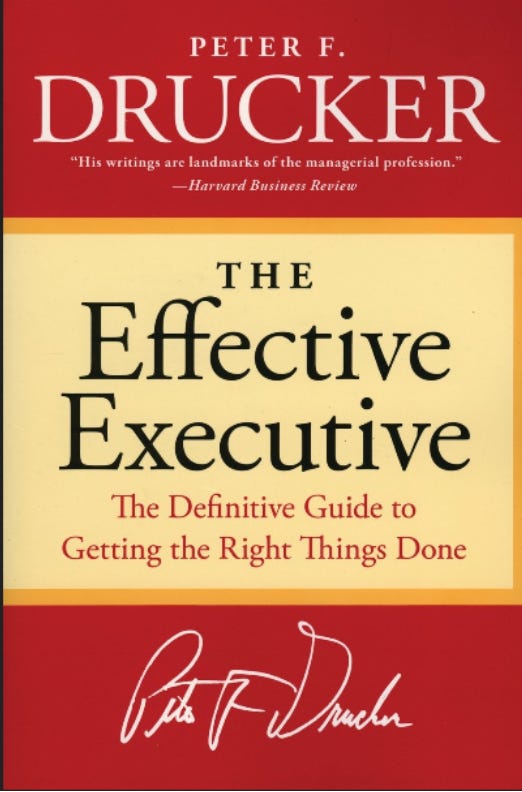
The Effective Executive
Peter F. Drucker
Most leaders think productivity means doing more in less time.
Wrong.
That is efficiency.
And efficiency can become dangerous when it is applied to the wrong things.
Drucker’s book matters because it forces a harder question:
Not “How can I do this faster?”
But:
“Should this be done at all?”
That question is the beginning of real leadership.
Because the most dangerous person in any organization is not always the lazy person.
Sometimes it is the disciplined person who is extremely committed to work that no longer matters.
5 shifts from the book
Know where your time actually goes.
Your calendar does not lie. It reveals your real priorities.Focus on contribution, not activity.
Being busy is not the same as creating value.Do first things first.
If everything matters, nothing gets your full strength.Build on strengths.
Stop spending your best energy compensating for every weakness.Make effectiveness a habit.
Effectiveness is not personality. It is a discipline.
The book is not about becoming busier.
It is about becoming harder to distract from what matters.
And that is the real work of leadership.
Until next week — remember:
Efficiency is doing things right.
Effectiveness is doing the right things.
Maturity is deleting the rest.
You got this!
Gregor Kosi
The CEO Coach