


If you need to see people working to believe they are working, you are not managing performance. You are managing presence.
Gregor Kosi
When I was CEO of Lidl Slovenia, we made a bold decision: from 2025 onward, employees whose roles allowed it would be able to choose whether to work from the office or from home.
The decision was not intended as a temporary arrangement, an occasional Friday privilege or a reward for selected employees. It was meant to become a permanent part of a more flexible and employee-friendly working environment.
I left the company in 2022, before the decision was due to take effect. As with many bold leadership decisions, designing the policy was only the first test. Having the courage to implement it was the real one.
Today, as the founder of GREAT Leadership Solutions, I regularly speak with owners, CEOs and leadership teams about flexible working models. These conversations are usually open and constructive until the subject turns to working from home.
At that point, opportunity is often replaced by concern.
The most common concern is productivity—or, more precisely, the fear that productivity will decline when employees are no longer physically visible.
What if they walk the dog during working hours?
What if they collect their children from school, go to the bank, take a longer lunch break or watch Netflix?
These questions may appear to be about productivity, but they usually reveal something else: a lack of trust and an unclear understanding of how performance should be managed.
The relevant question is not what employees might do when their manager cannot see them.
It is whether they will deliver the result that was agreed.
And that is where the real leadership conversation begins.
PART 1: PRESENCE IS NOT PERFORMANCE
For decades, many organisations have treated presence as evidence of performance.
An employee arrives in the morning, records their attendance, sits at a desk, attends meetings, answers messages and leaves eight hours later.
A productive day has apparently been completed.
But physical presence proves only that a person was physically present. It tells us very little about the quality, importance or value of the work they actually produced.
If your primary measure of performance is the time between someone clocking in and clocking out, working from home is not your biggest problem.
Your organisation does not know how to define, assign and measure results.
An employee can spend eight hours in the office without completing a single meaningful priority. Another can work from home and produce the same—or greater—value during four hours of focused work.
The first employee may be easier to supervise because their presence is visible. The second requires the leader to define expectations, agree on outcomes and manage performance more deliberately.
That is the difference between supervision and leadership.
Supervision asks whether the employee is online, available and sitting at their desk.
Leadership asks what must be achieved, why it matters, how success will be measured, what support is required and when progress will be reviewed.
Working from home does not make leadership impossible. It removes many of the visual signals that allow poor leadership to remain hidden.
PART 2: THE OFFICE DOES NOT ELIMINATE WASTED TIME
If we believe that people are productive throughout an entire eight-hour office day, we still have some room for greater honesty.
A widely cited survey of 1,989 UK office workers found that respondents considered themselves productive for an average of only two hours and 53 minutes per day. Because the findings are based on self-reported behaviour, they should not be treated as an exact scientific measure of every workplace. They do, however, expose the weakness of equating presence with productivity. (vouchercloud)
According to the survey, substantial parts of the working day were spent on activities such as:
reading news websites: 1 hour and 5 minutes;
checking social media: 44 minutes;
talking to colleagues about matters unrelated to work: 40 minutes;
looking for another job: 26 minutes;
smoking breaks: 23 minutes;
private telephone calls: 18 minutes;
preparing coffee and other hot drinks: 17 minutes;
sending private messages: 14 minutes;
eating snacks: 8 minutes;
preparing food in the office: 7 minutes.
The point is not that employees are lazy.
Human beings are not machines, and no one can perform highly focused intellectual work continuously for eight hours. We need breaks, informal conversations, movement and periods of lower cognitive intensity.
The real lesson is more uncomfortable:
The office does not eliminate wasted time. It simply makes it easier to confuse presence with productivity.
We tolerate an employee talking to a colleague in the corridor because we can see them. Yet we become suspicious when the same employee walks their dog while working from home.
Neither activity is automatically productive or unproductive. Its significance depends on whether the employee fulfils the responsibility entrusted to them.
Of course, this does not mean that time is irrelevant. Deadlines, availability, responsiveness and collaboration matter.
But these are conditions that support performance. They are not performance itself.
Productivity is the ability to achieve a desired result through the effective use of time, energy and other resources.
It is not the ability to look occupied for eight hours.
PART 3: REMOTE WORK REVEALS THE QUALITY OF YOUR LEADERSHIP SYSTEM
In an office, unclear expectations can remain hidden for years.
The leader sees people at their desks and assumes that work is progressing. Employees answer messages, attend meetings and remain visibly active, while no one can clearly explain the most important results that must be achieved during the week.
When work moves outside the office, the visual comfort of control disappears.
The leader can no longer rely on observation and must replace it with a more disciplined system built around:
clear expectations;
defined outcomes;
agreed deadlines;
measurable standards;
regular communication;
timely feedback;
individual accountability.
This is why remote work feels uncomfortable to some managers. It is not necessarily because people produce worse results at home, but because remote work demands greater precision from leaders.
A six-month randomised controlled trial involving 1,612 employees at Trip.com found that working from home two days per week improved job satisfaction and reduced resignation rates by one-third without damaging performance ratings or promotion prospects. (Nature)
The finding does not prove that every employee should work remotely or that every job can be performed from home. It does, however, challenge the assumption that hybrid work automatically reduces performance.
By 2026, hybrid work is no longer a temporary experiment. Gallup reports that six in ten employees in remote-capable roles prefer a hybrid arrangement, approximately one-third prefer fully remote work, and fewer than one in ten want to work exclusively on-site. Hybrid work also remains the dominant model among remote-capable employees. (Gallup.com)
Companies are free to ignore those expectations, but they should understand that flexibility has become part of the value an employer offers.
The best employees do not evaluate an employer solely by salary. They also assess the quality of leadership, their level of autonomy, the purpose of office attendance and their ability to organise work around the reality of their lives.
That does not mean employees should be free to do whatever they want.
It means organisations must become much clearer about what they actually require.
PART 4: THE RIGHT QUESTION IS NOT “HOME OR OFFICE?”
The debate is frequently presented as a choice between two opposing models: remote work or office work, freedom or control, trust or performance.
That is a false choice.
The right question is not:
Where should everyone work?
It is:
Where can this particular work be performed most effectively?
For focused individual work, home may provide the better environment. For a strategy workshop, the onboarding of a new colleague, a difficult conversation or a complex creative challenge, physical presence may produce more value.
Some work requires concentration, while other work requires rapid coordination, human closeness, spontaneous exchange or shared emotional energy.
The mistake is forcing every form of work into the same environment.
A mature organisation does not decide where people work solely according to the personal preference of its CEO. It connects the workplace to the purpose of the work.
People should not travel to an office only to sit alone with headphones and spend the day in virtual meetings. That does not strengthen culture or collaboration.
It merely increases traffic.
At the same time, fully remote work has real limitations. Gallup found that fully remote employees reported higher engagement than other groups, yet were less likely than hybrid employees to describe themselves as thriving in their overall lives. They also reported higher levels of loneliness and other forms of emotional strain. (Gallup.com)
Remote work is therefore not a miracle solution.
Neither is the office.
Both can work, and both can fail. The difference lies in the quality of the system built around them.
PART 5: TRUST WITHOUT ACCOUNTABILITY IS NAIVETY
When I speak about trust, some leaders hear a message I have never given:
Stop checking performance.
Allow people to do whatever they want.
Accept missed deadlines.
Lower your standards.
That is not trust.
That is avoidance.
Trust does not eliminate accountability. It makes meaningful accountability possible.
An employee should have the autonomy to organise their work, but that autonomy must exist within clearly defined expectations.
The organisation must determine:
the expected result;
the deadline;
the required standard;
the available resources;
the necessary moments of collaboration;
the way progress will be reviewed.
The employee is responsible for delivering what was agreed.
The leader is responsible for providing direction, checking understanding, offering support, removing obstacles and addressing poor performance.
A leader who claims to trust people but never defines expectations is not demonstrating trust. They are abandoning their responsibility.
A leader who tracks every movement, keystroke and online status is not creating accountability. They are replacing leadership with surveillance.
The objective is neither freedom without standards nor control without trust.
It is trust and accountability.
That is the foundation of every effective working relationship, regardless of where the work takes place.
PART 6: THE EIGHT-HOUR WORKDAY WAS DESIGNED FOR ANOTHER WORLD
The eight-hour working day was once a radical idea.
By 1817, social reformer Robert Owen had formulated the goal of dividing the day into eight hours of work, eight hours of recreation and eight hours of rest. At a time when factory workers could spend 14 or 16 hours a day at work, this represented an important step towards the humanisation of labour. (Wikipedia)
More than two centuries later, however, we continue to apply the same time-based logic to work that has become digital, global, creative, information-based and increasingly supported by artificial intelligence.
In a factory, time spent next to a machine was closely connected to production.
In knowledge work, one hour of presence and one hour of created value are not the same thing.
Artificial intelligence will make this difference even more visible.
A task that previously required three hours may now be completed in 30 minutes. When an employee discovers a faster and better way to produce the same result, the organisation has a choice.
It can reward the improvement.
Or it can immediately fill the remaining time with additional work until all eight hours are occupied.
The second response teaches employees an important lesson: efficiency is punished with more work.
If you primarily pay for time, people will learn how to provide time.
If you clearly define results, they can focus on creating results.
PART 7: WHAT THE FOUR-DAY WEEK REALLY TEACHES US
The four-day working week is often presented as proof that employees can simply work less and achieve more.
That is only part of the truth.
In the major UK trial, 92% of participating organisations planned to continue with the four-day week, while the programme also reported reductions in burnout and employee attrition. (4 Day Week Global)
But the additional day off was not a magical productivity tool.
Participating companies had to reconsider how work was performed. They reduced unnecessary meetings, removed low-value activities, improved planning, clarified priorities, accelerated decision-making and used technology more effectively.
A shorter working week is not automatically more productive.
It becomes possible when an organisation removes enough waste to produce the same or greater value in less time.
The free day is not the cause.
It is the consequence of a better system.
The same principle applies to working from home.
Flexibility does not compensate for poor organisation.
It reveals it.
PART 8: BEFORE YOU ORDER PEOPLE BACK TO THE OFFICE
Sometimes asking employees to work together physically is entirely justified.
Certain roles require it. Some teams need greater proximity. New employees may require more direct support, while difficult situations may be resolved more effectively face to face.
But before introducing a return-to-office requirement, every leader should answer several questions honestly:
Do we have evidence that remote work is reducing results, or do we simply feel less in control?
Have we clearly defined what employees are expected to achieve?
Do they understand the required standard?
Are responsibilities clearly assigned?
Do we review progress consistently?
Does each office day have a meaningful purpose?
Are we addressing a genuine organisational problem, or avoiding an individual performance conversation?
If one person repeatedly fails to deliver while working from home, the problem should be addressed with that person.
An individual leadership problem should not automatically become a restriction for everyone.
The office should not be a place where leaders observe work.
It should be a place where people create value together that would be more difficult to create apart.
PART 9: A LEADER DOES NOT MANAGE HOURS
A leader manages expectations, conditions and results.
Every week, a leader and an employee should be able to agree on seven things:
What must be achieved?
Why is it important?
How will success be measured?
When must it be completed?
What could prevent completion?
What support is required?
When will progress be reviewed?
The employee’s responsibility is to deliver the agreed result.
The leader’s responsibility is to create the conditions in which that result can be delivered.
This is not a special management system for remote work.
It is simply effective leadership.
And it should also be happening when everyone is sitting in the same office.
PART 10: REMOTE WORK IS A LEADERSHIP TEST
Working from home can work.
Hybrid work can work.
Office work can work.
All three can also fail spectacularly.
A poor leader will create confusion, unnecessary meetings, mistrust and exhaustion in any environment. A capable leader can create clarity, ownership, connection and high standards even in a distributed team.
The decisive factor is not primarily where people sit.
It is how they are led.
Remote work removes the visual illusion of control. What remains is the strength of your leadership system.
That is why working from home is not primarily a productivity problem.
It is a test of trust, accountability and leadership maturity.
TL;DR
Working from home is not automatically less productive.
The office does not guarantee focus, accountability or results.
Physical presence can easily be confused with performance.
Remote work does not create unclear expectations, weak accountability or poor communication.
It exposes them.
The real question is not where people work.
It is whether they understand:
what must be achieved,
how success will be measured,
when the result is due,
what support is available,
and who is accountable.
Trust without accountability is naivety.
Accountability without trust becomes surveillance.
The strongest hybrid systems are built on both.
ATTENTION: UNLOCK YOUR PRACTICE
Reading this article may help you understand why remote work is not primarily a productivity problem.
But understanding the problem will not redesign your leadership system.
Because on Monday, the same questions will return.
A manager will ask whether people are really working.
An employee will miss a deadline.
A team will spend another day in the office on video calls.
Someone will confuse flexibility with unlimited availability.
Someone will use one poor performer as evidence that nobody can be trusted.
And unless you have a better operating system, the organisation will return to what feels safest:
More rules.
More meetings.
More reporting.
More control.
Not because leaders are incapable.
Because they do not yet have a practical alternative.
That is what the paid section provides.
Not another argument for or against working from home.
A system for leading work wherever it happens.
In the paid section, you will get:
The Outcome Definition Framework
The Weekly Performance Agreement
The High-Trust Accountability Rhythm
The Purpose-Driven Office Day Model
The Poor Performance Conversation Script
The Hybrid Work Leadership Audit
Weekly Book Recommendation
The free section explains why presence is not performance.
The paid section helps you build a system that can manage performance without relying on presence.
Upgrade.
Define the results.
Build the rhythm.
Replace surveillance with accountability.
SPECIAL OFFER: LEADERS ARE READERS
Get 20% off your first year.
Because leaders are readers—and the best leaders invest in building better systems before problems force them to.
🔒 PAID SECTION
HOW TO BUILD A HIGH-TRUST, HIGH-ACCOUNTABILITY HYBRID SYSTEM
Most organisations begin in the wrong place.
They first decide how many days employees may work from home, which days are compulsory office days, when everyone must be online and who may approve an exception.
Only later do they ask how the system should actually work.
The order should be reversed.
First design the operating system.
Then decide where the work should take place.
1. DEFINE OUTCOMES, NOT ONLY TASKS
A task describes an activity.
An outcome describes what must exist because that activity was performed.
Consider the difference:
Task:
Prepare the monthly report.
Outcome:
By the fifth working day, management receives an accurate report that clearly identifies deviations from plan, explains their causes and recommends the necessary actions.
Another example:
Task:
Manage key customers.
Outcome:
Key customers receive responses within the agreed period, unresolved issues are actively managed, and retention and revenue targets are achieved.
When the outcome is clear, the place of work becomes less important.
When it is unclear, leaders begin measuring activity because they have no reliable way to assess contribution.
For every important responsibility, define:
the expected result;
the accountable person;
the deadline;
the quality standard;
the support required.
2. INTRODUCE A WEEKLY PERFORMANCE AGREEMENT
Each employee should have no more than three critical outcomes for the week.
Not 15 unrelated tasks.
Three outcomes that will be visible and verifiable by the end of the week.
THE WEEKLY PERFORMANCE AGREEMENT
What will be achieved?
Describe the result, not merely the activity.
Why does it matter?
Connect the result to a customer, team or business priority.
How will success be measured?
Define quality, quantity, time or impact.
By when?
Set a clear deadline.
What could block progress?
Identify risks before they become excuses.
What support is required?
Clarify the responsibility of the leader and other team members.
When will progress be reviewed?
Do not wait until the deadline to discover that the result is at risk.
3. CREATE A RHYTHM THAT DOES NOT BECOME SURVEILLANCE
When leaders cannot see people, they often compensate with more communication.
They introduce daily meetings, constant status updates, immediate response expectations, additional reports and monitoring software.
This does not necessarily create accountability.
It often creates anxiety and noise.
A simple weekly rhythm is usually more effective.
MONDAY: DIRECTION
Spend 20 to 30 minutes agreeing on the critical outcomes, priorities, dependencies and decisions required during the week.
WEDNESDAY: OBSTACLES
Use a short check-in only where necessary. The purpose is to identify barriers, make missing decisions and determine what the leader must remove.
FRIDAY: RESULTS
Review what was achieved, what was not achieved, why the difference occurred and what must change in the following week.
The purpose of this rhythm is not to prove that people are working.
It is to prevent the team from discovering too late that the agreed result will not be delivered.
4. GIVE OFFICE DAYS A PURPOSE
The weakest hybrid rule is:
Everyone must be in the office on Tuesday, Wednesday and Thursday.
When employees ask why, the answer is often:
Because those are our office days.
Attendance without purpose creates resistance.
Every shared day should be built around work that benefits from physical presence, such as:
important decisions;
strategic discussions;
creative problem-solving;
difficult conversations;
learning and development;
onboarding;
relationship-building;
celebration.
If people travel to the office only to sit alone and join virtual meetings, the organisation has created a ritual rather than value.
The goal is not to fill the office.
It is to use it intelligently.
5. ADDRESS POOR PERFORMANCE INDIVIDUALLY
When one employee fails to deliver while working from home, many organisations respond by introducing a new rule for everyone.
This is one of the most common leadership mistakes.
An individual performance problem should not automatically become a collective restriction.
When an employee misses an agreement, ask:
What was agreed?
What actually happened?
What caused the difference?
What will you do differently next time?
What support do you require?
What may I now reasonably expect from you?
If the employee repeatedly fails to deliver, address the performance directly.
Do not disguise the issue as a debate about where work happens.
Before creating a new policy, ask:
Am I solving an organisational problem, or avoiding an individual leadership conversation?
THE HYBRID WORK LEADERSHIP AUDIT
Rate each statement from 1 to 5.
1 = not true at all
5 = consistently true
Every employee understands their most important expected results.
Deadlines and quality standards are clearly defined.
Responsibility for each critical result is assigned to one person.
Employees understand when and why physical presence is required.
Office days are designed around meaningful collaboration.
Remote employees have equal access to information and decisions.
Leaders review outcomes rather than online activity.
Employees understand when they are expected to be available.
Poor performance is addressed directly and individually.
Leaders actively remove obstacles to execution.
Meetings have a clear purpose and desired outcome.
Employees can complete focused work without constant interruption.
YOUR RESULT
48–60: HIGH-TRUST SYSTEM
Your organisation is probably managing outcomes rather than presence. Your main task is to protect the system from unnecessary complexity.
36–47: FLEXIBILITY WITHOUT FULL DISCIPLINE
The model works, but it may still depend too heavily on the quality of individual managers. Clarify expectations, communication rhythms and decision-making authority.
24–35: REMOTE WORK BY ACCIDENT
You may offer flexibility, but you do not yet have a consistent leadership system. Results are probably dependent on strong individuals rather than reliable routines.
BELOW 24: CONTROL IS REPLACING LEADERSHIP
Your main problem is probably not remote work. It is unclear expectations, weak accountability and inconsistent management.
Identify the three lowest-rated statements.
Those are your starting points.
LEADERS ARE READERS
Remote: Office Not Required
Jason Fried and David Heinemeier Hansson
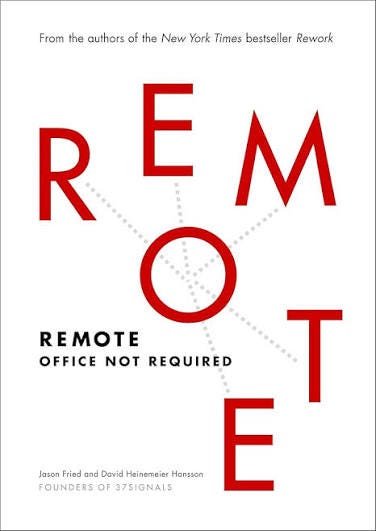
The central idea of this book is simple: remote work is not primarily a technology challenge but an organisational one.
The authors question several assumptions that have shaped traditional office work:
that collaboration requires constant physical presence;
that managers must see people to manage them;
that culture is created by sharing a building;
that productive work requires fixed hours;
that remote work leads to weaker accountability.
Its most useful lesson is not that every organisation should become fully remote.
It is that when work can no longer rely on physical proximity, companies are forced to become clearer about communication, responsibility and results.
That is precisely why remote work can feel uncomfortable.
It forces leaders to stop managing what is visible and start managing what matters.
FINAL WORDS
The hardest part of flexible work is not deciding how many days people should spend in the office.
The hard part is building an organisation in which people know what is expected, take responsibility for results and receive the support they need without being constantly monitored.
The office can hide unclear expectations, weak accountability and poor communication.
Remote work exposes them.
Your team does not need more surveillance. It needs clear results, defined standards, meaningful support and the autonomy to take responsibility.
Because the goal is not to force people into the same building.
The goal is to build a system in which the right work is done, at the right standard, by the right people—wherever it can be done best.
That is modern leadership.
Not managing presence.
Managing results.
You got this!
Gregor Kosi
The CEO Coach
ENGAGE WITH THIS IDEA
Leadership Mirror Question
Where are you still measuring visibility because you have not clearly defined the result?
Comment
What is the biggest obstacle to effective hybrid work in your organisation: trust, accountability, communication or leadership discipline?
Share
Share this with one leader who still believes that seeing people at their desks is the same as knowing they are productive.
Subscribe
Join 500+ modern leaders learning how to lead with clarity, responsibility and human strength.