

PREFACE - THE ORIGINAL SIN
Most leaders want performance.
Very few build the conditions for it.
They want ownership, but create confusion.
They want speed, but create noise.
They want accountability, but leave roles vague.
They want better people, but keep building weak systems.
Then the system slows down, people get tired, and leaders blame the people.
That is where most companies begin lying to themselves.
The truth is much simpler, and much harder to admit: you do not get performance from pressure first. You get performance from clarity. And clarity is breaking down.
Gallup reports that global employee engagement fell to 21% in 2024, costing the world economy an estimated $438 billion in lost productivity. Gallup also found that only 46% of employees clearly know what is expected of them at work.
You do not get performance from pressure first. You get performance from clarity.
Part 1 — WHEN CHAOS LOOKS LIKE LEADERSHIP
For the first ten years of my CEO journey, I did not really know what we were doing or where we were going.
I can admit that now without hiding behind results.
We were working. We were growing. We were solving problems. We were launching ideas. People were busy all the time. From the outside, it looked productive.
Inside, it was chaos with good branding.
We did many things because they felt right in the moment. Not because they were part of a clear vision. Not because they were aligned with a coherent strategy. Not because they strengthened the real function of the company.
And that is where many organizations quietly bleed energy.
They confuse movement with direction. They confuse busyness with learning. They confuse execution with intelligence.
After every vacation, or even after a slightly more relaxed weekend, I came back to the office with ten new ideas. Each one sounded smart. Fresh. Promising. Important. And because I was the CEO, those ideas instantly became work for someone else.
I expected the team to execute them because, to me, they made sense.
Then I was surprised that people were doing operational work over the weekend. I thought they were inefficient. I thought they lacked discipline. I thought they needed better time management.
I was wrong.
They were overloaded.
They were highly efficient at doing what I demanded, and less effective at doing what mattered most.
That is a dangerous difference.
That was us.
We were not building a learning organization.
We were building a reactive one.
And a reactive organization can survive for a while.
But it cannot mature with intention.
Activity is the favorite hiding place of confused companies.
What leaders fail to make clear, people pay for with time and energy.
Part 2 — THE COST OF NOT KNOWING WHAT MATTERS
This is not just a personal story. It is a pattern.
More than half of employees do not clearly know what is expected of them at work.
That means more than half of people are trying to create results without a solid map. Then leaders ask for more initiative, more ownership, and more accountability, as if those things can grow in the dark. They cannot. You cannot ask people to own what you never made clear.
The same problem shows up at the strategic level.
McKinsey says even high-performing companies often leave about 30% of strategy value unrealized because their operating models never fully turn strategic intent into daily work.
In plain language: the slide deck may be smart, but the company still does not know how to live it on a Tuesday morning.
The manager layer is under even more pressure than most executives admit.
Gallup reports that less than half of managers worldwide have received management training, even as manager disengagement has become a major driver of falling overall engagement.
That is not a side issue. It means the people expected to create clarity, coach performance, and carry culture are often doing it without enough preparation.
And this is why the learning organization is not just a nice idea.
A systematic review in the International Journal of Productivity and Performance Management found a consistent positive relationship between organizational learning and firm performance across the empirical studies it reviewed. Companies that learn better tend to perform better.
If people need constant rescue from the top, you do not have strategy. You have dependency.
A company does not collapse first in numbers. It collapses in meaning.
Part 3 — MOST COMPANIES DO NOT FEAR FAILURE
Most organizations do not fear failure first.
They fear uncertainty.
Failure is at least clear. Uncertainty is not. Uncertainty exposes what is weak: weak thinking, weak alignment, weak trust, weak leadership, weak self-knowledge.
That is why so many companies hide behind overprocessing. They hide behind meetings, approvals, decks, task forces, and phrases like “we need more clarity” or “now is not the right time.”
Sometimes that is wisdom.
A lot of the time, it is fear in a better suit.
And fear always leaves a trail. It creates delay, control, noise, safe decisions, and fake urgency. It keeps people moving, but not always moving forward. It creates the illusion of discipline while slowly draining life out of the system.
That is why I no longer think the real opposite of fear in a company is confidence.
Confidence without learning is often just denial with better posture.
What matters far more is the ability to learn: to face facts early, to adapt before reality humiliates you, and to keep building capability while the ground is still moving.
You do not beat uncertainty by waiting. You beat it by learning faster.
Certainty is not found. It is built.
The future is not built by companies that know everything. It is built by companies that keep learning before reality forces them to.
Part 4 — WHY DO YOU EXIST?
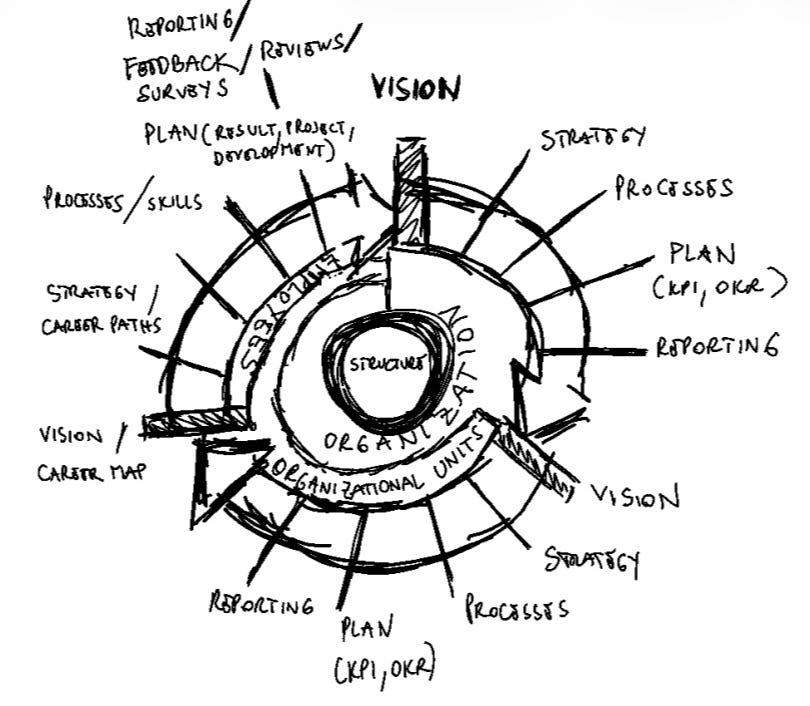
A real learning organization does not start with training.
It starts with function.
If a company does not know what it exists to do, its vision becomes decoration. If vision is weak, strategy becomes politics. If strategy is unclear, process becomes noise. If process is broken, roles become fog. If roles are foggy, hiring becomes guesswork. And then leaders blame people for problems the system designed.
That is the chain:
Function → Vision → Strategy → Process → Roles → Hiring → Development
Everything begins with function.
Every company should be able to answer one hard question without hiding behind brand language: What do we actually exist to do, and for whom? What value do we create? What problem do we solve? Why should we exist tomorrow?
If that answer is blurry, everything after it becomes theater. Vision becomes pretty language. Strategy becomes politics. Hiring becomes guesswork. Culture becomes mood management.
This is where many companies are weaker than they admit. They do not really know what game they are in. So they chase too much, change priorities too fast, hire people they cannot properly place, and call the mess growth.
If you do not know what your company is here to do, your vision is just decoration.
From there comes vision, and vision is not decoration either.
A real vision is a filter. It tells the organization what future it is trying to create, what deserves investment, what must be rejected, and what kind of people and capabilities are needed to move in that direction.
Without that filter, every new idea feels important, every request feels urgent, and every loud voice starts sounding strategic.
Then comes strategy.
Strategy is not your deck, your offsite, or your annual town hall.
Strategy is choice.
Where will we play? How will we win? What will we stop doing? What will we refuse?
McKinsey’s recent survey work found that only 21% of executives said their strategies passed four or more of its “Ten Tests of Strategy.”
That suggests a deeper problem than poor execution alone. In many companies, the strategy is weak because leaders never made real choices.
A strategy that cannot survive daily work is not a strategy. It is a wish.
Then the truth gets exposed in process.
How do decisions get made?
How do priorities change?
How do teams hand work to each other?
How is accountability tracked?
How is conflict handled?
How is bad news treated?
That is the real company.
Not the poster in the hallway.
Not the slogans on the website.
The process.
This is why role clarity matters so much.
Many companies say they want accountability while still tolerating role fog. Then they act surprised when strong people become hesitant, political, defensive, or tired. But you cannot ask people to grow in roles that were never truly defined.
You cannot ask for ownership in a structure that confuses responsibility.
Confusion at the top always becomes exhaustion below.
And then comes hiring, where the company usually tells the truth about itself whether it means to or not. Companies say they want growth, ownership, maturity, and initiative, but then hire for comfort, urgency, familiarity, or surface-level fit.
SHRM says companies lose an average of $17,000 per bad hire and notes a widely cited estimate that the cost can reach 30% of first-year earnings.
Hiring is not separate from learning culture.
Hiring is where the learning organization proves it is serious. It does not ask only whether someone can do the job. It asks whether this person can grow in this system, whether the role is clear enough for them to win, whether the values match, whether the standard is real, and whether the future the company is building actually means something to them.
Sometimes the person is not wrong.
The match is wrong.
Part 5 — THE MIRROR MOST LEADERS AVOID
Here is the harder mirror.
Ask yourself, and ask your leadership team:
Do people in our company clearly know what is expected of them?
Does our strategy help people make better daily decisions, or does it still need constant explanation from the top?
Are our managers actually trained to build clarity, ownership, and growth?
Do our processes reward learning, or do they reward caution, delay, and politics?
Are we building certainty through learning, or only trying to control chaos?
If those questions feel uncomfortable, good.
Discomfort is often the first honest teacher in leadership.
Most companies are not suffering from a talent shortage. They are suffering from a clarity shortage.
TL;DR
Most leaders say they want performance. What they often build is confusion.
That is the real tax on modern work. Not low effort. Not weak talent. Low clarity.
Gallup’s latest workplace data shows global engagement fell to 21% in 2024, costing the world economy an estimated $438 billion in lost productivity. At the same time, only 46% of employees clearly know what is expected of them at work.
McKinsey adds another brutal truth: even high-performing companies often lose about 30% of strategy value because their operating models fail to turn strategy into daily work.
Gallup also reports that less than half of managers worldwide have received management training.
So the first task of a serious company is not to demand more output.
It is to build a system that teaches people what matters.
That system moves in one direction: function → vision → strategy → process → roles → hiring → development.
Certainty is not found. It is built.
DON’T MISS THE PAID SECTION — LEADERS ARE READERS
The free section gives you the argument.
The paid section gives you the deeper layer.
Inside, I’m not giving you another motivational summary. I’m giving you the intellectual backbone behind the learning organization — the kind of thinking that helps leaders stop reacting to chaos and start designing companies that can learn, adapt, and grow with intention.
In this paid section, you’ll get:
a sharp summary of Peter Senge’s The Fifth Discipline
the 10 most important ideas from the book, translated into plain leadership language
a clear explanation of why systems thinking changes everything
the deeper link between function, vision, strategy, process, roles, hiring, and development
access to related articles that expand this exact theme from different angles
and the practical benefit of seeing this article not as a one-off insight, but as part of a bigger leadership operating system
You’ll also unlock access to connected pieces on:
hiring clarity and role fit
why the most expensive meeting in your company is often a badly done job interview
why many so-called people problems are really design problems
how role clarity, expectations, and competency thinking shape performance
why good people disengage when systems stay vague
Because the truth is simple:
Leaders who read deeply lead differently.
Not just louder.
Not just faster.
Better.
LEADERS ARE READERS
For this piece, I’m adding a 20% discount for paid access.
Because if you want to build a real learning organization, you do not just need more content.
You need better thinking.
And better thinking is almost always built through better reading.
Leaders are readers.
And serious leaders study the systems they are trying to build.
Final Words
A company becomes dangerous when it grows faster than it understands itself.
That is when meetings multiply, priorities blur, good people tire, and leaders start blaming individuals for problems the system created.
I know, because I helped build that kind of system once.
That is why I no longer believe the first task of leadership is to push harder.
It is to make meaning clear.
Because if people do not know what matters, they will spend their energy on noise. And if the company cannot teach them what matters, it will exhaust them while calling it performance.
So before you ask whether your people are capable enough, ask the harder question:
Have you built an organization that can actually teach them what matters?
Because if the answer is no, the problem is not your people.
The company still has not learned how to learn.
Engage With This Idea
Comment: Where is your company losing the most energy right now: unclear expectations, weak strategy, role confusion, or fear of uncertainty?
Share: Send this to a leader who still confuses activity with progress.
Subscribe: Join The Modern Leader if you want leadership that builds adults, clarity, and real organizational intelligence.
