


“Vacation should not be the place where leaders go to become human again.”
Gregor Kosi
Last Wednesday, I left for vacation.
Not because I could not take it anymore.
Not because I needed to escape work.
And not because I wanted to repair the damage created by the way I had worked all year.
I left because recovery is part of high performance.
That sentence sounds completely normal in sport.
It still sounds suspicious in business.
An elite athlete who trains at maximum intensity every day is not considered committed.
They are considered badly coached.
A leader who works at maximum intensity every day is often praised for dedication.
Until their judgement deteriorates.
Their patience disappears.
Their motivation collapses.
Or their body forces them to stop.
We have confused permanent strain with high performance.
They are not the same.
PART 1: VACATION IS NOT A RECOVERY SYSTEM
Many leaders treat vacation the same way some organisations treat crisis management.
Too late.
They push too hard for too long, ignore the signals, call exhaustion commitment and then expect two weeks away to repair the consequences of an unsustainable rhythm.
That is not recovery.
That is damage control.
Vacation matters. Distance matters. Sleep, movement, silence, relationships and a slower rhythm all matter.
But vacation becomes dangerous when it is the only recovery system a leader has.
If your whole year is built around surviving until the next vacation, the problem is not that you need more vacation.
The problem is the way you work.
Research confirms that vacations improve health and well-being. But it also shows that many of those positive effects begin to fade after people return to work. (de Bloom et al.)
The conclusion is not that vacations are ineffective.
The conclusion is that vacation cannot permanently repair a system that recreates the same exhaustion after you return.
Most leaders do not return from vacation into a different life.
They return to the same calendar.
The same meetings.
The same interruptions.
The same unclear priorities.
The same permanent urgency.
They return rested.
But they return to the system that made them tired.
Vacation does not repair the way you work.
It interrupts it.
PART 2: ELITE ATHLETES DO NOT TRAIN AT FULL INTENSITY EVERY DAY
The model that inspired this article comes from a textbook on sports training by Anton Usaj.
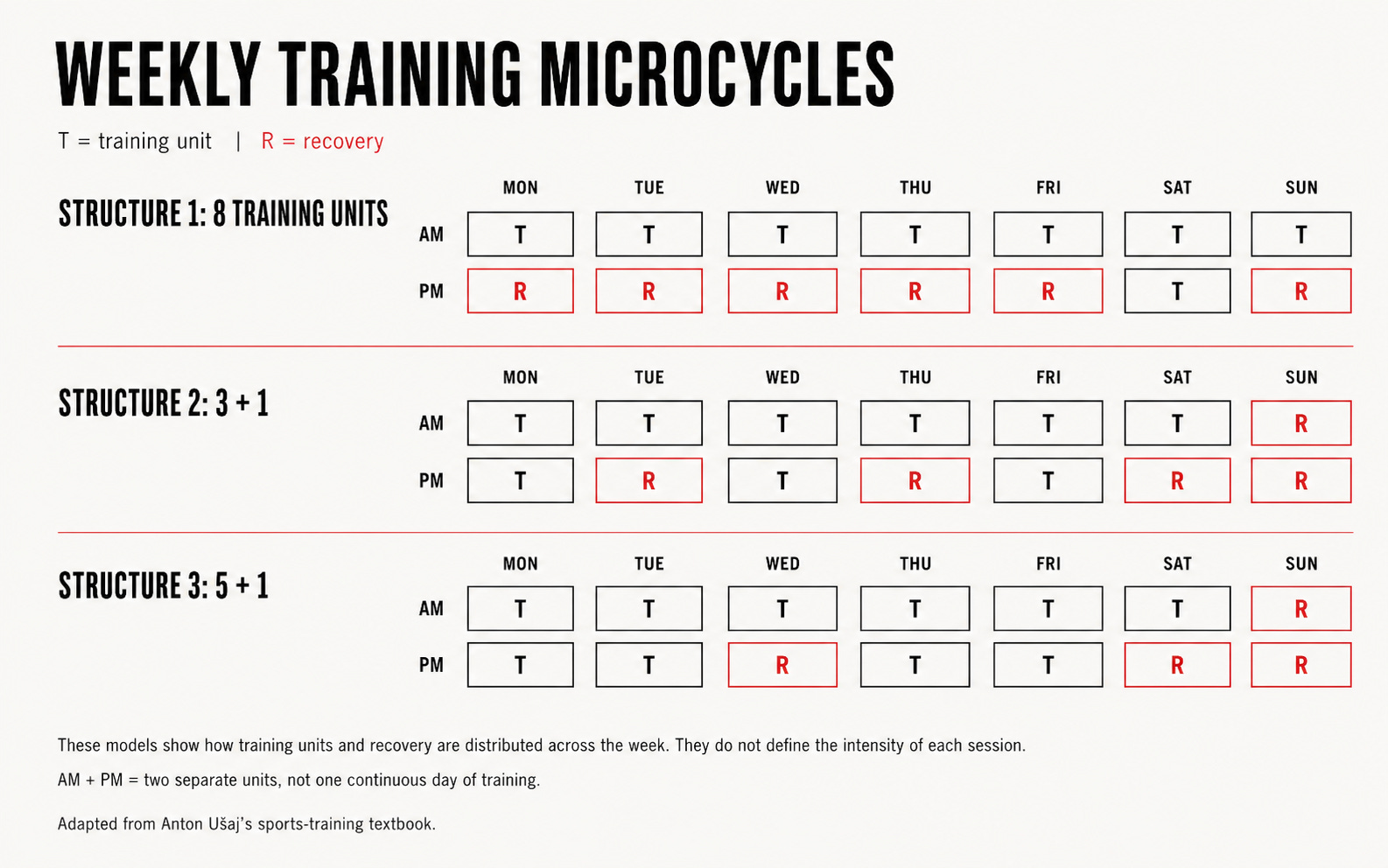
It presents examples of weekly training microcycles.
Each day is divided into two possible training units:
a morning unit and an afternoon unit.
Each unit is marked either as training or recovery.
A day may therefore contain two training units, one training unit and one recovery unit, or complete recovery.
Two training units do not mean one continuous day of maximum effort.
The athlete may train in the morning, recover for several hours and complete a second session later in the day.
Those individual units are then connected into a weekly microcycle.
One example contains eight training units across the week.
Another follows a 3 + 1 structure: three training units followed by one recovery unit.
A third follows a 5 + 1 structure: five training units followed by one recovery unit.
These models show how training and recovery can be distributed.
They do not, by themselves, define the total load.
A training unit can carry a high, medium or low load depending on its purpose, duration and demands. Five demanding sessions may create more strain than eight lighter ones.
That distinction matters.
PART 3: YOUR DAY IS A SERIES OF PERFORMANCE UNITS
A professional athlete does not organise training as one continuous block of maximum effort.
The day contains individual training units.
Between them, there may be rest, food, preparation, treatment, sleep or low-intensity activity.
Leaders rarely think this way.
Their days are divided into hours.
Not into units of performance and recovery.
A difficult conversation is followed by a critical decision.
The decision is followed by a presentation.
The presentation is followed by another meeting in which the leader is expected to be calm, curious and fully present.
There is no pause.
Only a change of subject.
A professional athlete would not call this high performance.
They would call it poor programme design.
Some leadership work requires deep concentration, while other work requires rapid coordination, emotional control, human closeness, creativity or courage.
A strategy workshop does not create the same load as a routine update.
A difficult performance conversation does not create the same load as reviewing a report.
A major negotiation does not create the same load as answering emails.
The calendar may assign sixty minutes to each of them.
But the demands are not equal.
The mistake is forcing every form of work into one uninterrupted sequence.
A ten-minute pause after a difficult conversation is not wasted time.
It is part of the next performance.
A short walk before an important decision is not a loss of productivity.
It may protect the quality of the decision.
Thirty minutes without input may create more value than another hour of reactive communication.
The goal is not to turn the working day into a wellness retreat.
The goal is to stop pretending that cognitive, emotional and relational capacity are unlimited.
PART 4: THE LEADERSHIP PERFORMANCE UNIT
A training unit has a purpose.
It is not simply movement placed on a schedule.
Leadership work should be treated in the same way.
A high-intensity leadership unit may be:
a critical negotiation,
a difficult performance conversation,
a crisis,
a major presentation,
a conflict between key people,
or a strategic decision with significant consequences.
A medium-intensity unit may be:
a team meeting,
a progress review,
a coaching conversation,
coordination,
or ordinary operational decision-making.
A low-intensity unit may be:
preparation,
reading,
writing,
reviewing data,
individual reflection,
planning,
or routine administration.
Low intensity does not mean low value.
Preparation may determine the quality of the presentation.
Reflection may prevent the next mistake.
A quiet review may reveal what permanent activity has hidden.
The question is therefore not only:
What do I need to do today?
It is also:
How many demanding leadership units can I perform well before the quality of my leadership begins to decline?
Most leaders do not know.
They discover the limit only after they have crossed it.
PART 5: YOUR WEEK IS A MICROCYCLE
Individual training units become meaningful when they are connected inside a weekly microcycle.
The same principle should shape a leader’s week.
Some days should carry greater cognitive, emotional and relational demand.
Other days should create space for preparation, execution, reflection and recovery.
The mistake is treating every day as a final.
And every week as an overload week.
This may look like commitment for a while.
Eventually, it becomes declining judgement, shorter patience, weaker listening, reduced creativity and lower motivation.
Pressure can build capability.
Pressure without recovery eventually reduces it.
A mature leader does not ask:
How much more can I fit into this week?
They ask:
Where must I perform at my highest level, and how should the rest of the week support that performance?
The same number of working hours can produce a completely different result depending on how they are organised.
A calendar filled with random intensity creates exhaustion.
A calendar built around purpose creates performance.
WHY I NEVER STARTED MONDAY WITH MEETINGS
For years, I avoided meetings on Mondays.
With one exception.
The most important meeting of the week.
A meeting with myself.
Monday was not a slow start.
It was a focused start.
I used it for deep individual work, strategic thinking, writing, reviewing results, preparing decisions and determining what genuinely deserved my attention.
When you begin Monday with meetings, you immediately enter the priorities, problems and expectations of other people.
They determine what you think about.
They determine what becomes urgent.
They distribute your attention before you have decided where it can create the most value.
When you begin with a meeting with yourself, you establish direction before the noise begins.
What matters most this week?
Where will I need to perform at my highest level?
Which decision can no longer be postponed?
Which conversation am I avoiding?
What should I stop doing?
What does my team need from me?
What must remain outside my calendar?
This is not isolation from the organisation.
It is preparation to lead it.
There is also a recovery argument.
A Monday morning filled with meetings does not begin on Monday morning.
It can begin in your head on Sunday.
You remember what you need to prepare.
You anticipate the difficult conversation.
You mentally enter the presentation.
Your weekend has not officially ended.
Psychologically, it has.
A meeting-free Monday does not guarantee recovery.
But it reduces the pressure to begin the working week before the weekend has ended.
The way Monday is designed determines whether you lead the week or merely react to it.
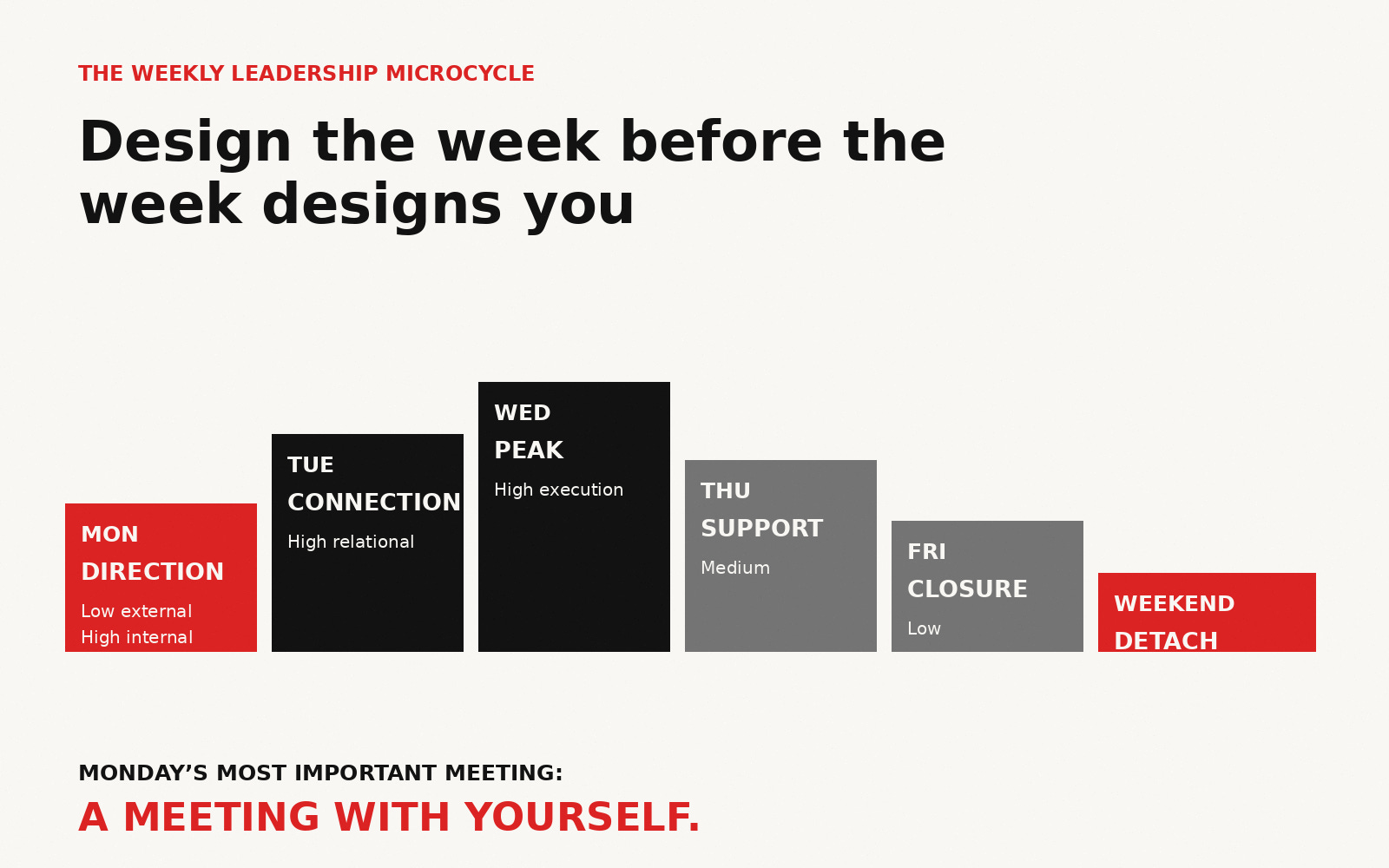
A BETTER WEEKLY RHYTHM
Monday can be a day of low external intensity and high internal focus.
It is for deep work, strategic thought, preparation, writing and the meeting with yourself.
Tuesday can carry higher relational intensity.
It is for key meetings, team conversations, alignment, coaching and important feedback.
Wednesday can become the peak execution day.
It is for negotiations, workshops, presentations, difficult decisions and other high-value work.
Thursday can carry medium intensity.
It is for support, coordination, removing obstacles and turning decisions into action.
Friday should reduce the load.
It is for reviewing the week, learning, closing open loops and preparing the next microcycle.
This is not the only possible structure.
Different businesses and roles require different rhythms.
The principle matters more than the exact days.
Do not allow the calendar to design your performance accidentally.
HOW TO REDESIGN YOUR WEEK IN 15 MINUTES
Before the week begins, look at your calendar and mark every important activity with one of three labels:
H = high-intensity leadership unit
M = medium-intensity leadership unit
L = low-intensity leadership unit
Then ask five questions:
Where do I need to perform at my highest level?
Which high-intensity units are placed too close together?
Where do I need recovery or preparation before an important moment?
Which meetings can be moved, shortened or removed?
Where is my meeting with myself?
You do not need to redesign your entire life.
Start by redesigning one week.
Because the problem is rarely that leaders have no time.
The problem is that they do not know which parts of their week require their best energy.
PART 6: YOUR NERVOUS SYSTEM DOES NOT CARE ABOUT YOUR JOB TITLE
This is not only a productivity issue.
It is a biological issue.
The problem is not that leaders enter periods of activation.
That is normal.
The problem is that many leaders never come down.
They begin the day activated.
They move from call to call activated.
They make decisions activated.
They handle conflict activated.
They answer messages activated.
They come home activated.
Then they wake up and call it leadership.
The body calls it stress.
The World Health Organization describes burnout as an occupational phenomenon resulting from chronic workplace stress that has not been successfully managed. (WHO)
That wording matters.
Burnout is not only about having too much work.
It is also about stress that has not been managed and recovered from over time.
Leaders do not only need time management.
They need intensity management.
Recovery is therefore not a private wellness topic.
It is a leadership-system topic.
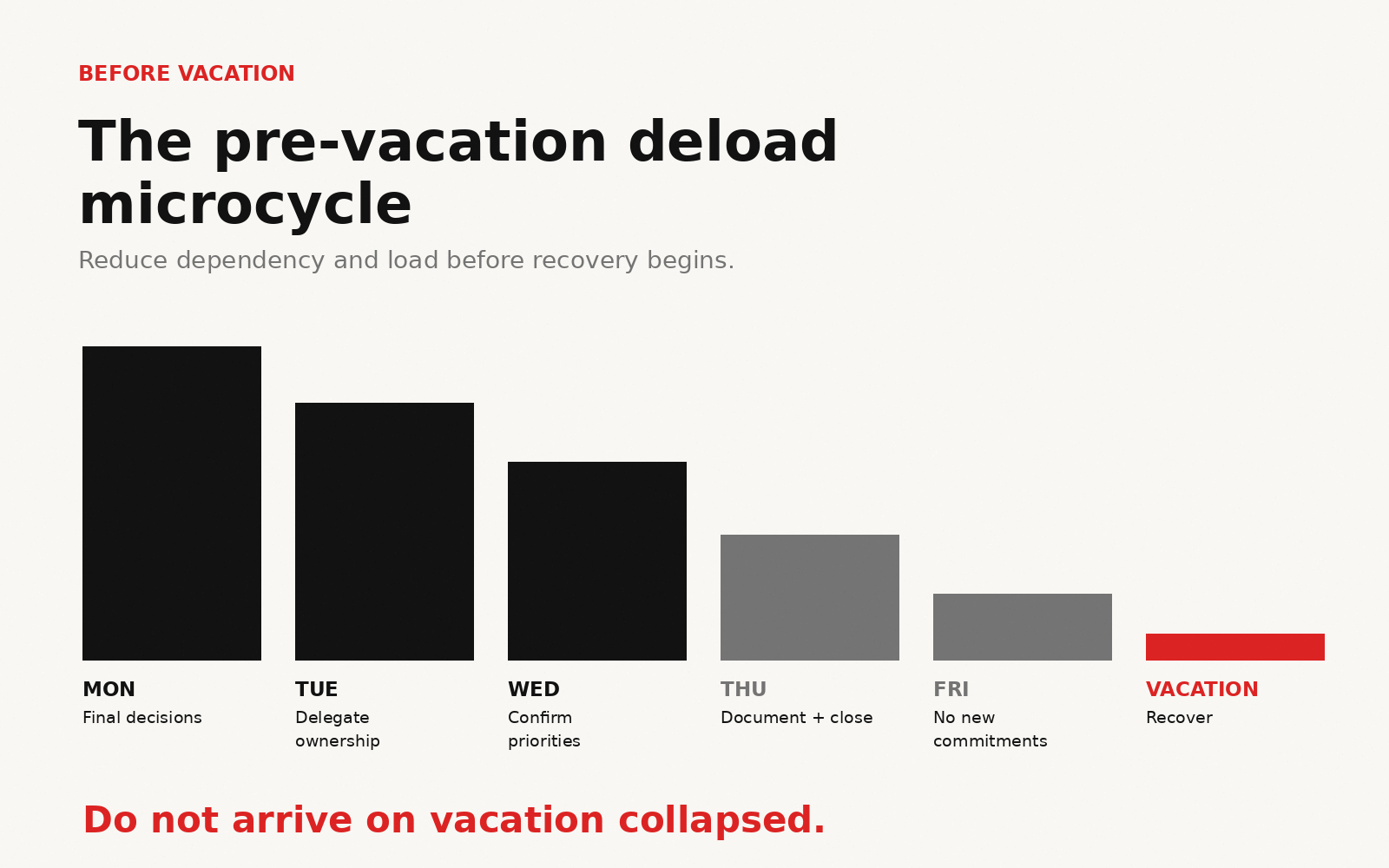
PART 7: THE WEEK BEFORE VACATION SHOULD REDUCE THE LOAD
Many leaders destroy the value of vacation before it begins.
They overpack the final week.
They squeeze in every possible meeting.
They try to close every open topic.
They accept new commitments.
They work late.
Then they leave exhausted and spend the first part of vacation trying to become human again.
That is not a vacation problem.
It is a load-design problem.
The final week before vacation should not be the hardest week of the quarter.
It should be a deliberate reduction in load.
At the beginning of the week, complete the most important decisions.
Clarify ownership.
Transfer authority.
Determine what the team can decide independently.
As the departure approaches, reduce new commitments.
The purpose is not to finish everything.
That is impossible.
The purpose is to leave behind a system that can function without constant intervention.
A leader who cannot leave without remaining permanently available may not have a vacation problem.
They may have a delegation problem.
A trust problem.
Or an organisational-design problem.
Your out-of-office message is not the real test.
The real test is whether the organisation continues to function when you are not watching it.
PART 8: THE FIRST WEEK BACK SHOULD REBUILD INTENSITY
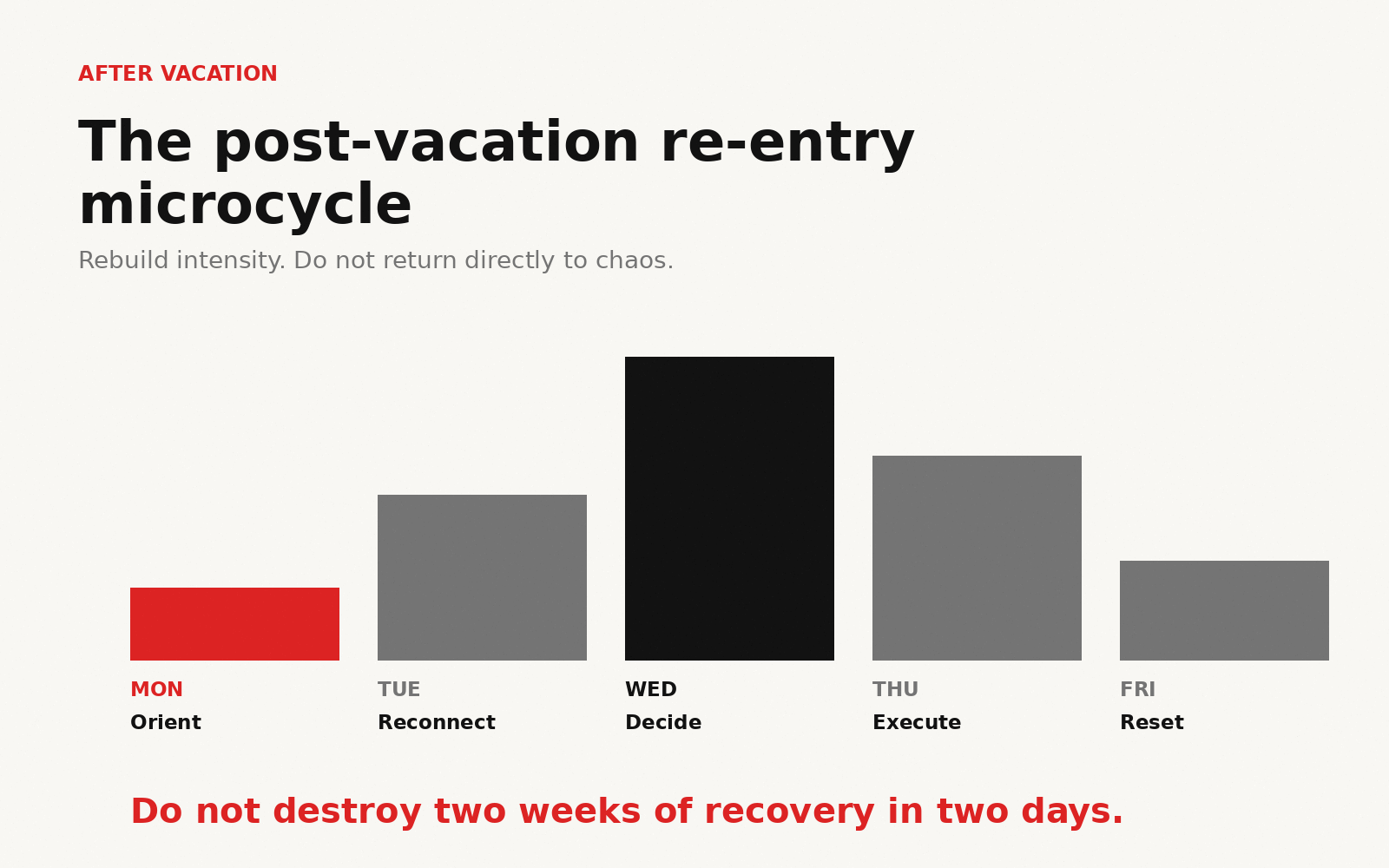
The first day after vacation should not contain ten meetings, several unresolved conflicts and a list of decisions everyone has been waiting for you to make.
That destroys the recovery effect before the first day has ended.
An athlete does not normally return from recovery and immediately perform the hardest session of the entire cycle.
The load is rebuilt.
Leadership should follow the same logic.
First, understand what happened.
Then separate what is important from what is merely loud.
Identify what the team resolved successfully without you.
Protect the responsibility they accepted.
Only then increase the intensity.
The purpose of the first day is not to reclaim control over everything.
It is to re-enter the system without immediately becoming its central bottleneck again.
A vacation followed by an immediate return to chaos does not prove that the organisation needs you.
It may prove that you designed it to depend on you.
TL;DR
Vacation helps, but it cannot repair an unsustainable way of working.
Elite athletes do not perform at maximum intensity every day.
They organise their days into training units and periods of rest.
They connect those units into weekly microcycles.
Leaders should stop pretending they are exempt from the same human limits.
A leader’s calendar should not only organise meetings.
It should manage intensity.
Monday should begin with the most important meeting of the week:
a meeting with yourself.
The week before vacation should reduce load and dependency.
The first week after vacation should rebuild intensity gradually.
Recovery is not a reward for performance.
Recovery is part of performance.
ATTENTION: UNLOCK YOUR PRACTICE
Understanding the problem will not redesign your calendar.
On Monday, the same meetings will return.
The same messages will arrive.
The same people will need decisions.
And unless you have a practical alternative, urgency will take control again.
The paid section gives you a simple operating system.
You will get:
The Leadership Performance Unit
The Meeting With Yourself Agenda
The Weekly Leadership Microcycle
The Pre-Vacation Deload Plan
The Post-Vacation Re-entry Plan
Weekly Book Recommendation
The free section explains why vacation is not a recovery system.
The paid section helps you build one.
Paid subscribers also receive subscriber-only articles, full archive access, printable leadership tools, recommended reading and direct community access.
Upgrade to the paid edition and build your leadership recovery system.
Plan the intensity.
Protect the recovery.
Lead longer.
PAID SECTION
THE LEADERSHIP RECOVERY SYSTEM
You do not need a more complicated calendar.
You need a better rhythm.
The following five practices translate the logic of sports training into leadership.
1. CLASSIFY THE PERFORMANCE UNIT
Before adding an important activity to your calendar, identify its intensity.
High intensity
A major negotiation, difficult conversation, crisis, strategic workshop or decision with significant consequences.
Medium intensity
Team meetings, coaching, coordination, progress reviews and ordinary operational decisions.
Low intensity
Preparation, writing, reading, reviewing data, reflection and planning.
Do not count only hours.
Count demands.
Five routine meetings do not create the same load as five difficult conversations.
After a high-intensity unit, protect a short recovery buffer.
A walk. Silence. Food. Reflection.
Preparation for the next unit.
A change of subject is not recovery.
Your goal is not to have fewer high-intensity units.
Your goal is to stop placing them randomly.
2. HOLD THE MOST IMPORTANT MEETING OF THE WEEK
Protect sixty to ninety minutes on Monday morning.
Do not use it for email.
Do not use it for administration.
Ask:
What are the three most important outcomes this week?
Where must I perform at my highest level?
Which conversation am I avoiding?
What does my team need from me?
What should I stop doing?
What must remain outside my calendar?
Your calendar should reflect your answers before other people fill it with their questions.
3. DESIGN THE WEEK AS A MICROCYCLE
A simple leadership rhythm may look like this:
Monday: deep work and direction
Tuesday: team connection
Wednesday: peak execution
Thursday: support and follow-through
Friday: closure and reduction
Do not copy the structure blindly.
Adapt it to your role.
The principle is to place the most demanding units deliberately and reduce intensity before recovery.
4. REDUCE THE LOAD BEFORE VACATION
During the final week:
Monday: complete the most important decisions
Tuesday: delegate ownership
Wednesday: confirm priorities
Thursday: document and close
Friday: accept no new major commitments
Before leaving, answer:
Who owns each important outcome?
Which decisions can be made without me?
What genuinely justifies contacting me?
What information still exists only in my head?
Do not arrive on vacation collapsed.
5. REBUILD INTENSITY AFTER VACATION
Use the first week back as a re-entry cycle.
Monday: orient
Tuesday: reconnect
Wednesday: decide
Thursday: execute
Friday: reset
On the first day, ask:
What did the team solve without me?
What improved while I was away?
Where did the system fail?
Which responsibilities should remain with the people who carried them successfully?
The goal is not to restore the old dependency.
The goal is to learn from your absence.
LEADERS ARE READERS
The Power of Full Engagement
Jim Loehr and Tony Schwartz

The central idea of the book is simple:
Energy, not time, is the fundamental currency of high performance.
Most leaders try to solve exhaustion with better time management.
That can help.
But a leader can have a perfectly organised calendar and still operate with a depleted body, overloaded mind and exhausted nervous system.
Performance and recovery are not opposites.
They are partners.
Capacity expands through movement between stress and recovery.
Not through permanent pressure.
FINAL WORDS
A professional athlete does not train at maximum intensity every day.
Not because they lack ambition.
Because they understand performance.
They divide the day into training units and rest.
They connect those units into weekly microcycles.
They vary intensity.
They reduce the load before recovery.
They rebuild it afterwards.
Leaders should do the same.
A difficult conversation is a performance unit.
A strategy workshop is a performance unit.
A major decision is a performance unit.
Deep work is a performance unit.
Recovery is not what remains after everything else has been scheduled.
It is part of the schedule.
You do not need every day to be easy.
Leadership sometimes demands exceptional effort.
But exceptional effort cannot become the permanent operating model.
If every day is a final, you are not performing at the highest level.
You are removing the conditions that make high performance possible.
Vacation should not be the moment when you finally become human again.
It should be a period of deeper recovery inside a leadership system that already works.
Do not use vacation to survive your work.
Design your work so that vacation can become what it was supposed to be:
Not escape.
Not repair.
Not rehabilitation.
Regeneration.
You got this!
Gregor Kosi
The CEO Coach
ENGAGE WITH THIS IDEA
Leadership Power-Question
Are you using vacation to regenerate — or to repair the damage created by the way you work?
Comment
What is the biggest reason leaders fail to recover properly: too many meetings, unclear priorities, weak boundaries or the belief that exhaustion proves commitment?
Share
Share this with one leader who is counting the days until vacation instead of questioning the way they work.
Subscribe
Join modern leaders learning how to lead with clarity, responsibility and human strength.