

Part 1 – The Most Common Leadership Complaint
One of the most common complaints I hear from leaders is this:
“My people don’t take responsibility.”
It sounds like a people problem.
It rarely is.
Human beings are naturally inclined toward responsibility—
unless we block that inclination early and repeatedly.
Responsibility doesn’t disappear on its own.
It gets trained out of people.
Part 2 – The Red Sweater (How Responsibility Dies Early)
Think back to childhood.
You wanted to wear your old, slightly faded red sweater.
You loved it.
Your parents stopped you.
Not because it was dangerous.
But because it didn’t look right.
Because what would people think?
Because it might look like we don’t have money.
Instead, they made you wear a brand-new green sweater.
You hated it.
You went to school feeling like an outsider.
Ashamed.
Powerless.
Slowly, something deeper happened.
You didn’t just start resenting your parents.
You started resenting yourself—
for wanting something that wasn’t allowed.
Later in life, you either rebelled…
or someone else still chooses your clothes for you.
Here’s the uncomfortable truth:
Organizations are often nothing more than an extension of the living room.
Sometimes, even an extension of psychiatry.
The same patterns repeat—only now we call them culture.
Part 3 – Why Responsibility Disappears at Work
In organizations, leaders say:
“People don’t think for themselves.”
“They avoid responsibility.”
“They wait for instructions.”
But people don’t avoid responsibility.
They avoid punishment for autonomy.
Psychology explains this clearly.
Martin Seligman described learned helplessness:
when individuals repeatedly experience that their choices don’t matter, they stop choosing altogether.
Edward Deci and Richard Ryan showed that autonomy is a core psychological need—alongside competence and relatedness.
Remove autonomy, and you don’t get discipline.
You get compliance.
And compliance never produces responsibility.
Part 4 – The Decision Autonomy Matrix (The Missing Framework)
If leaders want responsibility, they must first give freedom to decide.
Not unlimited freedom.
Appropriate autonomy.
Here’s the progression most leaders unconsciously move through:
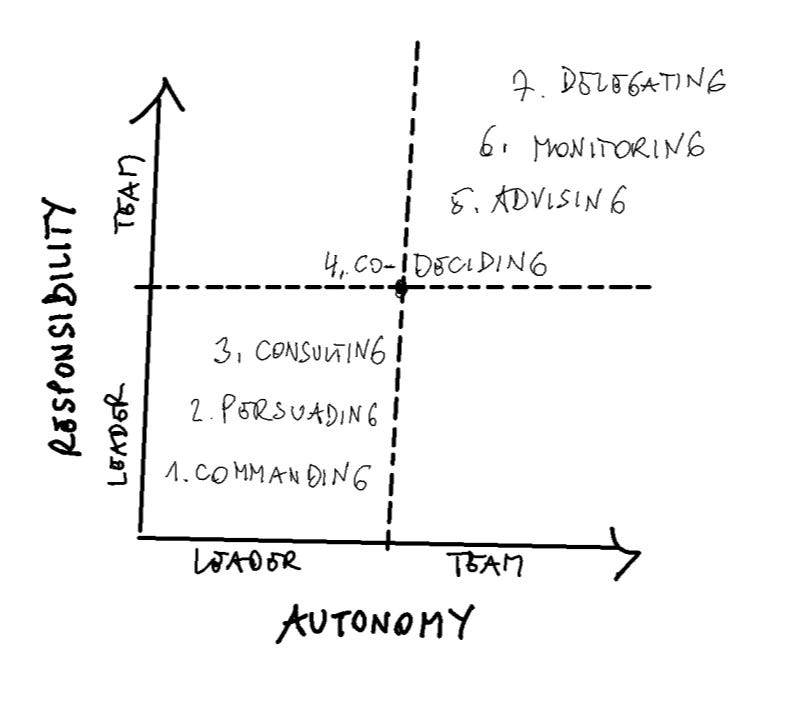
1. Commanding (Giving Orders)
Lowest autonomy.
You tell people what to do.
Often without explaining why.
This works only if:
conditions never change
tasks are repetitive
you personally showed every step
The moment circumstances shift, results collapse.
People can only repeat what you demonstrated.
Nothing more.
2. Persuading (Arguing Until They Give In)
Still no autonomy.
You now explain WHY—
but it’s your why.
People comply, not commit.
The outcome looks better on the surface.
Internally, nothing changes.
3. Consulting (Asking for Opinions)
This is the first real shift.
You ask for input.
But you still decide.
This matters.
Because if a team was never asked before,
they won’t open up overnight.
Consulting is the beginning of maturity—
but all responsibility still sits with the leader.
This is the breakthrough point.
4. Co-Deciding (Shared Decisions)
Now responsibility starts to emerge.
Decisions are made:
together
by majority
or by expert authority
For the first time, people feel ownership.
Mistakes are no longer the boss’s fault.
They’re our responsibility.
5. Advising (Leader as Counselor)
People decide independently.
The leader stays available:
before decisions (perspective)
after decisions (accountability)
Advice may be ignored.
Responsibility is not.
This is where real learning begins.
6. Monitoring (Leader Informed, Not Involved)
The leader steps back.
Informed through reporting.
Called in only when needed.
High trust.
High maturity.
7. Delegating Responsibility (Not Tasks)
The highest level.
Important distinction:
Delegating tasks = micromanagement
Delegating responsibility = leadership
At this level, people don’t wait.
They act.
Part 5 – Why Leaders Get Stuck at the Bottom
Most leaders stay in the first two levels.
Not because they’re bad.
But because control feels safe.
Control creates the illusion of importance.
Autonomy requires trust.
And trust feels risky—
especially under pressure.
But here’s the paradox:
Micromanagement doesn’t reduce your workload.
It guarantees you’ll carry it alone.
Part 6 – Autonomy Grows Like Athletic Performance
You don’t expect an athlete to run the same 400 meters
at the same time forever.
You raise the bar.
Autonomy works the same way.
New employees need:
more structure
clearer boundaries
closer support
But autonomy must expand with results.
Responsibility grows only when challenge grows with it.
Part 7 – Back to the Sweater
If the red sweater is truly too worn, fine.
But at least allow a choice between green and blue.
That choice matters.
Employees don’t demand total autonomy.
They demand inclusion in the decision process.
Even if it’s just choosing the name of the internal newsletter.
Because autonomy isn’t about power.
It’s about dignity.
TL;DR
People are naturally inclined to responsibility.
Responsibility dies when autonomy is removed.
Organizations repeat childhood patterns of control.
Commanding and persuading kill ownership.
Responsibility appears only when autonomy appears.
Leaders must scale decision freedom with capability.
Final Words
If people don’t take responsibility,
don’t ask what’s wrong with them.
Ask:
Where did I take their freedom first?
Because responsibility never disappears.
It only goes underground
in cultures that don’t trust it.
Engage With This Idea
💬 Where are you on the Decision Autonomy Matrix right now?
1) Commanding → 2) Persuading → 3) Consulting → 4) Co-Deciding → 5) Advising → 6) Monitoring → 7) Delegating Responsibility
Leave a comment with your number — and which decision you want to move one level up.
🔗 Send this to a leader who still delegates tasks… but expects responsibility.
✉️ Join 444+ leaders building responsibility through autonomy, not control.
🔒 ATTENTION: Unlock Your Practice - Join The Community Of Paid Subscribers!
Everything above explains why responsibility disappears.
This section shows you how to rebuild it—step by step.
Inside, you’ll work with:
a decision-autonomy map for your team
a method to move people safely between autonomy levels
a responsibility-first delegation framework
a leadership checklist to stop accidental control
If you want compliant people, stop here.
If you want responsible adults, continue.
TODAY ONLY — SPECIAL OFFER: “LEADERS ARE READERS”
Get 20% off your first year. Because leaders are readers — and the best leaders invest in their growth.
🔒 Paid Section — Designing Responsibility
Everything above explains why responsibility disappears.
This section shows you how to rebuild it — deliberately, safely, and without losing control.
Not by speeches.
Not by motivation.
By design.
1. The Decision–Autonomy Map (Start Here)
Responsibility never fails everywhere.
It fails in specific decisions.
Start by mapping who decides what.
Take one team and list:
key recurring decisions
who currently decides
who should decide
Then mark each decision on this scale:
I decide. You execute.
I decide after persuasion.
I decide after consultation.
We decide together.
You decide. I advise.
You decide. I’m informed.
You own the decision and the outcome.
Most teams discover something uncomfortable here:
they expect responsibility at level 6 or 7
while operating at level 1 or 2.
Responsibility never survives that gap.
2. How to Move People Between Autonomy Levels (Without Chaos)
Autonomy is not a switch.
It’s a progression.
To move someone up one level, three conditions must be clear:
Decision scope – what exactly are they deciding?
Boundaries – what’s non-negotiable (budget, risk, values)?
Consequences – what happens if it works… or fails?
Say this explicitly:
“This decision is yours.
Here are the boundaries.
Here’s how we’ll review the outcome.”
Never jump levels.
Jumping creates fear — not responsibility.
One level at a time builds confidence.
3. Responsibility-First Delegation (Not Task Dumping)
Most leaders think they delegate responsibility.
They actually delegate tasks.
Here’s the difference:
Task delegation sounds like:
“Do this by Friday.”
Responsibility delegation sounds like:
“You own the outcome.
Decide how to get there.
Update me if something blocks you.”
Tasks create dependence.
Responsibility creates ownership.
If someone keeps coming back with questions, ask one thing:
“What do you think the right decision is — and why?”
That question shifts the burden back where it belongs.
4. The Accidental Control Checklist (Use Weekly)
Before blaming people for passivity, check yourself:
Did I change the decision after they made it?
Did I override without explanation?
Did I ask for input but ignore it?
Did I punish a mistake that was within agreed boundaries?
Did I step in too early “to be safe”?
Each “yes” trains people to stop thinking.
Control is rarely intentional.
It’s usually accidental.
5. The One Rule That Changes Everything
Never ask for responsibility
without first granting autonomy.
And never grant autonomy
without clearly defining the playing field.
Freedom without structure creates anxiety.
Structure without freedom creates compliance.
Responsibility lives only in the middle.
Final Line
If you want compliant people, stop here.
If you want responsible adults,
design for autonomy — and let go of control one level at a time.
That’s leadership.