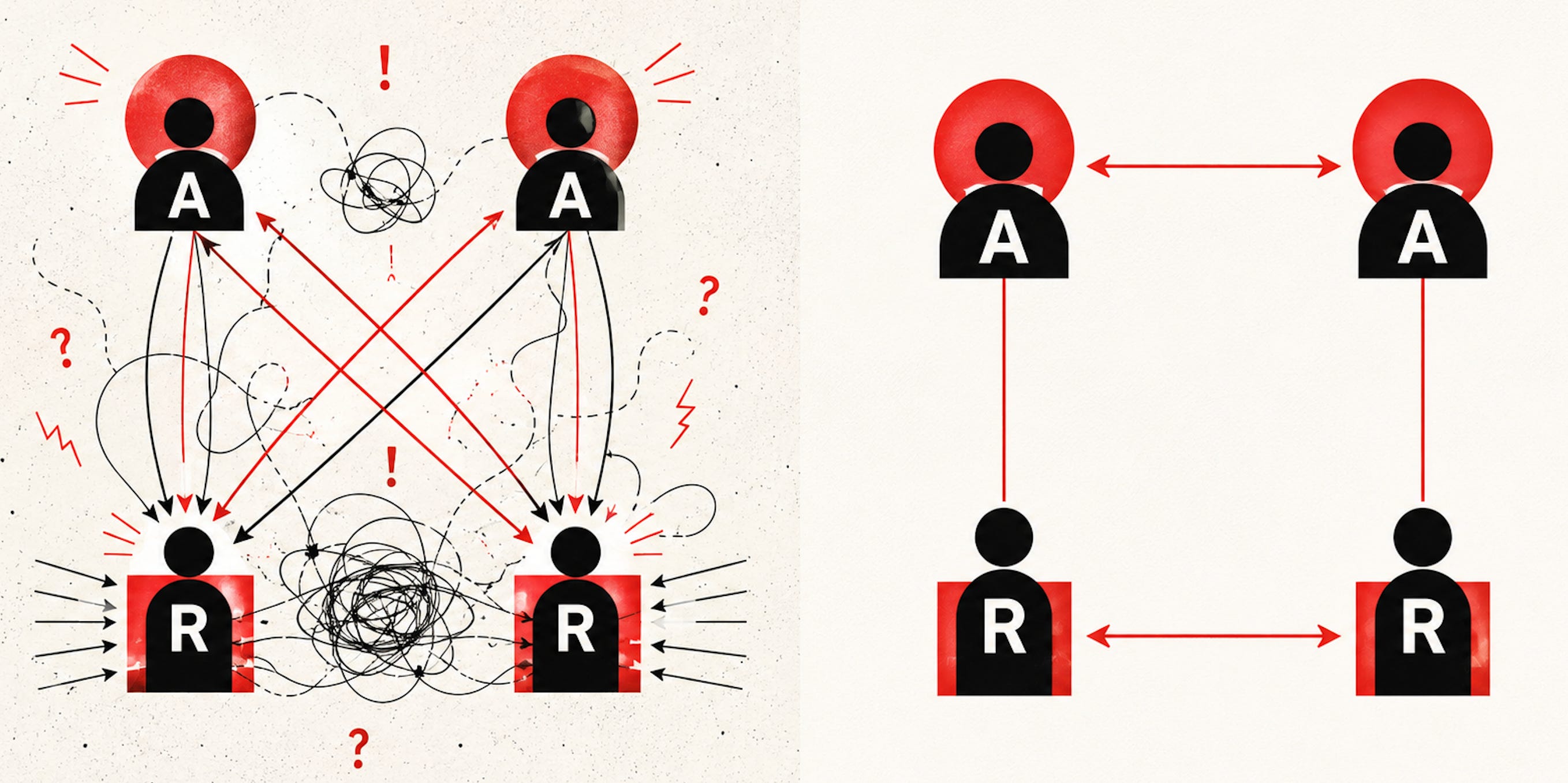
“No employee can have two bosses. The moment two leaders assign priorities to the same person, accountability starts disappearing.”
Gregor Kosi
When was the last time your company had a swingers’ party?
If the question sounds strange, stay with me.
Because this kind of “swinging” happens in companies every day. Often several times a day. And it usually happens with the best intentions.
A senior leader has an idea. A founder sees a problem. A director notices something urgent. A CEO walks through the organisation, spots an issue and immediately knows who could fix it fastest.
So they go directly to that person.
Not to the person’s manager. Not to the owner of the result. Not through the agreed line of accountability. Directly to the employee who can “just quickly take care of it.”
It feels fast.
It feels practical.
It feels like leadership.
But very often, it is not leadership. It is “organisational swinging”.
In business, swinging happens every time you assign a task, change a priority or create a new expectation for someone who does not report directly to you, while bypassing the person who is responsible for that employee’s work.
And the consequences are not funny.
The consequences are chaos, overload, burnout, sick leave, double standards, lower productivity and results that slowly stop happening.
Because the employee now has two bosses.
Two bosses mean two authorities. Two authorities mean two priority lists. And the employee is forced to decide which boss to satisfy and which boss to disappoint.
That is not empowerment.
That is confusion with better branding.
PART 1 - THE MOST DANGEROUS SENTENCE: “CAN YOU JUST QUICKLY…”
For more than ten years, I was also guilty of this.
I was not only guilty.
I was probably the main swinger in the company.
Whenever I had a “great” idea as CEO, I would often look for the person who could execute it fastest and give the task directly to them. At the time, it felt efficient. Why spend time explaining the idea to a director who might ask questions, challenge the priority or remind me of other commitments, when I could simply go to the person who could make it happen?
Especially when I did not feel like dealing with one of my directors and listening to their counterarguments, I would sometimes bypass them and go straight to a member of their expert team.
Of course, that person did not resist.
When the CEO comes directly to you, it is very difficult to say no.
That was part of the problem.
I thought I was accelerating execution. In reality, I was creating hidden chaos.
The person already had tasks, priorities, deadlines and a direct manager who expected a certain result. Then I arrived with my new, brilliant, obviously urgent idea.
Suddenly, the employee had two bosses.
Which task became more important?
Mine.
Not necessarily because it was more important for the company, but because it came from the highest-ranking person in the company.
That is where leadership becomes dangerous. Not because the leader has bad intentions, but because the leader forgets the weight of their position.
When a CEO says, “Can you just quickly…”, it rarely feels like a suggestion.
It feels like a priority.
PART 2 - WHEN POSITION STARTS DEFINING PRIORITIES
Once senior leaders start bypassing the line, the behaviour spreads.
Examples are powerful. Bad examples are even more powerful.
Soon, directors begin assigning work to people in other teams. Managers start bypassing their colleagues. Founders and CEOs jump directly into operations whenever they notice a problem or have a new idea.
Everyone believes their request is important. Everyone believes they are helping. Everyone believes they are speeding things up.
But no one has the full picture of the other person’s existing tasks, deadlines, agreements and priorities.
So employees begin guessing.
They guess which task is more important. They guess which leader is more dangerous to disappoint. They guess which priority will matter tomorrow. They guess whether the official plan still matters or whether the last instruction from the most senior person has replaced it.
In this kind of organisation, priorities are no longer defined by strategy.
They are defined by position, volume and recency.
The highest-ranking person wins. The loudest person wins. The latest request wins.
The result is not agility.
The result is operational gambling.
At first, the hierarchy starts to crack. Then priorities start to crack. Then accountability starts to crack. Eventually, the organisation loses its ability to systematically execute what it agreed to execute.
And the worst part is that everyone still feels busy.
Busy is not the same as aligned.
Busy is often what chaos looks like before the results expose it.
PART 3 - NO ONE CAN HAVE TWO BOSSES
No employee can have two bosses.
This sounds obvious, but many companies violate this rule every day.
Two bosses mean two sources of authority. Two sources of authority mean two sets of priorities. Two sets of priorities mean the employee must make a decision they should never have been forced to make.
Who is responsible when the task is not completed?
The employee, who received conflicting instructions?
Their direct manager, who did not even know about the new task?
Or the senior leader, who bypassed the agreed line and changed someone else’s priorities?
When responsibility is shared by too many people, it eventually belongs to no one.
This is why leadership discipline matters.
A company is not well-led because everyone can assign anything to anyone at any time. A company is well-led when people know who owns the work, who owns the result, who must be consulted and who must be informed.
That is where RACI becomes useful.
RACI is not bureaucracy. It is an accountability language.
R means Responsible: the person who executes the task.
A means Accountable: the person who carries the final responsibility for the result.
C means Consulted: the people who should be involved before the decision is made.
I means Informed: the people who need to know what was decided or what happened.
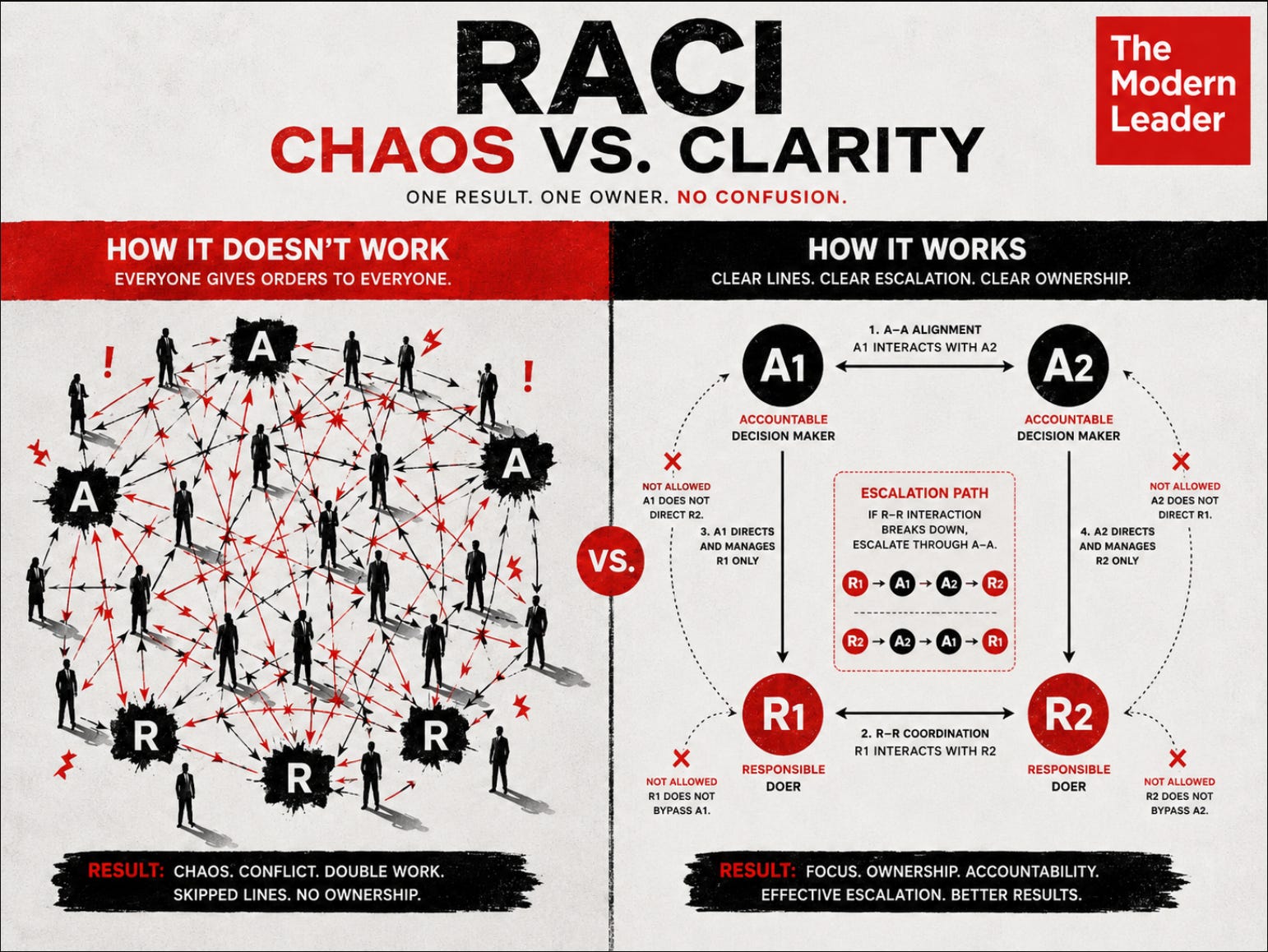
The most important rule is simple:
Every task needs one R and one A.
One person must know they are responsible for execution.
One person must know they are accountable for the result.
When there are two Rs, execution gets passed around.
When there are two As, accountability gets passed around.
When someone outside the agreed accountability line starts assigning tasks and changing priorities directly, the whole system begins to collapse.
PART 4 - WHAT I REALLY DID TO THE CASHIER
I once gave instructions directly to a cashier.
At the time, I probably thought I was showing interest in the operation and care for the customer. In reality, I had bypassed at least four levels of leadership.
The cashier had agreed tasks and a direct manager. Her manager was responsible for the shift result. The store manager was responsible for the store result. The regional leader carried responsibility for a broader area. At the top of that chain, there was me.
When I gave the cashier a new instruction directly, I did not remove responsibility from her manager.
I only removed part of his influence.
He still carried responsibility for the result, while I had started determining priorities for one of his people.
That was not effective leadership.
That was damaging the very system I was supposed to build and protect.
If I saw a problem in her work, I should have addressed the person accountable for the result. That person should have diagnosed the root cause, decided who the right R was and determined how the new task fit among already agreed priorities.
That may sound slower.
But it is not.
It is slower only if you measure speed by how quickly the instruction leaves your mouth.
It is faster if you measure speed by whether the organisation can execute without confusion, rework and hidden frustration.
PART 5 - HIERARCHY IS NOT FOR COMMANDING EVERYONE BELOW YOU
Hierarchy is often misunderstood.
The purpose of hierarchy is not that everyone higher can command everyone lower.
The purpose of hierarchy is to create a clear chain of accountability.
The higher you are in the organisation, the broader the picture you are responsible for. Your job is not to touch everything directly. Your job is to build a system in which the right people can make the right decisions at the right level.
When a CEO constantly drops into operations and assigns tasks directly to individual employees, the CEO is not just doing the work of other leaders.
The CEO is taking away their authority.
And when leaders lose authority but keep responsibility, frustration becomes inevitable.
They are accountable for results they can no longer fully influence.
That is one of the fastest ways to create weak managers, confused employees and a leadership culture full of passive resistance.
Instead of building the system, the senior leader becomes the system.
Instead of developing leaders, the senior leader creates dependency.
And then everyone wonders why people do not take ownership.
Ownership cannot grow where authority is constantly bypassed.
PART 6 - THE ONE R / ONE A CHECK
Before you assign the next task to someone who does not report directly to you, use The One R / One A Check.
It has five questions.
1. Who is A for this result?
Before touching the task, identify the person who carries final accountability for the result. If you do not know who the A is, you are already operating in fog.
2. Who is R for this task?
Execution needs one clear owner. Not a group. Not “the team.” Not “someone from marketing.” One person who knows they are responsible for moving the task forward.
3. Do I have the authority to change this person’s priority?
Your title may give you power, but that does not automatically mean you should use it directly. If the person does not report to you, changing their priority means you are entering someone else’s accountability system.
4. Does their direct leader know I am entering their team’s work?
If the answer is no, stop. You may be creating a hidden conflict that the employee will have to manage alone.
5. What existing task will be delayed, changed or removed because of this new request?
A new priority is not real until something else becomes less important. If nothing is removed, you have not created a priority. You have created overload.
If you cannot answer these five questions clearly, do not assign the task yet.
Go to the person who is accountable for the result. Explain the problem or the expected outcome. Align on the priority. Then let them determine the right responsible person and the right execution path.
This is not unnecessary bureaucracy.
This is discipline of accountability.
PART 7 - HOW TO USE IT TOMORROW
Tomorrow, notice one moment when you are tempted to bypass the line.
Maybe you want to send a direct message to someone in another department because you know they will act quickly. Maybe you want to give instructions to a specialist because explaining the issue to their manager feels slower. Maybe you want to solve something immediately because you see the problem so clearly.
Pause.
Ask yourself:
“Who is accountable for this result?”
If it is not the person you are about to contact, do not start with the executor. Start with the owner.
This does not mean you should never speak to people outside your direct line. Of course you should. Leaders should stay close to the organisation. They should listen, observe, understand reality and build relationships across levels.
But there is a difference between listening to people and assigning them new priorities.
There is a difference between asking questions and creating work.
There is a difference between being connected to the organisation and bypassing its accountability structure.
Modern leadership does not mean destroying hierarchy.
It means using hierarchy for what it is supposed to do: create clarity, responsibility and flow.
TL;DR
No employee can have two bosses.
Bypassing managers may feel fast, but it often creates hidden chaos.
The highest-ranking request quickly becomes the highest priority, even when it should not.
Hierarchy is not for commanding everyone below you; it is for protecting accountability.
Every task needs one clear R and one clear A.
If you add a new priority without removing another one, you create overload.
The One R / One A Check prevents “speed” from becoming confusion.
ENGAGE WITH THIS IDEA
Leadership Mirror Question:
Am I creating speed — or am I creating chaos that someone else will have to pay for later?
Comment:
Where do you most often see accountability bypassing in companies: founders, CEOs, directors, managers or cross-functional projects?
Share:
Send this to a leader who keeps calling chaos “agility.”
Subscribe:
Subscribe to The Modern Leader if you want practical leadership tools that help you build stronger leaders, clearer ownership and companies that execute without chaos.
⚠️ ATTENTION: UNLOCK YOUR PRACTICE
The free section gives you the truth.
But truth alone will not stop leaders from bypassing the line tomorrow morning.
Because under pressure, every leader becomes tempted by speed. It is faster to send the message directly. It is easier to go to the person who will execute. It feels more efficient to avoid the manager who might ask difficult questions about priorities, capacity and responsibility.
That is exactly how the chaos starts.
In the paid section, you get The Accountability Line Personal Workbook — a practical operating system for protecting ownership, priorities and execution in your team.
You will unlock:
The One R / One A Worksheet
A simple template for clarifying who owns execution and who owns the result before work begins.The Accountability Bypass Script
A script for senior leaders who want to address a problem without undermining the direct manager.The Priority Replacement Question Set
A practical question set to prevent leaders from adding work without removing work.The Team RACI Reset
A simple exercise for cleaning up unclear ownership in ongoing projects.The “C or I” Discipline Check
A tool for deciding whether you should be consulted, informed or directly involved.
The free section gives you the mirror.
The paid section gives you the system.
If you stop here, you may agree that no employee can have two bosses and still create two bosses tomorrow.
Upgrade to Paid Subscriber and get The Accountability Line Personal Workbook™.
Stop bypassing.
Start protecting accountability.
TODAY ONLY: LEADERS ARE READERS OFFER
Get 20% off your first year.
Because leaders are readers—and the best leaders invest in turning insight into practice.
WELCOME TO THE PAID SUBSCRIBERS’ SECTION
THE ACCOUNTABILITY LINE PERSONAL WORKBOOK
The purpose of this workbook is simple: to help leaders create speed without destroying ownership.
Use it before assigning work across teams, changing priorities, entering another leader’s area or intervening in execution that does not directly belong to you.
1. THE ONE R / ONE A WORKSHEET
Before work begins, write down:
Result: What result are we trying to achieve?
A — Accountable: Who carries final responsibility for the result?
R — Responsible: Who owns execution of the specific task?
C — Consulted: Who must be involved before the decision is made?
I — Informed: Who must know what was decided?
Then check the two most important rules:
There must be one A.
There must be one R.
If you cannot name them, the task is not ready to move. It may feel urgent, but urgency does not replace ownership.
Memorable line:
Unclear ownership is not a people problem. It is a design problem.
2. THE ACCOUNTABILITY BYPASS SCRIPT
Use this when you see a problem in another leader’s area and feel tempted to go directly to the person who can fix it.
Say to the accountable leader:
“I noticed something that may affect your result. I do not want to bypass your accountability, so I am bringing it to you first. The issue I see is this. The outcome I believe matters is this. How do you want to handle it, and who should own the next step?”
This script does three things.
It shows respect for accountability.
It keeps the problem visible.
It allows the accountable leader to choose the right responsible person.
You are not ignoring the issue.
You are addressing it without damaging the system.
Memorable line:
Bring the problem to the owner before you bring the task to the executor.
3. THE PRIORITY REPLACEMENT QUESTION SET
Use this whenever a new task, idea or request enters the system.
Ask:
What is the new priority?
Why does it matter now?
Who is A?
Who is R?
What existing work will be delayed, reduced or stopped?
Who must be informed about the change?
If nothing changes, the new priority is fake.
It is just more work.
Leaders often create overload because they add priorities without subtracting anything. Then they blame employees for poor execution, when the system has become impossible to execute.
Memorable line:
A new priority without an old priority removed is just disguised overload.
4. THE TEAM RACI RESET
Use this when a project feels slow, political or confusing.
Take one important project and list all current tasks. For each task, ask:
R - Who is responsible for execution?
A - Who is accountable for the result?
C - Who must be consulted?
I - Who must be informed?
Then look for red flags.
Two people believe they are accountable.
No one believes they are accountable.
The person responsible does not have the authority to execute.
Too many people are consulted.
Key stakeholders are informed too late.
The senior leader is acting as R when they should be A, C or I.
Fix the ownership before you blame the team.
Memorable line:
Many execution problems are accountability problems wearing a productivity mask.
5. THE “C OR I” DISCIPLINE CHECK
Senior leaders often create chaos because they think every important issue requires their direct involvement.
It does not.
Before entering the work, ask:
Am I truly accountable for this result?
Am I responsible for execution?
Do I need to be consulted before the decision?
Or do I only need to be informed?
This question is uncomfortable for senior leaders because it challenges the ego. Sometimes the most mature leadership move is not to enter the work. It is to let the owner own it.
Your importance is not proven by being involved in everything.
Your leadership is proven by building a system where everything does not need you.
Memorable line:
Sometimes your correct role is not A or R. It is C or I.
LEADERS ARE READERS
Every week, I recommend one book to paid subscribers that connects directly to the article.
Because leaders are readers.
Not because reading makes you smarter by itself.
But because the right book gives you better language, better questions and better mental models for the leadership challenges you are already facing.
This week’s recommendation:
High Output Management by Andrew S. Grove
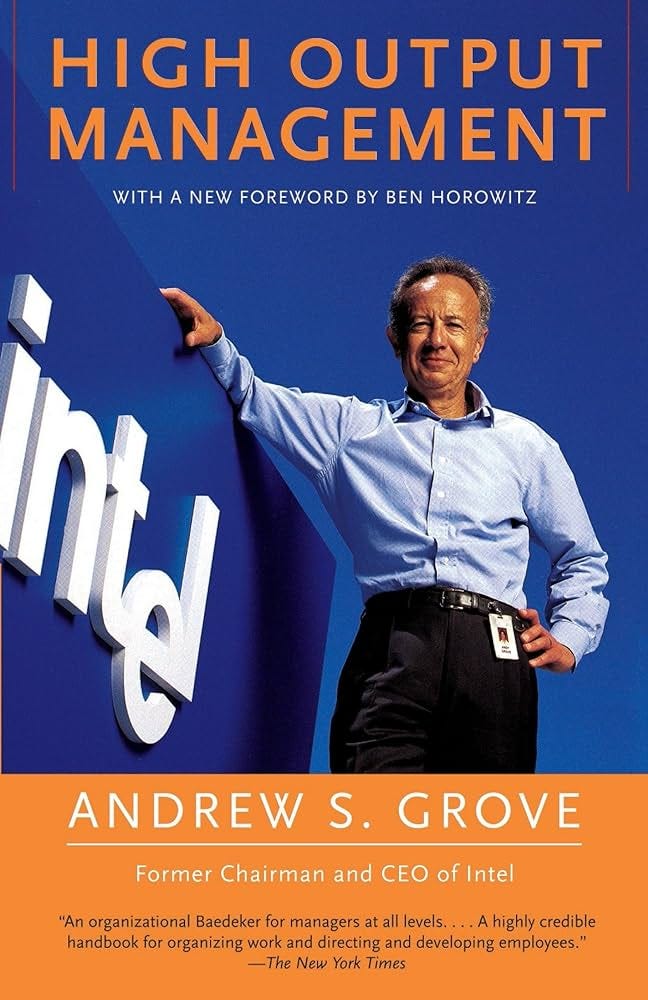
This book matters because Grove understood management as a system of leverage, output and clear operating rhythm. He did not romanticise leadership. He treated management as disciplined work that turns effort into results.
Key shifts:
A manager’s output is the output of their organisation.
Leverage matters more than personal activity.
Meetings are tools, not rituals.
Clear ownership improves execution.
Good management creates systems in which people can perform.
Connection to this article:
If your organisation depends on constant bypassing, personal intervention and heroic follow-up, you do not have enough management leverage. You have activity pretending to be execution.
FINAL WORDS
No employee can have two bosses.
Not if you want clarity.
Not if you want ownership.
Not if you want accountability.
You can call bypassing “speed.”
You can call it “agility.”
You can call it “being close to the business.”
But if people no longer know whose priorities matter, who owns the result and what should be done first, you are not leading an agile company.
You are hosting a swingers’ party.
And sooner or later, the bill will arrive.
Employees will pay with overload.
Managers will pay with lost authority.
The company will pay with missed results.
One R.
One A.
One clear line of accountability.
Everything else is chaos with confidence.
You got this!