


By Gregor Kosi (The Modern Leader) × Damjan Blagojević (Human Face)
Most companies don’t have an employer branding problem.
They have a human system problem.
They spend on narrative — then hire people into reality.
Reality always wins.
The gap isn’t “misalignment.”
It’s betrayal.
And the market always finds out.
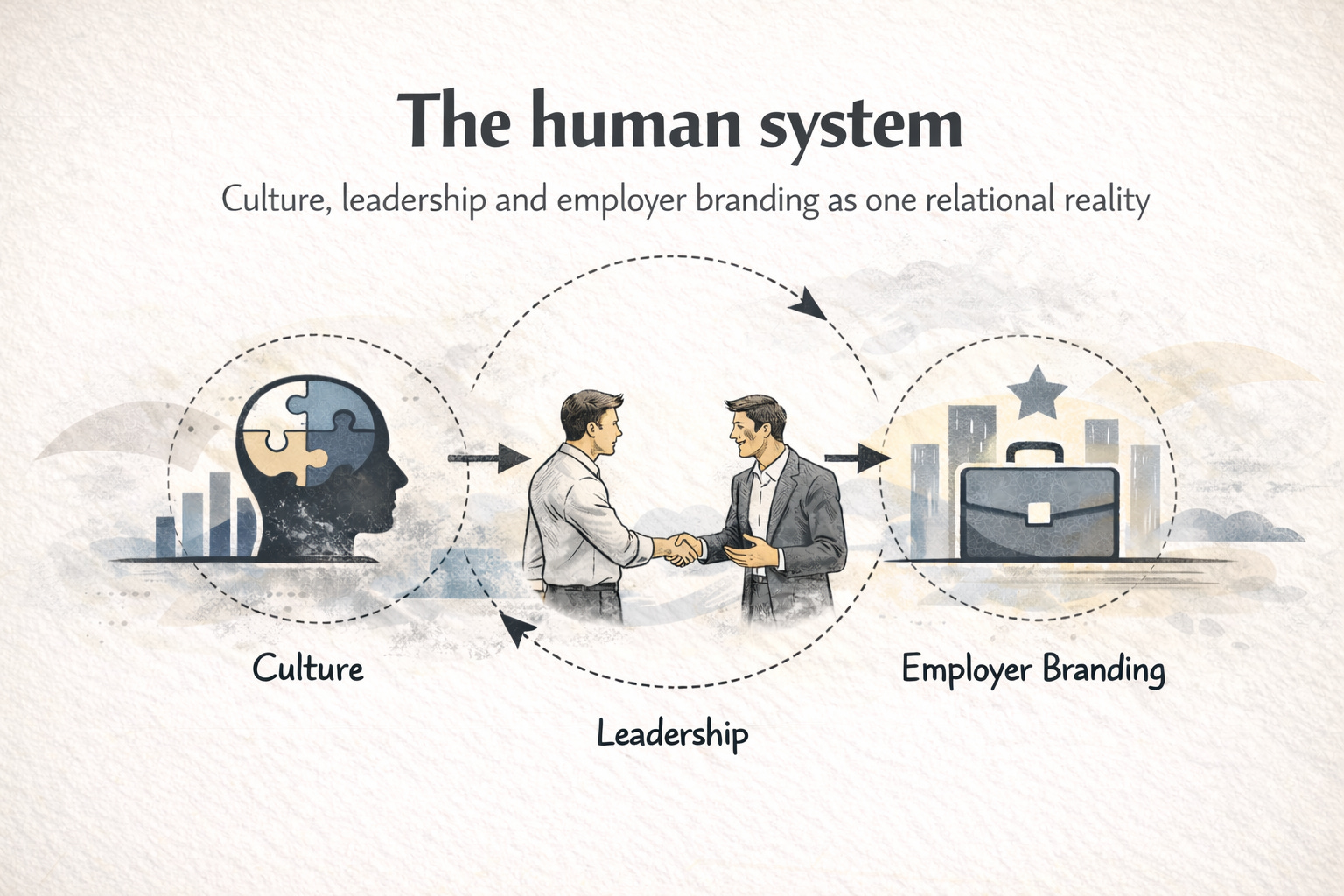
Because culture, leadership, and employer branding are not three topics.
They’re one system:
Culture is what people feel is safe to say and do.
Leadership is how tension is handled in real time.
Employer branding is the public echo of that private truth.
When words and actions don’t match, only one thing is missing:
Integrity.
And without integrity, employer branding doesn’t build trust.
It builds future anti-branding.
Why we wrote this together
Damjan studies language as a system — the words that decide what a culture can admit. I’ve led systems where those words decide performance, retention, and trust — in real time.
Same human problem. Two angles.
Words inside → behavior inside → reputation outside.
TL;DR
Employer branding doesn’t fail in marketing. It fails in integrity.
Culture, leadership, and employer branding are one system — words create structure, structure creates reputation.
Fix the human system first: truth circulation, clear ownership, tension capacity — then let branding become the echo of reality.
Preface: (choice of) words matter more than we admit
(Damjan)
When I write about content creation, personal branding, or employer branding, I keep returning to the same underlying principle:
Language shapes structure.
Not symbolically, but structurally.
In my coaching and leadership processes, we spend a lot of time on something many consider secondary - the exact words we use. The expressions. The recurring phrases. The metaphors embedded in everyday communication.
Because language is not decoration.
It defines what is thinkable.
What is challengeable.
What is reformable.
Over time, certain phrases become identity markers. They distinguish individuals. They differentiate organizations. They become conceptual anchors. They encode what is valued and what is quietly discouraged.
There is an old saying, “The word becomes flesh.”
What we repeatedly name becomes embodied behaviour.
The same is true inside organizations.
Research in organizational psychology consistently shows something simple: people do not primarily respond to formal structure. They respond to how safe they feel inside it.
When speaking up carries social risk, intelligence goes quiet.
When disagreement feels dangerous, initiative shrinks.
When language frames tension as threat, people adapt, and adaptation often looks like compliance.
Every organization lives inside its own linguistic frame. That frame determines what can be discussed openly, what must be softened, and what becomes unspeakable.
Once you begin observing language this way, a deeper question emerges:
What if the vocabulary used to describe leadership, people, and culture is already distorting the system it attempts to improve?
Most organizational failures begin long before strategy.
They begin in language.
The language problem: why “managing people” is already a fundamental error
(Damjan)
The phrase “managing people” appears harmless.
Yet embedded within it is a mechanistic worldview, people as variables to regulate, resources to allocate, inputs to optimize.
But people are not elements inside the system.
They are the system.
When leadership is framed as management, attention moves toward behavioral correction instead of relational architecture. The default response becomes operational, adjust processes, introduce programs, refine communication.
What remains untouched is the invisible infrastructure, the quality of relationships, the level of psychological safety, the clarity of responsibility.
Organizations rarely collapse because of strategy failure alone. They erode when relational systems cannot carry truth, tension, and difference.
This is where fragmentation begins.
Culture becomes an HR topic.
Leadership becomes a role description.
Employer branding becomes a communication function.
Three initiatives, one human system.
What an organization cannot name accurately, it cannot improve intelligently.
Language sets the ceiling of systemic evolution.
Organizational charts don’t run companies
(Gregor)
Structure explains very little about how an organization actually behaves.
An organisational chart can tell you who reports to whom.
It cannot tell you:
where tension accumulates,
where truth stops circulating,
where responsibility gets diffused,
where people have learned to stay quiet to stay safe.
Those are the invisible systems.
And they decide whether your culture can carry reality — or whether it needs stories to survive.
A company is not a mechanism you optimize.
It is a living community you either mature — or you slowly exhaust.
The problem is rarely “people.”
The problem is the system we refuse to name clearly.
Control is a leadership illusion
(Gregor)
Many leadership models are built on a subtle illusion: control.
They teach leaders to manage behaviors, reduce friction, and stabilize outcomes.
But real leadership begins where control ends.
Because the moments that define culture are rarely planned:
a disagreement in a meeting,
a mistake under pressure,
an uncomfortable truth,
a failed hire,
a public conflict.
In those moments, leaders don’t “manage.”
They either expand the system’s capacity to hold truth, or they shrink it.
The key transition is simple:
From control → to capacity.
Capacity to stay present, to let tension exist, and to keep responsibility clear.
The stability loop
(Gregor)
Most organizations think culture moves linearly: one initiative at a time.
But culture doesn’t behave like a project.
It behaves like a loop.
A living system stabilizes when its internal conditions support truth, responsibility, and growth. It decays when those conditions weaken — even if everything looks calm.
Here is the stability loop at the core:
Psychological safety
↓
Diversity of thought
↓
Relational cohesion
↓
Perceived value
↓
Personal growth
↓
Shared purpose
↓
Organizational maturity
↺ (back to psychological safety, higher or lower)
This isn’t a motivational ladder.
It’s system logic.
When psychological safety weakens, diversity shrinks.
When diversity shrinks, cohesion becomes artificial.
When cohesion becomes artificial, perceived value declines.
When value declines, growth stagnates.
When growth stagnates, purpose becomes rhetorical.
And the cycle resets — at a lower level of maturity.
Organizations often confuse calm with health.
But health is not the absence of tension.
It is the capacity to process it.
That’s when culture stops maturing.
And starts role-playing.
Want to see why your company sometimes feels like your childhood living room — just in a suit?
Welcome to the Drama Triangle.
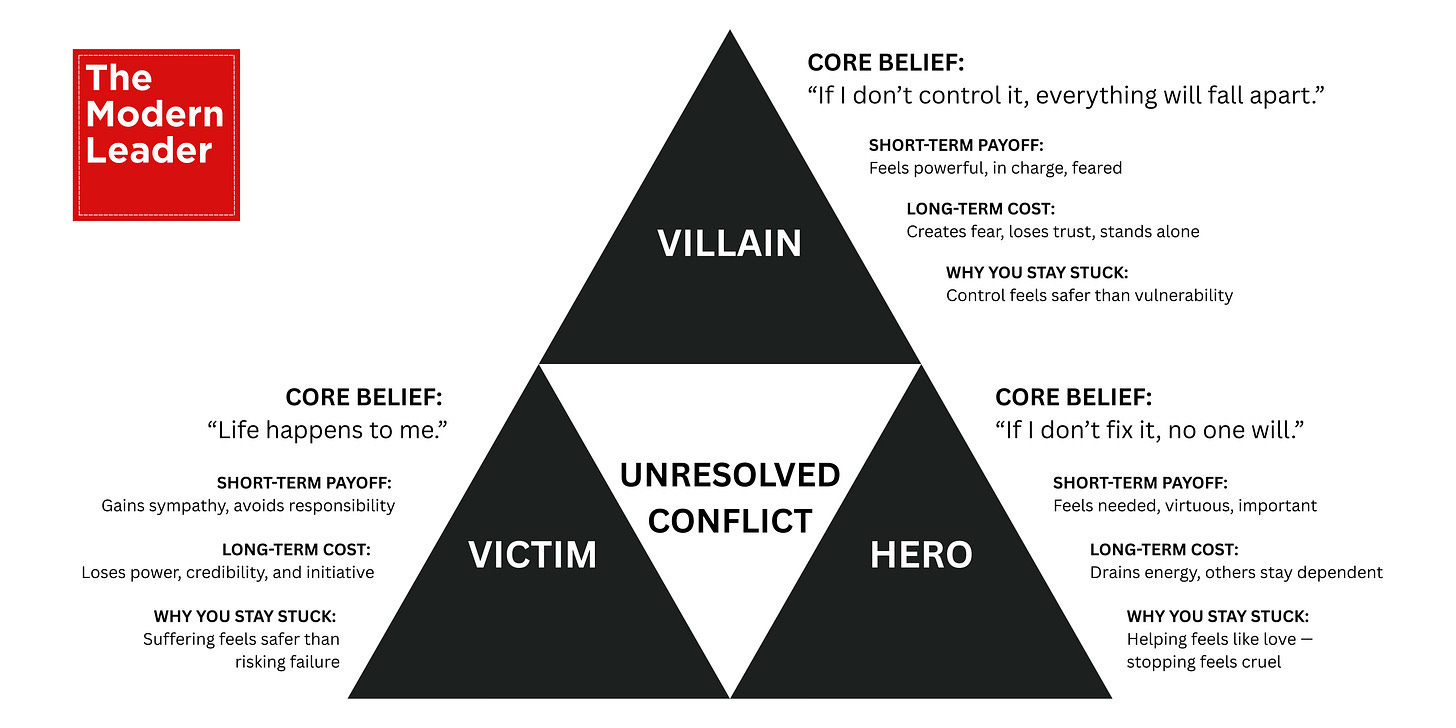
The drama triangle in a suit: When good intentions reinforce dysfunction
(Gregor + Damjan)
The Drama Triangle rarely looks dramatic inside modern organizations.
At first glance, it looks productive.
Leaders over-function in the name of support.
HR introduces protective structures to reduce conflict.
Managers push for accountability in the name of performance.
Yet beneath the surface, energy shifts.
Ownership gets blurred.
Resentment accumulates quietly.
People oscillate between over-responsibility and withdrawal.
The pattern persists not because individuals lack maturity, but because the system struggles to process tension openly.
The most subtle version of the triangle is disguised as care.
Rescuing becomes habitual when leaders cannot tolerate discomfort.
Control increases when uncertainty feels threatening.
Victim language spreads when effort consistently fails to translate into meaningful influence.
Without structural maturity, the ability to let tension exist without rushing to neutralize it, roles rotate endlessly.
Each rotation deepens cynicism.
Breaking the triangle is not about softening leadership.
It is about increasing the system’s capacity to hold responsibility without diffusing it.
Related reading (The Modern Leader):

Silent erosion
(Gregor)
When psychological needs are not met systemically, the first symptom is not conflict.
It’s silence.
People begin to self-censor. Not because they’re weak — but because they’re adaptive.
They learn what is safe to say, what is rewarded, and what costs them socially.
This is how organizations drift into a dangerous pattern:
safety without truth.
It looks like alignment.
It feels like calm.
But it produces conformity — and eventually, withdrawal.
The most expensive version of disengagement is not open resistance.
It’s quiet performance without investment.
People stay.
They deliver.
But they stop bringing their full intelligence.
That is how erosion looks when it’s still polite.
Leadership is system-bearing
(Gregor)
Leadership is not a role you play.
It is a system you carry.
Not through speeches — through micro-reactions:
How you respond to dissent.
How you respond to failure.
How you respond to ambiguity.
How you respond to conflict.
How you respond when responsibility is unclear.
Those moments determine whether the system opens or closes.
And this is why so many programs fail:
No program can compensate for a leader who exports tension downward.
No branding can compensate for a culture that punishes truth.
Maturity is the missing layer.
Branding is a leak: Employer branding as systemic output
(Damjan + Gregor)
Employer branding is often framed as narrative engineering.
In reality, it is signal emission.
Organizations constantly emit signals about how it feels to work inside them.
Candidates sense it in interviews.
New hires detect it in micro-interactions.
The market absorbs it through reputation.
Employer branding does not create credibility.
It amplifies whatever is structurally present.
When people feel they have no real influence, no space to grow, and no genuine sense of belonging, engagement shifts.
They stay.
They perform.
But they stop investing themselves.
What looks like stability can be energy withdrawal.
Communication cannot compensate for that. It can only accelerate exposure.
Expectations form before the first working day. If those expectations exceed what the internal system can actually carry, disappointment becomes predictable.
Employer branding becomes sustainable only when internal dynamics support external promises, when people experience autonomy, growth, and recognition in real terms, not in presentation.
In that configuration, branding is not leverage.
It is merely a consequence.
Expectation gap as diagnostic indicator
One of the most reliable early indicators of systemic misalignment is the expectation gap. When external narrative consistently exceeds internal lived experience, the system is overstretched.
This gap can be mapped:
Pre-hire narrative
↓
First 90-day lived experience
↓
Internal truth circulation
↓
Long-term retention pattern
Where alignment breaks, the system reveals its weakest link.
Employer branding then becomes not a campaign, but a measurement tool.
→ A CEO translation of this:
Employer branding doesn’t just attract candidates.
It attracts expectations.
If your system can’t carry those expectations, you’re recruiting disappointment.
Related reading (The Modern Leader):
Leadership branding: Visibility is accountability (and responsibility)
(Damjan + Gregor)
Leadership branding is frequently reduced to visibility strategy.
At its core, it is system responsibility made visible.
Leaders shape psychological climate through micro-reactions. How they respond to dissent. How they react to failure. How they speak when there is no prepared script.
When leaders avoid public presence, abstraction replaces embodiment.
Abstraction weakens trust.
Employer branding without visible leadership coherence becomes narrative without anchor.
Visibility is not self-promotion.
It is structural accountability expressed outwardly.
A leader’s personal brand functions as a behavioral signature. It signals whether the leader can:
hold complexity without collapsing into control,
tolerate dissent without interpreting it as disloyalty,
remain aligned under pressure.
The external brand always trails the internal maturity curve.
A simple addition from my side (Gregor):
Silence from leadership doesn’t create humility.
It creates suspicion.
Fewer initiatives. More truth.
Organizations rarely transform because someone announces change.
They transform when patterns shift.
Patterns shift when leaders respond differently to tension, truth, and responsibility.
Surface initiatives adjust visible behaviors.
Structural evolution alters what is repeatedly tolerated and therefore normalized.
Whatever behavior is repeatedly tolerated becomes the new standard.
Culture stabilizes or destabilizes through small, consistent reactions.
Leadership is not positional authority.
It is the ability to absorb tension without exporting it downward.
Employer branding is not positioning.
It is the visible trace of invisible coherence.
When culture, leadership, and branding are understood as one human system, organizations move from reactive correction to structural evolution.
Structural evolution takes longer.
But it does not fracture under pressure.
The diagnostic sequence
The human system cannot be strengthened through isolated action.
It follows a sequence:
Linguistic clarity
Naming what is actually happening.
System mapping
Identifying where tension accumulates.
Responsibility alignment
Clarifying who carries what.
Tension capacity building
Increasing the system’s ability to process disagreement.
External alignment
Aligning narrative with lived reality.
Skipping steps creates temporary improvement.
Following sequence creates structural evolution.
Before optimization: diagnosis
Most organizations jump to intervention.
Workshops.
Rebranding.
Leadership programs.
Very few pause to ask a more fundamental question:
Where is the system currently unstable?
A cultural diagnostic is not an employee survey.
It is not an engagement score.
It examines:
Where truth circulation slows down
Where ownership becomes diffused
Where psychological safety turns into conformity
Where expectations exceed structural capacity
Where energy withdrawal is already happening
The purpose of diagnosis is not to assign blame.
It is to identify structural friction points before they escalate into visible crisis.
Optimization without diagnosis creates activity.
Diagnosis before optimization creates leverage.
Damjan and I work with organizations through this diagnostic process, examining the human system beneath structure before any intervention is introduced.
And when organizations are ready to move beyond surface adjustments, we begin there.
Comment: Where is your company selling one culture and living another?
Share: With a leader who still thinks branding can compensate for integrity.
Subscribe: If you want leadership that builds adults - and branding that survives reality.
Strong statement, maybe too binary for me. Saying “branding is probably lying” oversimplifies the issue. Not every employer brand is lying. In many cases, it is simply not measured properly and not fed back into the system.
Let’s clarify something first. Branding has two basic jobs. First, to make it unmistakably clear who you are in a way that matters to the target audience. Second, to make that identity meaningfully different from others. Most employer branding efforts fail because they miss one or both of these conditions.
Problem1) they are not distinctive. If I remove the logo from the job ad and print it in black and white, it looks exactly like the competitor’s. No ownable identity, no recognisable workplace signal.
Problem2) they are not relevant. They talk to blue collar workers about fruit days when shift schedule and factory temperature matter more. Or you tell white-collar talent everything about sustainability and green values, but leave compensation out of the story.
And on the “lying” part: across 100 plus global brands I have worked with, I have never seen leaders start from the intention to mislead candidates. What happens much more often is simpler. They do not measure real audience needs, so they talk about what is easier or more comfortable for them. Then, when the gap between promise and reality becomes visible, they do nothing and choose the easier path again.
Neither of these is an employer branding problem. It is a leadership accountability problem.
Branding isn’t about flashy spending it’s about being clear, honest, and true to what people actually experience. If your message doesn’t match reality, it won’t attract the right people and only leads to frustration.