

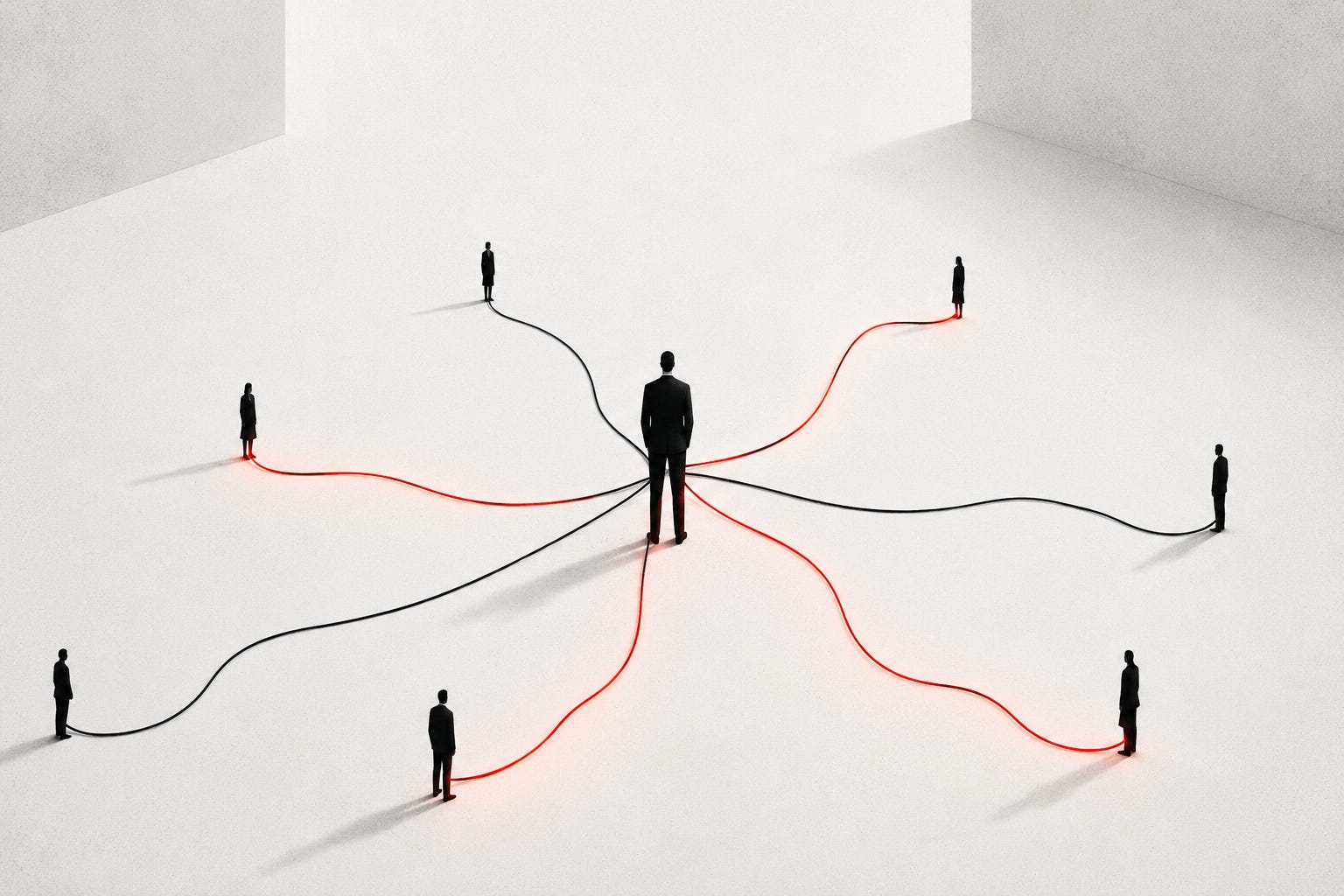
Your team does not only follow your strategy. They absorb your energy.
Gregor Kosi
Many leaders are very quick to recognise what is missing in their teams.
They see a lack of ownership, a lack of initiative, a lack of accountability, a lack of courage, a lack of speed or a lack of responsibility. They see employees who wait too long, ask too many questions, avoid difficult decisions, complain about pressure or bring problems without offering solutions.
And sometimes they are right.
But the first diagnosis is rarely the full diagnosis.
Because before a leader asks, “Why is my team like this?”, there is a much harder question that should come first:
Before you blame the team, check what your leadership has taught them to become.
That question is uncomfortable because it moves the leader from observation to responsibility. It does not mean that every problem in the team is the leader’s fault. That would be childish. People are adults. They have their own responsibility, their own attitude, their own discipline and their own choices.
But leadership always creates conditions.
It creates the emotional climate in which people decide how honest they can be, how much responsibility they should take, how safe it is to make a mistake, how much initiative is welcome, how quickly truth can be spoken and how much courage the system can tolerate.
That is why your team is never only reacting to the work.
They are also reacting to you.
PART 1: BEFORE YOU DIAGNOSE THE TEAM
The most dangerous leadership mistake is not that leaders see problems in their teams. The mistake is that they often stop there.
They say the team is passive, but they do not ask whether they have built a system in which waiting is safer than deciding. They say people do not take ownership, but they do not ask whether every important decision still needs their approval. They say employees do not speak openly, but they do not ask what happened the last time someone told them the truth.
Over time, teams become very skilled at reading the leader.
They learn what creates praise, what creates pressure, what creates silence and what creates consequences. They learn whether the leader really wants ownership or only wants execution. They learn whether disagreement is welcome or simply tolerated until it becomes inconvenient. They learn whether “I trust you” means real autonomy or only a nicer sentence before the next control mechanism.
This is why weak leadership often hides behind strong expectations.
A leader can expect ownership while creating dependency. A leader can ask for honesty while punishing discomfort. A leader can demand initiative while correcting every attempt at independent thinking. A leader can speak about trust while building a working environment that teaches people to protect themselves.
People do not only behave according to what you expect.
They behave according to how you treat them.
This is not an argument for lowering standards. It is the opposite. It is an argument for taking leadership seriously enough to understand that expectations alone do not create results.
One of the most useful leadership formulas is simple:
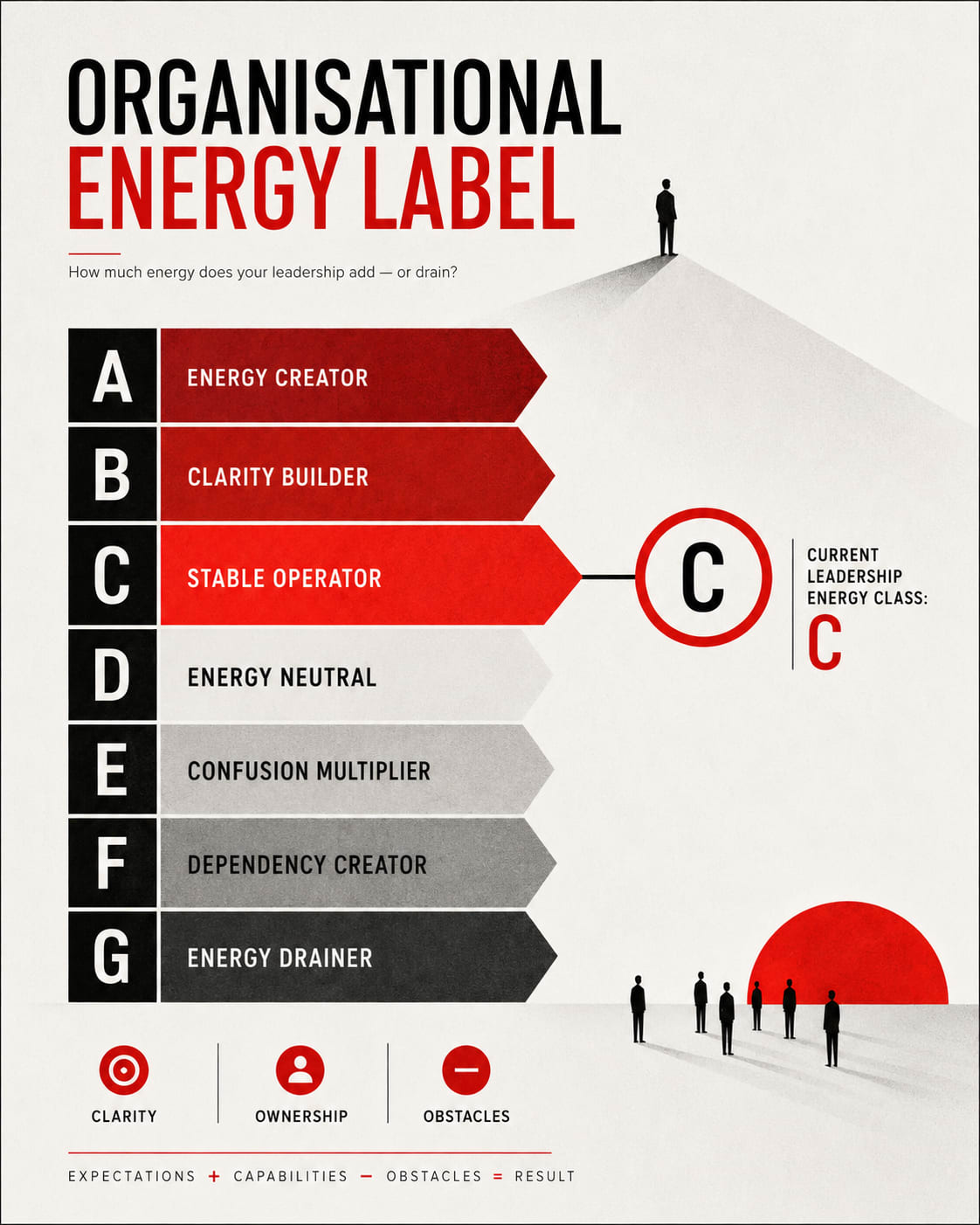
Expectations + Capabilities − Obstacles = Result.
If expectations are high but capabilities are too low, the result will suffer.
If expectations are clear but obstacles are not removed, the result will suffer.
If people are asked to take ownership but the system punishes mistakes, delays decisions or requires approval for everything, the result will suffer.
The leader may still call it a people problem.
But very often, it is a system problem.
And leadership is part of that system.
PART 2: YOUR ORGANISATIONAL ENERGY LABEL
Every organisation has energy.
If organisations had an energy label, like the one we see on a fridge, many leaders would be surprised by the rating.
Not because their teams lack talent.
But because too much energy is lost through unclear priorities, delayed decisions, emotional pressure, unnecessary control, unresolved conflict and leadership behaviour that creates dependency instead of ownership.
The question is not only how much energy exists in the organisation.
The question is how much energy leadership adds — and how much it silently takes away.
Not the kind of energy you see on motivational posters, but the real energy that determines whether people can move, decide, collaborate, solve problems and stay committed when work becomes difficult.
Team energy is the potential of your people: their abilities, engagement, trust, motivation and willingness to contribute. Environmental energy is the pressure around them: competition, uncertainty, complexity, unclear processes, internal politics, market demands and constant change.
But the leader has a special role.
The leader can either strengthen the energy of the team or exhaust it.
That is the part many leaders underestimate.
Which energy class does your leadership create?
A — Energy Creator
Your leadership creates clarity, courage, ownership and movement. People leave conversations with you stronger, not smaller.
B — Clarity Builder
Your leadership gives direction and removes confusion. The team may still face pressure, but they know what matters and what must happen next.
C — Stable Operator
Your leadership keeps the system functioning. Work moves forward, but energy does not significantly increase. The team performs, but does not necessarily grow stronger.
D — Energy Neutral
Your leadership neither seriously harms nor meaningfully strengthens the team. Things continue, but mostly because people compensate, adapt and push through.
E — Confusion Multiplier
Your leadership creates unclear priorities, too many changes, mixed messages and unnecessary noise. People spend energy interpreting you instead of doing the work.
F — Dependency Creator
Your leadership solves too much, controls too much or approves too much. The team becomes safer, but weaker. People wait because waiting has become rational.
G — Energy Drainer
Your leadership consumes more energy than it creates. People leave interactions more anxious, smaller, more cautious and less willing to take ownership.
Most leaders believe they are at least a B.
Their team often experiences them one or two levels lower.
That gap is where the real leadership work starts.
The market creates pressure. Customers create pressure. Competition creates pressure. Internal complexity creates pressure. But the leader can either reduce the weight of that pressure or multiply it.
A leader increases energy through direction, trust, standards, support, calm, clarity and timely decisions. A leader drains energy through confusion, fear, emotional instability, unclear priorities, over-control, avoidance and constant urgency.
This does not mean that a leader must always be positive. That is fake leadership. Real leadership includes pressure, difficult decisions, uncomfortable conversations and high standards. A strong leader is not a smiling entertainer whose job is to make everyone feel good.
But the leader must understand that their internal state often becomes the team’s external climate.
When the leader operates from constant stress, the team rarely becomes braver. More often, people become careful. They start protecting themselves from the leader’s reactions instead of focusing on the work itself. They hesitate, they wait, they escalate decisions and they slowly learn that safety is more important than ownership.
When the leader is unclear, the team does not usually become strategically independent. It becomes fragmented. Everyone starts guessing what matters most. When the leader is inconsistent, people stop trusting words and start watching moods.
How you enter the room changes the room.
This is why leadership energy is not private.
It becomes culture.
PART 3: WHAT RESULTS TAUGHT ME
When I was CEO, I often thought I was dealing with team problems.
A project was late. A manager did not take enough responsibility. A decision returned to me that should have been made elsewhere. A topic appeared again and again, even though I thought we had already solved it.
It was easy to look at the person or the team and conclude that something was missing there. Sometimes that was true. But with experience, I started to see that results were not only feedback about the team. They were also feedback about the system I had helped create.
The result is often the most honest feedback a leader will ever receive.
If expectations were unclear, I had to look at how I communicated them.
If people escalated too much, I had to ask whether I had trained them to believe that only my decision was safe.
If a manager avoided a difficult conversation, I had to ask whether I had built enough maturity and support around leadership responsibility.
If people waited instead of acting, I had to ask whether I had created a culture where mistakes were used for learning or for blame.
This was not always pleasant.
But it was useful.
Because the moment you stop asking only, “What is wrong with them?”, you can begin asking a better question:
What are they learning from me?
That question does not weaken leadership. It strengthens it. It gives the leader influence again, because the leader can change their own behaviour faster than they can change everyone else’s personality.
This is also where leadership maturity begins.
Immature leadership needs someone to blame.
Mature leadership looks for the part of the system it can influence.
And the first part of the system a leader can influence is always themselves.
PART 4: THE LEADERSHIP ENERGY AUDIT
Before you blame the team, audit the energy you bring into the system.
Use this tool before an important meeting, after a difficult week or whenever you notice a pattern in your team that frustrates you.
1. What energy do I bring into the room under pressure?
Do not answer this based on who you are on a good day. Answer it based on who you become when pressure rises. Some leaders become clearer under pressure. Others become controlling, impatient, defensive, silent or emotionally unpredictable.
Your team learns more from your behaviour under pressure than from your leadership values.
2. Does my team leave with more clarity or more confusion?
After a meeting with you, people should know what matters, what was decided, who owns what, what good looks like and what must happen next. If they leave with more activity but less clarity, your leadership has produced movement without direction.
That is expensive.
3. Do I create ownership or dependence?
This may be the most important question.
If every decision returns to you, if every problem needs your solution and if every risk waits for your approval, your leadership may look useful in the short term, but it is weakening the system in the long term.
A strong leader does not prove their value by being needed everywhere.
A strong leader builds people who can carry more without them.
4. Do I remove obstacles or add confusion?
A leader should remove friction from the system: unclear priorities, missing decisions, conflicting expectations, unnecessary meetings, emotional drama and blocked resources. But many leaders add new confusion while believing they are helping.
More updates. More urgency. More control. More meetings. More changes in direction.
Sometimes the team does not need more leadership presence.
It needs less leadership interference.
5. What part of my team’s behaviour may be a mirror of my leadership?
If the team is avoiding responsibility, where are you still taking too much responsibility from them? If people are not speaking openly, where has honesty become unsafe? If people wait for instructions, where have you made independent thinking too risky? If people lack energy, where might your leadership be draining more than it gives?
Your team is not always resisting you.
Sometimes they are reflecting you.
This is not self-blame.
This is self-leadership.
PART 5: BEFORE YOUR NEXT IMPORTANT MEETING
You do not need to redesign the whole organisation to start using this.
Tomorrow, before your first important meeting, take two minutes and ask yourself what the team actually needs from you in that moment.
Do they need direction, or are you about to bring pressure?
Do they need a decision, or are you about to bring another discussion?
Do they need support, or are you about to rescue them?
Do they need space, or are you about to control the process because you feel anxious?
Then choose your leadership energy deliberately.
After the meeting, do not only ask whether the meeting was successful. Ask whether your presence made the team stronger or weaker. Did people leave with more clarity, more ownership and more confidence to act, or did they leave with more caution, dependence and confusion?
That is the practice.
The goal is not to become perfect. The goal is to become conscious, because unconscious leadership repeats itself and calls the repetition culture.
TL;DR
Your team does not only follow your strategy. They absorb your energy.
Before you blame the team, check what your leadership is teaching them.
Low ownership can be a sign of unclear expectations, over-control or too much rescue.
The leader’s internal state often becomes the team’s external climate.
Your stress can create caution. Your clarity can create focus.
The result is often the most honest feedback a leader receives.
The Leadership Energy Audit helps you see whether your leadership lifts the team or drains it.
⚠️ ATTENTION: UNLOCK YOUR PRACTICE
Understanding this idea may make you more aware, but awareness alone will not change your leadership under pressure.
Tomorrow, something will happen.
A person will disappoint you.
A meeting will lose focus.
A project will be late.
A team member will bring you a problem they should probably solve themselves.
Someone will ask for your decision because deciding alone feels unsafe.
And in that moment, you will return to your default.
Control. Rescue. Pressure. Silence. Avoidance.
Or clarity.
That is what the paid section is for.
Not more theory. Not another reminder to become a better leader. A practical operating system for managing the energy, clarity and responsibility you bring into the team.
In the paid section, you will get:
the Before-the-Meeting Energy Check
the Clarity–Ownership–Support Check
the Team Mirror Review
the Expectations / Capability / Obstacles Map
the Weekly Leadership Energy Score
The free section shows the mirror.
The paid section gives you the tools to use it.
Upgrade. Run the audit. Lead the room before the room absorbs you.
PAID SECTION: THE LEADERSHIP ENERGY OPERATING SYSTEM
Most leaders try to improve their team by changing the team first.
More reporting. More meetings. More rules. More pressure. More follow-up. More control.
Sometimes structure is necessary. But very often, the first upgrade is not in the team. It is in the leader’s impact on the team.
This operating system helps you work with that impact in a practical way.
1. The Before-the-Meeting Energy Check
Use this before every important meeting, especially when the topic is emotionally charged or strategically important.
Ask yourself:
What is the real purpose of this meeting?
What emotional state am I bringing into it?
What does the team need from me today?
What must I not bring into the room?
What outcome should exist when we finish?
This tool prevents you from entering the meeting unconsciously. If you do not choose your energy, your pressure will choose it for you.
2. The Clarity–Ownership–Support Check
Use this during meetings, project reviews and one-to-ones.
Check three things.
Clarity: Do people know what matters, what was decided and what success looks like?
Ownership: Is one person clearly responsible for the next step?
Support: Have the obstacles been named, reduced or removed?
If one of these three is missing, the team may leave the meeting motivated but still ineffective. Motivation without clarity becomes noise. Ownership without support becomes frustration. Support without ownership becomes dependency.
You need all three.
3. The Team Mirror Review
Use this once per week.
Choose one team behaviour that frustrates you and write it down as honestly as possible.
For example:
“They wait too long before making decisions.”
Then ask:
Where might I have trained this behaviour?
What do I reward that keeps this behaviour alive?
What do I tolerate?
What do I punish unintentionally?
What would I need to change first?
This is not about making yourself guilty. It is about making yourself useful. A leader who cannot see their own contribution will keep fixing symptoms.
4. The Expectations / Capability / Obstacles Map
Use this when results are weak.
Write down the expected result, then check three things.
Expectations: Was the expected result clear enough?
Capability: Did the person or team have the skills, time, authority, confidence and resources to deliver?
Obstacles: What blocked execution?
Then choose the right leadership response.
If expectations were unclear, clarify. If capability was too low, develop. If obstacles were too strong, remove. Do not call it a motivation problem before you check the system.
5. The Weekly Leadership Energy Score
At the end of the week, rate your leadership energy from 1 to 5.
1 means: I drained the team.
5 means: I strengthened the team.
Then answer:
Where did I create clarity?
Where did I create confusion?
Where did I increase ownership?
Where did I create dependence?
What must I do differently next week?
Your goal is not to impress yourself with a high score. Your goal is to become honest enough to improve.
START THE WEEK BEFORE THE WEEK STARTS USING YOU
Before the week starts, write down five things:
The most important team outcome this week.
The energy your team needs from you.
The behaviour you must stop repeating.
The meeting where your presence matters most.
The one place where you must create more ownership.
Do this before the week starts using you.
LEADERS ARE READERS
Leadership and Self-Deception
The Arbinger Institute
This book matters because it explains one of the hardest truths in leadership: we often believe we are seeing people clearly, when in reality we are seeing them through our own fear, frustration, pressure and self-justification.
That is why the Leadership Energy Audit matters.
A leader who is trapped in self-deception sees the team mainly as the problem. A mature leader starts asking what they are doing that contributes to the pattern.
The key lesson is simple:
The way you see people shapes the way you lead them.
And the way you lead them shapes the way they respond.
FINAL WORDS
Your team is not only shaped by your strategy. It is shaped by your presence, your standards, your calm, your impatience, your clarity, your fear, your trust, your control and your ability to tell the truth without destroying safety.
That is leadership.
Not the title. Not the office. Not the presentation. Not the meeting.
The impact.
The room after you leave it.
If people leave stronger, clearer and more responsible, your leadership is creating energy. If they leave smaller, more anxious and more dependent, your leadership is consuming it.
The leader is not responsible for everything.
But the leader always has an effect.
And mature leadership begins when you are brave enough to ask:
What effect am I having?
You got this!
Gregor Kosi
The CEO Coach
ENGAGE WITH THIS IDEA
Leadership Mirror Question
Where is your team carrying the cost of your unmanaged leadership energy?
Comment
What drains a team faster: unclear expectations, emotional pressure, over-control or too much rescue?
Share
Share this with one leader who needs to look in the mirror before blaming the team.
Subscribe
Join The Modern Leader if you want practical leadership ideas that help you build clarity, responsibility and human strength.