

“Support is love with responsibility. Rescue is fear with good manners.”
— Gregor Kosi

PART 1 — THE GREAT PARADOX
The lie is simple: “If I help, I am helping.”
No.
Not always.
Sometimes when you help someone, you do not reduce their suffering.
You reduce your discomfort.
You see pain.
You feel guilt.
You feel morally invited.
So you step in.
You give money.
You solve the problem.
You take over the task.
You protect them from consequence.
You call it kindness.
But sometimes it is not kindness.
Sometimes it is rescue.
And rescue is dangerous because it looks like love from the outside while quietly stealing responsibility on the inside.
The most dangerous help makes both people feel good while nothing actually changes.
This is why I wrote earlier about the Drama Triangle — the roles of Victim, Persecutor, and Rescuer.
You can read that article here:
Why You Keep Playing Victim, Villain, or Hero — And How to Stop

“If you spend more than 10% of your time solving conflicts, you either have too many employees or the wrong ones.”
The Rescuer appears noble.
But often, the Rescuer does not save the Victim.
The Rescuer protects the Victim from becoming a Creator.
That is the paradox.
We live in a world that celebrates help but rarely asks whether help creates capacity.
Not:
“Did I help?”
But:
“Did my help make this person stronger?”
PART 2 — THE HIDDEN COST
Rescue feels cheap in the moment. It becomes expensive later.
Let’s be clear.
Humanitarian help matters.
Food matters.
Shelter matters.
Emergency money matters.
Medical care matters.
Dignity matters.
This article is not an attack on compassion.
It is an attack on unconscious compassion.
Because there is a difference between relieving immediate pain and building future agency.
There is also a difference between structured support and emotional handouts.
The World Bank estimates that hundreds of millions of people still live in extreme poverty. Cash transfers, according to large international reviews, can reduce suffering, support investment, and do not automatically make people lazy.
So the point is not:
“Never give money.”
The point is:
Never confuse money with transformation.
Money can interrupt suffering.
But money alone does not create identity, discipline, agency, responsibility, skill, trust, or future orientation.
The same applies to lottery winners.
The popular claim that “70% of lottery winners go bankrupt” is not reliably supported. But the leadership lesson remains true:
A person who receives a new condition without developing a new inner operating system will often recreate the old condition in a more expensive form.
A human being must create the condition. The condition cannot create the human being.
The same happens in companies.
A leader keeps solving the same employee’s problems.
At first, it feels efficient.
Then the employee stops thinking.
Then the leader becomes the bottleneck.
Then the team becomes passive.
Then the leader complains:
“Why is nobody taking ownership?”
Because you trained them not to.
Gallup reports that only about one in five employees globally is engaged, and low engagement costs the global economy trillions. Gallup also shows that managers account for around 70% of the variance in team engagement.
Translation:
Leadership creates conditions.
But weak leadership creates dependency.
Dependency is not a personality issue. It is often a leadership design issue.
If you want to understand how the Rescuer hides inside the Drama Triangle — and why it often looks noble before it becomes destructive — read this:

PART 3 — WHERE IT SHOWS UP IN REAL LIFE
Rescue is not rare. It hides inside professional language.
1. In meetings: “Let me solve this quickly.”
A team brings an unclear problem.
The leader jumps in.
“Do this. Call that person. Send me the file. I’ll handle it.”
The meeting ends faster.
Everyone feels relieved.
But nobody learned how to think.
The mechanism is simple:
When the leader solves the problem too early, the team learns that escalation is faster than ownership.
Every unnecessary rescue today becomes tomorrow’s dependency.
2. In decision-making: “It’s faster if I decide.”
A manager complains that employees are not proactive.
But every time they try, the manager corrects, interrupts, reworks, or takes over.
Soon the team stops deciding.
Not because they are weak.
Because the system punishes imperfect autonomy.
Self-determination theory shows that autonomy and competence are core psychological needs for motivation, learning, and growth.
Rescue kills both.
It removes autonomy.
And it prevents competence from developing.
You cannot build responsible people by removing responsibility from their hands.
3. In charity: “Here is money. Good luck.”
You see a beggar.
You give money.
Maybe that is right in that moment.
Maybe hunger needs an immediate answer.
But if the deeper message is only:
“Here is money,”
then the person receives relief without a path.
Real support asks deeper questions:
What happened?
What pattern repeats?
What support system is missing?
What skill, connection, treatment, structure, or opportunity is needed?
What first responsible step can still belong to this person?
This is not judgment.
This is dignity.
Because dignity is not only being helped.
Dignity is being seen as capable.
Do not only reduce pain. Restore authorship.
PART 4 — THE DEEPER MECHANISM
The Rescuer needs the Victim more than he admits.
This is the brutal part.
Many people help because they care.
But many people also help because help gives them identity.
The Rescuer gets to feel useful.
Moral.
Needed.
Superior.
Important.
Good.
The Victim gets relief.
The Rescuer gets significance.
And both avoid the deeper work.
The Victim avoids responsibility.
The Rescuer avoids emptiness.
That is why rescue becomes addictive.
Not because it solves problems.
Because it feeds identity.
Sometimes help is not love. Sometimes help is ego dressed as compassion.
This is also why rescue often turns into resentment.
At first, the Rescuer says:
“Let me help you.”
Later:
“After everything I’ve done for you?”
Eventually:
“You are ungrateful.”
That is the moment the Rescuer becomes the Persecutor.
The triangle turns.
The original problem remains untouched.
Learned helplessness research shows that when people repeatedly experience situations as uncontrollable, they may stop trying even when action later becomes possible.
Bad help can teach helplessness.
Bad help says:
“You cannot handle this.”
Support says:
“You are not alone, and you still have a role.”
Rescue deepens fixed mindset.
Support strengthens growth mindset.
Rescue says:
“You are the problem. I am the solution.”
Support says:
“You are capable. Let’s build the next step.”
PART 5 — THE MODEL
The 3C Support Model™
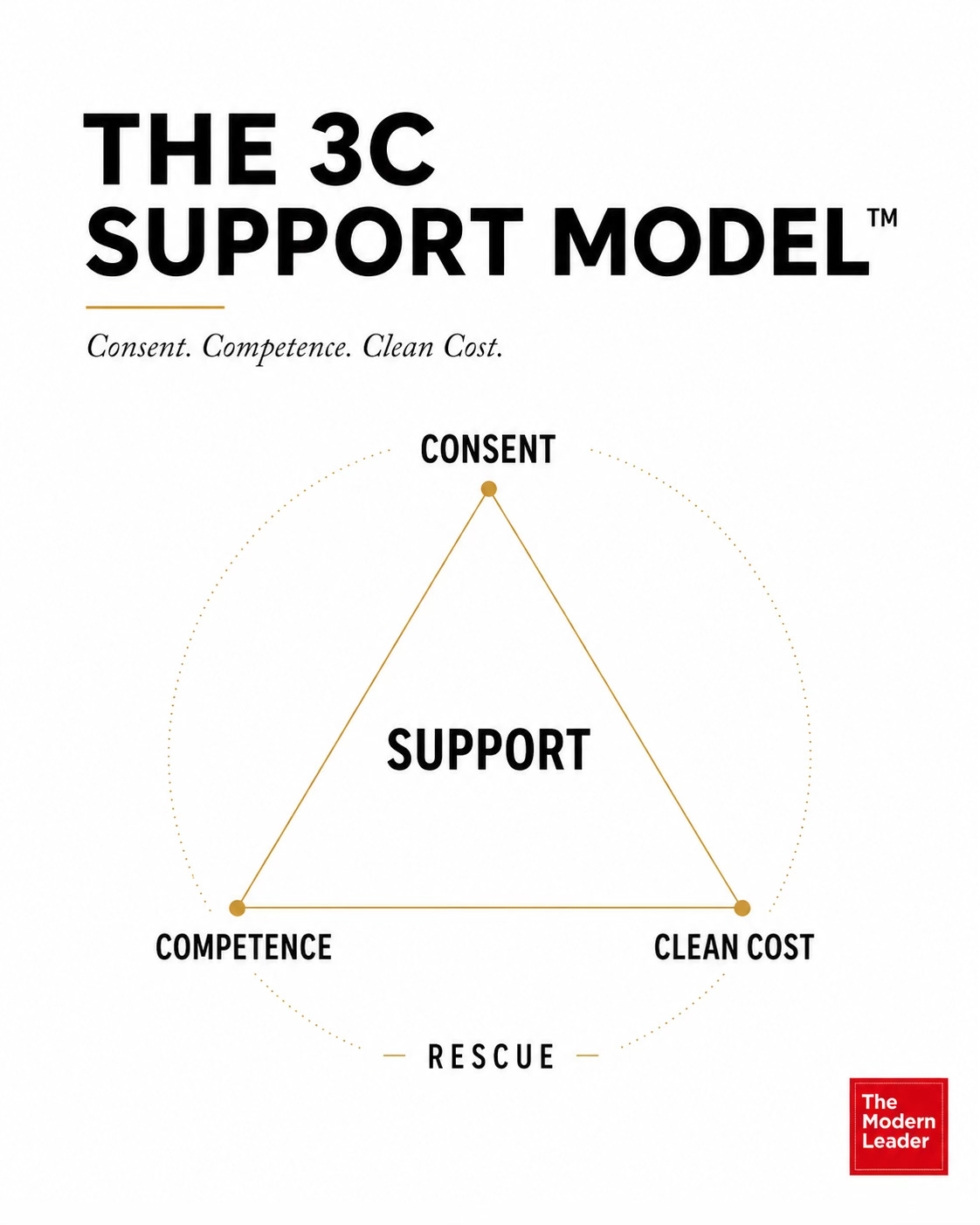
Before you help, ask three questions:
First C: CONSENT
Was help asked for?
Unasked help often becomes control.
Examples:
You rewrite someone’s presentation before they ask.
They learn their work is never good enough.You give advice to someone who only needed listening.
They feel unseen, not supported.You jump into your child’s problem too early.
They learn discomfort is dangerous.
Rule:
If nobody asked, start with curiosity.
Ask:
“Do you want me to listen, coach, or help solve?”
Uninvited help often sounds like support but lands as superiority.
Second C: COMPETENCE
Am I competent to help?
Good intentions are not qualifications.
Examples:
You give legal advice because you once had a similar case.
You coach trauma without being trained for trauma.
You advise a founder on strategy without understanding cash flow.
Rule:
When competence is low, do not perform wisdom.
Refer.
Connect.
Ask.
Learn.
Helping without competence is risk with a friendly face.
Third C: CLEAN COST
Can I help without taking the hit?
If helping destroys your time, energy, money, health, family, or boundaries, the help is not clean.
Examples:
You always cover for a colleague’s missed deadline.
They avoid consequence. You absorb the damage.You lend money you cannot afford to lose.
Now generosity becomes hidden pressure.You take over your employee’s task at midnight.
You call it leadership. Your family calls it absence.
Rule:
Support must not create a second victim.
If helping someone costs you your own stability, you are not helping. You are transferring the collapse.
The model is simple:
CONSENT — invited, not imposed
COMPETENCE — qualified, not emotional
CLEAN COST — support, not self-sacrifice
If one is missing, pause.
Do not rescue.
Redesign the support.
The rule is simple:
Support restores ownership. Rescue removes it.
FREE TOOL
The 5-Minute Rescue Audit™
Before you step in, ask:
Did they ask for help — or am I reacting to my discomfort?
Am I helping them think — or replacing their thinking?
Will this increase their responsibility — or reduce it?
Am I competent to support this?
What remains theirs after I help?
The fifth question is the key.
If nothing remains theirs, you did not support them.
You took ownership.
Real support always leaves responsibility in the hands of the person who must grow.
PART 6 — THE REAL-LIFE CASES
The shift from Rescuer to Builder
1. CEO / Executive Example
Situation:
A CEO keeps solving conflicts between two directors.
Mistake:
He believes he is protecting speed.
Consequence:
The directors never build conflict maturity. They escalate everything upward.
Shift:
The CEO says:
“I will not solve this for you. I will help you define the decision, the criteria, and the owner. Then you will decide.”
That is leadership.
Not rescue.
2. Leadership Team Example
Situation:
A leadership team misses deadlines. Everyone explains. Nobody owns.
Mistake:
The COO creates more reminders, follow-ups, and meetings.
Consequence:
Responsibility moves from the owner to the system.
Shift:
Every topic now ends with:
owner
deadline
definition of done
first risk
next visible checkpoint
Now help becomes structure.
Not babysitting.
3. Individual Employee Example
Situation:
An employee repeatedly brings unfinished work and says:
“I am not sure if this is right.”
Mistake:
The manager corrects it every time.
Consequence:
The employee learns to outsource judgment.
Shift:
The manager says:
“Bring me your recommendation, your reasoning, and the risk you see. I will coach your thinking, not replace it.”
That one sentence changes everything.
The goal is not to make people need you. The goal is to make them stronger because they worked with you.
PART 7 — THE INNER SHIFT
Mature help requires mature ego.
Weak leadership wants to be needed.
Strong leadership wants people to grow.
Immature help says:
“I will save you.”
Mature support says:
“I will stand with you while you take the next responsible step.”
This is a different identity.
You stop being the hero.
You become the builder.
You stop giving answers.
You build capacity.
You stop absorbing consequences.
You clarify ownership.
You stop confusing compassion with rescue.
Here is the mirror:
Maybe the problem is not that people around you are too dependent.
Maybe the problem is that some part of you needs them to be.
If people becoming independent feels like a threat, you were never leading them. You were owning them.
TL;DR
Not all help is helpful. Some help prolongs responsibility.
Rescue reduces discomfort. Support builds agency.
Money can relieve suffering, but it cannot replace mindset, skill, or responsibility.
The Rescuer often feeds ego while pretending to serve.
Bad help deepens fixed mindset. Real support builds growth mindset.
Before helping, ask: Was it requested? Am I competent? Can I help without taking the hit?
The goal is not to be needed. The goal is to help people become capable.
🔒 ATTENTION: UNLOCK THE PRACTICE
Free content shows you the pattern.
Paid gives you the tools to break it.
Because insight does not change your culture.
Practice does.
And if this article described your leadership, your team, your silence, or your hidden rescue pattern too accurately, do not just nod and move on.
That is how nothing changes.
Upgrade.
Use the tools.
Stop rescuing people from the responsibility that could transform them.
Inside the paid section, you get The Anti-Rescuer Field Manual™ — a practical toolkit you can use immediately with your team, your employees, your family, or yourself.
Inside the Field Manual:
1. The Help-or-Support Filter™
Separate real support from rescue before you step in.
2. The Three-Permission Script™
Ask the one question that stops uninvited help from becoming control.
3. The Competence Boundary Check™
Know when to help, when to ask, and when to refer.
4. The Clean Cost Rule™
Make sure your help does not create a second victim: you.
5. The Responsibility Return Script™
Give ownership back without sounding cold, harsh, or distant.
6. The Monday Morning Ownership Map™
Turn repeated problems into clear responsibility, capability, and action.
7. The Support Contract™
Create clean agreements with no hidden rescue, no emotional debt, and no silent resentment.
Paid subscribers also get:
Subscriber-only articles — deeper frameworks, leadership cases, and tools I do not share publicly.
Full archive access — every past guide, playbook, and operating system unlocked.
Exclusive printable templates — copy, print, and use in your next leadership conversation.
Recommended reading — curated books that deepen the practice.
Direct community access — comment, ask questions, and get answers from me personally.
Upgrade to Paid & Get the Field Manual
It’s your daily companion to move from theory to transformation.
TODAY ONLY!!!!
SPECIAL OFFER: “LEADERS ARE READERS”
Get 20% off your first year.
Because leaders are readers — and the best leaders invest in their growth.
FINAL WORDS
The highest form of help is responsibility with dignity.
Feed the hungry.
Protect the vulnerable.
Support the exhausted.
Stand beside people in crisis.
But do not confuse relief with transformation.
Do not confuse generosity with growth.
Do not confuse your need to be good with their need to become capable.
A human being does not rise because someone carries them forever.
A human being rises when someone finally sees them as capable of standing.
Support is love with responsibility. Rescue is fear with good manners.
ENGAGE WITH THIS IDEA
Mirror question:
Where in your life are you calling it “help” because you are afraid to let someone face responsibility?
Comment:
Where do you see the Rescuer role most often — leadership, parenting, relationships, charity, or teams?
Share:
Send this to one person who helps too much and pays for it silently.
Subscribe:
Join The Modern Leader if you want leadership that does not create dependency, but builds responsibility, maturity, and courage.
PAID SECTION
THE ANTI-RESCUER FIELD MANUAL™ (INCL. PRINTABLE HANDBOOK)
A practical operating system for helping without creating dependency
1. The Help-or-Support Filter™
What it does:
Separates rescue from real support.
How to use it:
Before stepping in, ask:
Am I reducing pain only?
Am I building capacity?
What responsibility stays with them?
What will they do next because of this support?
If nothing stays with them, you are rescuing.
2. The Three-Permission Script™
What it does:
Stops uninvited help from becoming control.
How to use it:
Say:
“Before I jump in — do you want me to listen, ask questions, or help solve?”
This protects dignity.
It also reveals whether the person wants comfort, clarity, or action.
3. The Competence Boundary Check™
What it does:
Prevents good intentions from causing damage.
How to use it:
Before giving advice, rate yourself from 1 to 5:
I know almost nothing.
I have personal experience only.
I understand the situation partly.
I have real competence.
I am qualified to guide this.
If you are below 4, do not advise.
Ask questions or refer.
4. The Clean Cost Rule™
What it does:
Protects you from becoming the second victim.
How to use it:
Complete this sentence:
“I can support this person without sacrificing ______.”
Examples:
my health
my family
my finances
my energy
my boundaries
my integrity
If you cannot complete the sentence, redesign the help.
5. The Responsibility Return Script™
What it does:
Gives ownership back without sounding cold.
How to use it:
Say:
“I can support you with thinking through this. But the next step must remain yours.”
Or:
“I will not take this over, because that would not help you grow.”
Or:
“I can help you clarify the decision, but I will not make the decision for you.”
This is how you stop rescuing without withdrawing care.
6. The Monday Morning Ownership Map™
What it does:
Turns problems into responsibility.
How to use it:
For every repeated problem, define:
Who owns it?
What result is expected?
What capability is missing?
What support is needed?
What consequence must remain visible?
What is the next responsible action?
This map turns drama into development.
7. The Support Contract™
What it does:
Creates a clear agreement between helper and receiver.
How to use it:
Use this structure:
“I will support you with ______.
You will remain responsible for ______.
The next step is ______.
We will review progress on ______.
If this does not move forward, the consequence is ______.”
This is adult support.
Clean.
Clear.
Respectful.
No hidden rescue.
No emotional debt.
No silent resentment.
Get the PRINTABLE HANDBOOK HERE: THE ANTI-RESCUER FIELD MANUAL™
LEADERS ARE READERS
Every week, I recommend one book that helps you think deeper, lead cleaner, and stop repeating old patterns under the name of experience.
This week’s recommendation:
The Empowerment Dynamic by David Emerald
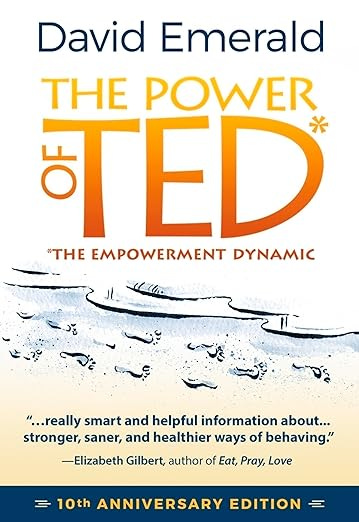
A powerful book for understanding how to move out of the Drama Triangle and into a more mature way of relating, leading, and supporting others.
Emerald reframes the old roles:
Victim → Creator
You stop defining yourself by the problem and start choosing your response.
Rescuer → Coach
You stop fixing people and start helping them access their own capability.
Persecutor → Challenger
You stop attacking or blaming and start creating honest pressure for growth.
This is the essence of the whole article:
Not less compassion.
Cleaner compassion.
Not less help.
Better support.
The Rescuer fixes the problem.
The Coach awakens the person.
Until next week — remember: the best leaders do not create people who depend on them. They create people strong enough to stand without them.
With love and respect,
Gregor Kosi
The CEO Coach